| | | | | PROGRAMME INFO | | | |
| | | From Shetland to the Scilly Isles, Open Country travels the UK in search of the stories, the people and the wildlife that make our countryside such a vibrant place. Each week we visit a new area to hear how local people are growing the crops, protecting the environment, maintaining the traditions and cooking the food that makes their corner of rural Britain unique.
Email: open.country@bbc.co.uk
Postal address: Open Country,
BBC Radio 4, Birmingham, B5 7QQ.
| | | | | LISTEN AGAIN | | | |
|
|
| | PRESENTER | | | |
|  | | | | More about Helen Mark | | | | |
| | | | | | PROGRAMME DETAILS | | | |
 | | Rick Taylor | |
Helen Mark visits Lincolnshire, the fourth largest county in England. Contrary to popular opinion, most of the county isn't flat and has a wide variety of countryside: the Wolds, a series of rolling hills, the cliff-like Lincoln Edge running like a spine down the county, the Fens with massive skies and network of rivers and dykes and the coastline with its wide sandy beaches as well as salt marshes, dunes and pools.
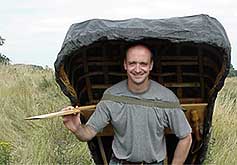
Helen's first port of call is a river where she meets coracle-maker Rick Taylor. He sees his craft as a direct link with the countryside, making use of natural materials and keeping old rural skills alive "in an increasingly plastic world". Since seeing a picture of a Celt carrying a coracle in a history book at school as an eight-year-old, these ancient craft have always fascinated Rick, but it wasn't until his early 20s that he started to experiment with building them. In the mid 1990s he began to research the methods of coracle building used by the craftsmen coracle makers of rural Wales. He prefers the Teifi coracle because he likes working with cleft wild woods such as willow, hazel and ash rather than pre-sawn materials. This makes coracle building a very personal experience for him as he has to select his own materials from where they are growing before cutting them in a sustainable manner. Using such a coracle on the water, be it for fishing, bird watching or simply for the pleasure of paddling, it is very much a meditational experience for Rick. "The coracle is built from nature with the utmost respect and reverence for nature. Willows that once bent and swayed in the wind now bend beneath the coracleman to support the skin that keeps me afloat and in a rustic celebration of nature and the skill and patience of the craftsman."
Rick Taylor
In the middle of a working farm at Temple Bruer, Helen stumbles into the Middle Ages: next to a squat square tower, Terry Butcher and his family are combat training as Knights Templar, knights who went with pilgrims to Jerusalem to protect them, and who later organised pilgrimages of their own. Terry and his son Chris belong to the Feudal Archers who re-enact medieval battles, and they explain the layers of armour which can double a knight's bodyweight, and the fearsome weapons they use. It's an appropriate place for sword fights, the tower itself is all that remains of a 12th century preceptory - a monastery which specialised in the training of Knights Templar. Jo Hambly from Heritage Lincolnshire takes Helen on a tour of the amazingly well-preserved building, and explains how the preceptory was always part of a farm. It was the centre of a sizeable monastic foundation which needed to provide enough income to keep itself going, and farming was the obvious way. In fact, it was the Knights Templar who were the first to keep sheep in Lincolnshire.
Heritage Lincolnshire site
Feudal Archers
Annette Binding is a passionate field biologist, invertebrate spotter and identifier and takes Helen on a beetle hunt. Lincolnshire is the home of the rare Hazel Pot Beetle, so-called because the female adult lays her eggs in containers she constructs from her own dung. As they grow, the larvae must also use their own waste to extend the size of their pots. In the end, the pot has the shape and size of a rat dropping. They can be elusive little creatures, but Helen and Annette (with the aid of a huge sweeping-net) find a whole host of tiny creatures hiding in the undergrowth of Whisby Nature Park.
Lincolnshire Wildlife Trust
Helen's next stop is a conservatory on the outskirts of Lincoln. It's like a mini Kew Gardens, which is entirely appropriate as it's a memorial to Kew's founder - explorer and botanist Sir Joseph Banks. Jean Burton tells Helen the story of this Renaissance man who was a great figure of Lincolnshire life, and had a huge impact on the landscape of the county. He was involved in draining the Fens, an enthusiastic tree planter and canal engineer. He was told by George III to improve the quality of wool in England, so Banks introduced the Merino sheep from Spain to Lincolnshire and created a hybrid which meant Britain no longer relied on imported wool. Of course he was also the botanist who sailed with Captain Cook on The Endeavour - in fact, Australia was nearly called Banksia. Jean recounts how, as well as the plants he brought back, he introduced a new animal and the Lincolnshire landscape briefly featured kangaroos.
Lincolnshire is famous for a song about poaching and Helen meets singer Kate Witney who says it's not such a jolly song as is thought. It is, in fact, very dark, and dates from the Napoleonic era. It portrays gangs of violent men who had been to war and come back home to find themselves with little to do and a lot of violent training to put to use. On a lighter note, Kate talks about the rich heritage of folk song in the county and how composer Percy Grainger was key to collecting them before they disappeared. As well as producing a number of British folk-song settings over the succeeding years, in 1940 he published A Lincolnshire Posy, possibly his finest work. The suite comprises settings of five songs from his collecting expeditions in Lincolnshire. Delius was so impressed with the tune of Brigg Fair that he requested Grainger's permission to adapt it himself for orchestra: the well-known and much loved Brigg Fair - English Rhapsody.
Kate's website
This week's competition
What is the name for medieval underpants, as worn in the 12th century? The prize is some books about the Knights Templar.
Last week's competition winner is Lynne Watkins from Bristol, who correctly said that wemyss is an old word for caves.
Submit your entry by emailing open.country@bbc.co.uk
The BBC is not responsible for external websites | | |
RELATED LINKS
BBC Holiday Category
BBC Countryfile
| |
| | | | | | |  | | | | | | | | | Audio Help | | | | | | PREVIOUS PROGRAMMES | | | | | Current Week
Last Week
The A44
Aberdeenshire
Aberdeenshire, River Don
Aberfan
Alderley Edge, Cheshire
Ancient buildings
Anglesey
Applecross Peninsula
Aran Islands
Armistice Day, Somerset & Sussex
Auxiliary Units
Bardsey Island
Batsford Park Estate, Glos
Berkshire
Berwyn Mountains
Birdsong
Blackwater Estuary, Essex
Blaenafon
The Blean, Kent
Bosworth Field
Brecon Beacons
Buckinghamshire
Butterflies
By Brook Valley
The Cairngorms
Caithness
Cambridgeshire
Carmarthenshire
Cheddar Gorge
Cherwell Valley
Cheshire: Harrop Valley
Chesil Bank
Clee Hills, Shropshire
Climbers
Corfe Castle
Cornwall
Cornwall: Cape Cornwall
Cornwall: Padstow Lifeboat
Cornwall: Roseland Peninsula
Cotswold
Cotswold Way
County Clare, Ireland
Cranbourne Chase
Cumbria: Eden Valley
Cumbria: Coniston Water
Cumbria: Sellafield
Cumbria
Daingean in Glengarry
Dee Estuary
Derbyshire
Devon & Somerset: Grand Western Canal
Donegal
Dorset
Dorset: Cranborne Chase
Dorsetman
Dowsing
Dunalastair
Durham
Durham: Witton Park
East Anglian Churches
Eden Valley in Cumbria
Eigg
Eire: Co. Mayo
Eire: Skibbereen
Eire: West Cork
Elan Valley, Wales
Eshott, Norhumberland
Essex
Essex: coastal
Exmoor, churches
Falkirk
Farne Islands, Part 1
Farne Islands, Part 2
Fenn's, Whixall & Bettisfield Mosses National Nature Reserve
The Fens
Fife
Flanders
Forster Country
Glencoe Mountains
Glencoe
Gloucestershire
Goa
Goodwin Sands
Gower Peninsula, June 2006
Gower Peninsula, October 2005
Grouse shooting
Guernsey
Hadrian's Wall 2003
Hadrian's Wall 2004
Hambledon Cricket Club
Hampshire: Odium
Hampshire: Selborne
Hardcastle Crags
Heart of Wales Railway
Hebden Bridge
Herefordshire
Hertfordshire
Hidden Treasures
High Weald, Sussex
Holy Island
Ilmington
Isle of Gigha 2004
Isle of Gigha, 2005
Isle of Man - Seas
Isle of Man
Isle of Wight, 2003
Isle of Wight, 2005
Izak Walton
Kent: Dover
Kent: Dungeness Peninsular
Kent: North
Kielder Water
Kinver Edge
Kingham, Oxfordshire
Lake District
Leicestershire: Bosworth Field
Leicestershire: death rituals
Lincolshire farming
Lincolnshire
Lincolnshire
Loch Morar
Looe Island
Ludlow
Lunar Influence
Don McCullin
Richard Mabey
Marsden, West Yorkshire
Mary Towneley Loop
Mersea Island
Mersey Marshes
Metal Detectingg
Mid-Wales
Morecambe Bay
Moel Findeg, North Wales
Morecombe Sands
Nant Gwrtheyrn
National Forest
New Forest
Newton Dee, nr Aberdeen
Norfolk Broads
Norfolk: Thetford Forest
Norfolk: North Norfolk coast
North Devon Combes
Northants: Sulgrave Manor
Northants: Underground
Northern Ireland: Belfast
Northern Ireland: Border Counties
Northern Ireland: Moneypenny's Lock
Northern Ireland: Sperrin Mountains
Northern Ireland: Strangford Lough
Northern Ireland: Toomebridge
North Norfolk Coast
Northumberland, part 1
Northumberland, part 2
North Wessex Downs
North Yorkshire
North Yorkshire Moors
North Yorkshire Moors Railway
Nottinghamshire
Nottinghamshire: Sherwood Forest
Oak Trees
Offa's Dyke
Orford Ness
Orkneys
Out Skerries, Shetland
Outward Bound
Oxfordshire
Peak District
Peak District
Pembrokeshire Coast
Pentland Hills
Perthshire
Poachers
Pony Club
River Severn
Romney Marsh
Rutland Water
Scilly
Scotland: Abernethy Forest
Scotland: Loch Morar
Scotland: Shetland
Scotland: Strathclyde
Scotland: What value the countryside?
Scottish Borders
Sefton Coast
Self-sufficient communities
Severn Valley Railway
Shropshire: Ellesmere
Shropshire: Much Wenlock
Shropshire and Wales, Newport
Skegness
Skomer Island
Snowdon
Snowdonia National Park
Somerset Levels
Somerset Levels
Somerset: Montacute House
Somerset writers
South Downs
South Somerset: watermills
Southwold
Spurn Peninsular
Start Bay
Stour Valley
Survival
Sussex
Sutherland, Scotland
Tamar Valley
Thornham Estate, Suffolk
Thurstonland Cricket Club
Twyford Down
Tyntesfield, North Somerset
Village Life
Terry Waite
Wales
Wales: Flatholm Island
Wales: Nant Gwrtheyrn
Wales: Snowdonia
Warwickshire: rare breeds
Wayoh Reservoir
Wenlock Edge
West Sussex
West Yorks: Calder Valley
Weston Common, Surrey
Wild boar
Wiltshire
Wiltshire: Savernake Forest
Women's Institute
Wroxeter
Yorkshire Dales, June 2002
Yorkshire Dales, 1 July 2006
Yorkshire Dales, 8 July 2006
Z to Z Britain
Open Country looks back 2003
| | | | | MESSAGE BOARDS | | | | | Join the discussion:
The Learning Curve
Pick of the Week
Questions, Questions
Woman's Hour
Word of Mouth | | | | | RELATED PROGRAMMES | | | | | Excess Baggage
Changing Places
Similar programmes this week on Radio 4
| | |
Don't miss We want to hear your experiences |