| | | | | PROGRAMME INFO | | | |
| | | From Shetland to the Scilly Isles, Open Country travels the UK in search of the stories, the people and the wildlife that make our countryside such a vibrant place. Each week we visit a new area to hear how local people are growing the crops, protecting the environment, maintaining the traditions and cooking the food that makes their corner of rural Britain unique.
Email: open.country@bbc.co.uk
Postal address: Open Country,
BBC Radio 4, Birmingham, B5 7QQ.
| | | | | LISTEN AGAIN | | | |
|
|
| | PRESENTER | | | |
| 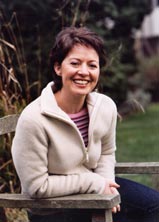 | | | | More about Helen Mark | | | | |
| | | | | | PROGRAMME DETAILS | | | |
| 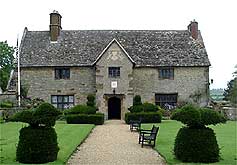 | | Sulgrave Manor | |
Helen Mark visits Sulgrave Manor in Northampstonshire to celebrate Harvest Home. The house is a Tudor mansion and was home to the ancestors of George Washington's family, which is why the Stars and Stripes flies from its flagpole. The manor estate was bought by Lawrence Washington, a wealthy wool merchant and Mayor of Northampton when Henry VIII dissolved the monasteries, and built the house. His great-great grandson emigrated to Virginia in 1656, and America's first president was born three generations later. In 1914, Sulgrave Manor was presented by a body of British subscribers to the Peoples of Great Britain and the United States of America in celebration of 100 years' peace between the two countries. Sulgrave Manor
Helen steps back in time to meet Lawrence Washington himself, who explains some of the customs and traditions that surround harvest time. Harvest legends go back to Greek mythology: Demeter was the corn goddess, associated with the earth, vegetation and agriculture. (Our word cereal comes from her Roman name, Ceres). Her daughter Persephone's abduction by the Lord of the Underworld explains the seasons and the need to gather a good harvest before Persephone vanishes underground each year. Demeter/Ceres would mourn her absence until she returned in the Spring, and nothing would grow in this bleak time.
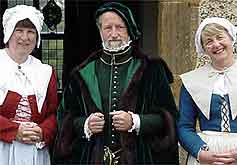 | | Lawrence Washington and his cooks | |
The first of August was Lammas Day in Tudor times, the first day of the Autumn and of the harvest. Some say the name Lammas comes from "loaf-mass", due to the breads made at this time baked with the first-cut corn of the harvest and blessed by the priest. Or possibly it comes from "lamb mass", as lambs were once dedicated at church on this day and large sheep-fairs were traditionally held. Lammas Day used to be a time for foretelling marriages and trying out partners. Two young people would agree to a "trial marriage" lasting the period of the fair (usually 11 days) to see whether they were really suited for wedlock. At the end of the fair, if they didn't get on, the couple could part.
Before automation took over, each harvesting day was usually heralded by a bell-peal from the local church. The days usually ran from 5.00am to 7.00pm, the work and rest periods being dictated by a foreman called the Lord of the Harvest, or King of the Mowers. His badge of office was a straw hat bedecked with poppies and bindweed. The Lord upended any newcomer to the team and struck the soles of his boots with a stone. The novice was released from the mock-showing only once he put a shilling towards the mowers' beer.
Great ceremony was always attached to the gathering of the last sheaf of corn. The Harvest-spirit lived in the field, and as the mowers progressed, the spirit was thought to be forced into the corn which remained, retreating until there was nowhere left to run. All the mowers would throw their scythes at the final stook so that no one person would be responsible for the corn spirit's death. The last sheaf of corn cut was treated with special respect and used to make Corn Dollies. Helen meets up with Tudor miller's wife Mary Course to learn about them. The original purpose of the corn dolly was to preserve the spirit of the corn throughout the winter. Come January, on the first Monday following Twelfth Night, known as Plough Monday, the corn dolly would be ploughed back into the soil so that its spirit would be released and ensure a good harvest.
Dances and local crafts
The last wagon of grain brought in was held to be particularly important and was called the Horkey or Hockey Cart. The cart and the horses drawing it were decorated with flowers and ribbons and the last sheaf took pride of place on top. It would call at all the inns and public houses along the route; vast quantities of ale and cider would be drunk, and it would then make its way to the farm where everyone involved with that year's harvest would celebrate the Harvest Home.
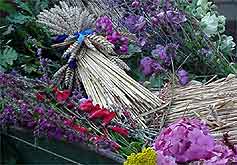 | | The corn maiden on her cart | |
It wasn't only grain that was important to the harvest. Herbs, too were gathered to see people through a winter of coughs and colds, and needed to freshen and disinfect the houses and make sure the bed-bugs didn't bite. Cheryl Waller from the Herb Society tells Helen about the importance of herbs to housework through the ages.
Herb Society
The Harvest Home itself was a feast with the farmer footing the bill, somewhere between a show of thanks by the generous empoyer and a massive blow-out to take the labourers' minds off how little they had been paid for their work. Helen goes into the kitchen of the Manor to meet cooks Martha and Hannah to see what's on the table. The usual fare varied across the country. Many suppers featured boiled beef or mutton (a rare treat), whilst others would have a roast along with rabbit or hare pie. Special harvest breads were made and these too vary as one moves round the country, from the rich saffron breads of Cornwall to the bannocks of Scotland. Helen learns when to go nutting, when not to pick blackberries and where the expression "to drawn the curtains" comes from.
To bring things up to date, Helen also talks to some of the local people living around the manor today. The Rev Brian Eaves is vicar to six parishes and says people still celebrate the harvest, although the produce collected is auctioned for famine relief. Headmaster Stephen Wass uses the celebrations to teach children about the importance of agriculture. And farmer Roger Cherry explains how very different 21st century harvests are: just a few men and a combine harvester.
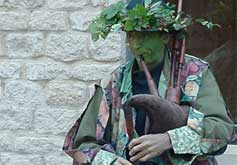 | | Paul Saunders | |
Throughout the programme, folk and medieval music is provided by:
Stephen Wass
John and Carol Leslie
Paul Saunders
This week's competition
What is the more common name for the herb that a Tudor Lady of the Manor would have known as knitbone?
Submit your entry by emailing open.country@bbc.co.uk
Last week's winner
As many of you no doubt frustratingly realised, as we did, St Ciaran was born on Cape Clear but no one knows the definitive date of his birth. The question had a range of possible answers so all your replies went into the hat and the winner is Mrs Grace Scott of Christchurch, Dorset.
The BBC is not responsible for external websites | | |
RELATED LINKS
BBC Holiday Category
BBC Countryfile
| | | | |
| | | | | | |  | | | | | | | | | Audio Help | | | | | | PREVIOUS PROGRAMMES | | | | | Current Week
Last Week
The A44
Aberdeenshire
Aberdeenshire, River Don
Aberfan
Alderley Edge, Cheshire
Ancient buildings
Anglesey
Applecross Peninsula
Aran Islands
Armistice Day, Somerset & Sussex
Auxiliary Units
Bardsey Island
Batsford Park Estate, Glos
Berkshire
Berwyn Mountains
Birdsong
Blackwater Estuary, Essex
Blaenafon
The Blean, Kent
Bosworth Field
Brecon Beacons
Buckinghamshire
Butterflies
By Brook Valley
The Cairngorms
Caithness
Cambridgeshire
Carmarthenshire
Cheddar Gorge
Cherwell Valley
Cheshire: Harrop Valley
Chesil Bank
Clee Hills, Shropshire
Climbers
Corfe Castle
Cornwall
Cornwall: Cape Cornwall
Cornwall: Padstow Lifeboat
Cornwall: Roseland Peninsula
Cotswold
Cotswold Way
County Clare, Ireland
Cranbourne Chase
Cumbria: Eden Valley
Cumbria: Coniston Water
Cumbria: Sellafield
Cumbria
Daingean in Glengarry
Dee Estuary
Derbyshire
Devon & Somerset: Grand Western Canal
Donegal
Dorset
Dorset: Cranborne Chase
Dorsetman
Dowsing
Dunalastair
Durham
Durham: Witton Park
East Anglian Churches
Eden Valley in Cumbria
Eigg
Eire: Co. Mayo
Eire: Skibbereen
Eire: West Cork
Elan Valley, Wales
Eshott, Norhumberland
Essex
Essex: coastal
Exmoor, churches
Falkirk
Farne Islands, Part 1
Farne Islands, Part 2
Fenn's, Whixall & Bettisfield Mosses National Nature Reserve
The Fens
Fife
Flanders
Forster Country
Glencoe Mountains
Glencoe
Gloucestershire
Goa
Goodwin Sands
Gower Peninsula, June 2006
Gower Peninsula, October 2005
Grouse shooting
Guernsey
Hadrian's Wall 2003
Hadrian's Wall 2004
Hambledon Cricket Club
Hampshire: Odium
Hampshire: Selborne
Hardcastle Crags
Heart of Wales Railway
Hebden Bridge
Herefordshire
Hertfordshire
Hidden Treasures
High Weald, Sussex
Holy Island
Ilmington
Isle of Gigha 2004
Isle of Gigha, 2005
Isle of Man - Seas
Isle of Man
Isle of Wight, 2003
Isle of Wight, 2005
Izak Walton
Kent: Dover
Kent: Dungeness Peninsular
Kent: North
Kielder Water
Kinver Edge
Kingham, Oxfordshire
Lake District
Leicestershire: Bosworth Field
Leicestershire: death rituals
Lincolshire farming
Lincolnshire
Lincolnshire
Loch Morar
Looe Island
Ludlow
Lunar Influence
Don McCullin
Richard Mabey
Marsden, West Yorkshire
Mary Towneley Loop
Mersea Island
Mersey Marshes
Metal Detectingg
Mid-Wales
Morecambe Bay
Moel Findeg, North Wales
Morecombe Sands
Nant Gwrtheyrn
National Forest
New Forest
Newton Dee, nr Aberdeen
Norfolk Broads
Norfolk: Thetford Forest
Norfolk: North Norfolk coast
North Devon Combes
Northants: Sulgrave Manor
Northants: Underground
Northern Ireland: Belfast
Northern Ireland: Border Counties
Northern Ireland: Moneypenny's Lock
Northern Ireland: Sperrin Mountains
Northern Ireland: Strangford Lough
Northern Ireland: Toomebridge
North Norfolk Coast
Northumberland, part 1
Northumberland, part 2
North Wessex Downs
North Yorkshire
North Yorkshire Moors
North Yorkshire Moors Railway
Nottinghamshire
Nottinghamshire: Sherwood Forest
Oak Trees
Offa's Dyke
Orford Ness
Orkneys
Out Skerries, Shetland
Outward Bound
Oxfordshire
Peak District
Peak District
Pembrokeshire Coast
Pentland Hills
Perthshire
Poachers
Pony Club
River Severn
Romney Marsh
Rutland Water
Scilly
Scotland: Abernethy Forest
Scotland: Loch Morar
Scotland: Shetland
Scotland: Strathclyde
Scotland: What value the countryside?
Scottish Borders
Sefton Coast
Self-sufficient communities
Severn Valley Railway
Shropshire: Ellesmere
Shropshire: Much Wenlock
Shropshire and Wales, Newport
Skegness
Skomer Island
Snowdon
Snowdonia National Park
Somerset Levels
Somerset Levels
Somerset: Montacute House
Somerset writers
South Downs
South Somerset: watermills
Southwold
Spurn Peninsular
Start Bay
Stour Valley
Survival
Sussex
Sutherland, Scotland
Tamar Valley
Thornham Estate, Suffolk
Thurstonland Cricket Club
Twyford Down
Tyntesfield, North Somerset
Village Life
Terry Waite
Wales
Wales: Flatholm Island
Wales: Nant Gwrtheyrn
Wales: Snowdonia
Warwickshire: rare breeds
Wayoh Reservoir
Wenlock Edge
West Sussex
West Yorks: Calder Valley
Weston Common, Surrey
Wild boar
Wiltshire
Wiltshire: Savernake Forest
Women's Institute
Wroxeter
Yorkshire Dales, June 2002
Yorkshire Dales, 1 July 2006
Yorkshire Dales, 8 July 2006
Z to Z Britain
Open Country looks back 2003
| | | | | MESSAGE BOARDS | | | | | Join the discussion:
The Learning Curve
Pick of the Week
Questions, Questions
Woman's Hour
Word of Mouth | | | | | RELATED PROGRAMMES | | | | | Excess Baggage
Changing Places
Similar programmes this week on Radio 4
| | |
|