| | | | | PROGRAMME INFO | | | |
| | | From Shetland to the Scilly Isles, Open Country travels the UK in search of the stories, the people and the wildlife that make our countryside such a vibrant place. Each week we visit a new area to hear how local people are growing the crops, protecting the environment, maintaining the traditions and cooking the food that makes their corner of rural Britain unique.
Email: open.country@bbc.co.uk
Postal address: Open Country,
BBC Radio 4, Birmingham, B5 7QQ.
| | | | | LISTEN AGAIN | | | |
|
|
| | PRESENTER | | | |
|  | | | | More about Helen Mark | | | | |
| | | | | | PROGRAMME DETAILS | | | |
|  | | Llamas | |
This week Helen's in the Lake District in the rain. But this doesn't stop her discovering a real "good news" story. For the second time in 150 years the wild ospreys overlooking Bassenthwaite (the only ones in England) have produced chicks - and for the first time they have twins. Ospreys are one of the world's most spectacular and popular raptors, famed for its dramatic fishing technique of plunging into water with wings swept back, talons thrust forwards at the last minute to snatch a fish below the surface. Helen meets Graeme Prest of the Forestry Commission who's been involved with the project team involved with the ospreys from the start. Bird watching is his hobby, and he has helped to build the artificial nest, manage view points and is thoroughly excited at the new chicks. The chicks are little balls of fluff at the moment, but growing fast. They are fed on high protein fish and are expected to fledge in August. The nest has to be protected, but it's possible to watch the birds through high-powered telescopes from a safe distance - and pictures are being beamed to a visitor centre and to the internet.
Lake District Osprey Project
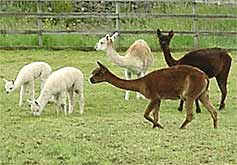
Seeing the white dots of sheep on the fells is as much part of the Cumbrian scenery as the fells themselves. And after the culls for FMD, re-stocking has done much to restore this familiar sight. But if Pat Bentley has her way, you will come to expect to see the landscape covered in alpacas. She went on holiday to Peru in 1974 and fell in love with an alpaca outside the walls of Cousco City. Smitten with their lovely soft fleece and gorgeous eyes, Pat decided that when she retired she would breed alpacas, and that's what she now does. Helen visits her at the Alpaca Centre at Stainton near Penrith and learns that these peaceful creatures with their wonderfully strange mooing sounds, are a kind of South American camel, but they're just as happy on the heights of Cumbria as they are in the High Andes.
The Alpaca Centre
Blackmore Vale Alpacas
There can't be anyone who's been out walking in Cumbria who hasn't tasted Kendal Mint Cake. Helen visits the tiny factory (naturally, near Kendal!) where Romney's of Kendal have been making the confectionery by hand for four generations. The famous hiker's snack was developed by accident - the ingredients are the same as in transparent mints and it's believed that the sugar boiler in charge of the mixture stirred the liquid for too long and made it cloudy. Rather than deciding to throw it away, he poured it into the copper pan and it set - and hence the mint cake was discovered. It was Shane Barron's grandfather who really spotted the gap in the market and in 1953 he offered it to Sir Edmund Hillary's Everest expedition. Hillary was quoted as saying: "We sat on the snow and looked at the country far below us…we nibbled Kendal Mint Cake." A member of the successful Everest expedition wrote: "It was easily the most popular item on our high altitude ration - our only criticism was that we did not have enough of it." It has remained very popular with walkers because no matter if it's boiling hot weather or freezing cold, the Mint Cake and its texture remains consistent. The sweet is still made in the old-fashioned way in small batches, using 80 year old copper pans. And Helen discovers the power of mint essence when it's added to boiling sugar!
Romney's of Kendal
C R Ashbee wrote that 'the proper place for the Arts and Crafts is in the country'. So Helen visits Blackwell House - one of England's most important surviving houses from the turn of the 20th century. Designed by M H Baillie Scott between 1897 and 1900, it's an excellent example of Arts & Crafts architecture. The Movement developed in 19th-century Britain as a rebellion against the fashion for inventive sham and over-elaborate design and as an attempt to reverse the growing dehumanisation of work in society. It was based on simple forms, truth to materials and the use of nature as the source of pattern. Young London-based architects were inspired by the ideas of John Ruskin and William Morris. They founded the Art Workers' Guild in 1884 to break down barriers between architects, artists, designers and makers. The Movement included both the romanticising of rural life and an attempt to preserve its surviving heritage. Cherry Trelogan has been involved in the restoration of Blackwell house. She shows Helen around and explains that under the influence of Ruskin, who had a house nearby, the Lake District became a centre for Arts and Crafts practitioners - traditional rural crafts were restored, and new ones developed, to international acclaim.
Blackwell House
And it's not just the fells and lakes that make up the Cumbrian landscape - the forests are important too. But psychologists have told the Forestry Commission that folklore, fairytales and films like the Blair Witch Project have been causing tourists to steer clear of woods. So work is being carried out to brighten up the forests - it means the appearance of cleared paths, neatly manicured glens and strategically placed water features. One of the first woodland makeovers has taken place at Grizedale Forest (the largest forest within the Lake District) and recreational manager Penny Nock explains to Helen that they have started developing more areas where people can feel safe, with dappled shade and open areas where flowers such as bluebells can spread. And to lessen people's fear from all things scary they've set up an education programme to introduce children, particularly those not used to playing unsupervised, to the forest.
Forestry Commission
Grizedale Forest Park
This week's competition
Apart from Mint Cake, Kendal is also associated with a particular colour - what is it?
Last week's competition winner is Mrs Pia Reynolds of Harpenden, who correctly said that the Woodland Trust was founded by Kenneth Watkins in 1972.
Submit your entry by emailing open.country@bbc.co.uk -->
The BBC is not responsible for external websites | | |
RELATED LINKS
BBC Holiday Category
BBC Countryfile
| |
| | | | | | |  | | | | | | | | | Audio Help | | | | | | PREVIOUS PROGRAMMES | | | | | Current Week
Last Week
The A44
Aberdeenshire
Aberdeenshire, River Don
Aberfan
Alderley Edge, Cheshire
Ancient buildings
Anglesey
Applecross Peninsula
Aran Islands
Armistice Day, Somerset & Sussex
Auxiliary Units
Bardsey Island
Batsford Park Estate, Glos
Berkshire
Berwyn Mountains
Birdsong
Blackwater Estuary, Essex
Blaenafon
The Blean, Kent
Bosworth Field
Brecon Beacons
Buckinghamshire
Butterflies
By Brook Valley
The Cairngorms
Caithness
Cambridgeshire
Carmarthenshire
Cheddar Gorge
Cherwell Valley
Cheshire: Harrop Valley
Chesil Bank
Clee Hills, Shropshire
Climbers
Corfe Castle
Cornwall
Cornwall: Cape Cornwall
Cornwall: Padstow Lifeboat
Cornwall: Roseland Peninsula
Cotswold
Cotswold Way
County Clare, Ireland
Cranbourne Chase
Cumbria: Eden Valley
Cumbria: Coniston Water
Cumbria: Sellafield
Cumbria
Daingean in Glengarry
Dee Estuary
Derbyshire
Devon & Somerset: Grand Western Canal
Donegal
Dorset
Dorset: Cranborne Chase
Dorsetman
Dowsing
Dunalastair
Durham
Durham: Witton Park
East Anglian Churches
Eden Valley in Cumbria
Eigg
Eire: Co. Mayo
Eire: Skibbereen
Eire: West Cork
Elan Valley, Wales
Eshott, Norhumberland
Essex
Essex: coastal
Exmoor, churches
Falkirk
Farne Islands, Part 1
Farne Islands, Part 2
Fenn's, Whixall & Bettisfield Mosses National Nature Reserve
The Fens
Fife
Flanders
Forster Country
Glencoe Mountains
Glencoe
Gloucestershire
Goa
Goodwin Sands
Gower Peninsula, June 2006
Gower Peninsula, October 2005
Grouse shooting
Guernsey
Hadrian's Wall 2003
Hadrian's Wall 2004
Hambledon Cricket Club
Hampshire: Odium
Hampshire: Selborne
Hardcastle Crags
Heart of Wales Railway
Hebden Bridge
Herefordshire
Hertfordshire
Hidden Treasures
High Weald, Sussex
Holy Island
Ilmington
Isle of Gigha 2004
Isle of Gigha, 2005
Isle of Man - Seas
Isle of Man
Isle of Wight, 2003
Isle of Wight, 2005
Izak Walton
Kent: Dover
Kent: Dungeness Peninsular
Kent: North
Kielder Water
Kinver Edge
Kingham, Oxfordshire
Lake District
Leicestershire: Bosworth Field
Leicestershire: death rituals
Lincolshire farming
Lincolnshire
Lincolnshire
Loch Morar
Looe Island
Ludlow
Lunar Influence
Don McCullin
Richard Mabey
Marsden, West Yorkshire
Mary Towneley Loop
Mersea Island
Mersey Marshes
Metal Detectingg
Mid-Wales
Morecambe Bay
Moel Findeg, North Wales
Morecombe Sands
Nant Gwrtheyrn
National Forest
New Forest
Newton Dee, nr Aberdeen
Norfolk Broads
Norfolk: Thetford Forest
Norfolk: North Norfolk coast
North Devon Combes
Northants: Sulgrave Manor
Northants: Underground
Northern Ireland: Belfast
Northern Ireland: Border Counties
Northern Ireland: Moneypenny's Lock
Northern Ireland: Sperrin Mountains
Northern Ireland: Strangford Lough
Northern Ireland: Toomebridge
North Norfolk Coast
Northumberland, part 1
Northumberland, part 2
North Wessex Downs
North Yorkshire
North Yorkshire Moors
North Yorkshire Moors Railway
Nottinghamshire
Nottinghamshire: Sherwood Forest
Oak Trees
Offa's Dyke
Orford Ness
Orkneys
Out Skerries, Shetland
Outward Bound
Oxfordshire
Peak District
Peak District
Pembrokeshire Coast
Pentland Hills
Perthshire
Poachers
Pony Club
River Severn
Romney Marsh
Rutland Water
Scilly
Scotland: Abernethy Forest
Scotland: Loch Morar
Scotland: Shetland
Scotland: Strathclyde
Scotland: What value the countryside?
Scottish Borders
Sefton Coast
Self-sufficient communities
Severn Valley Railway
Shropshire: Ellesmere
Shropshire: Much Wenlock
Shropshire and Wales, Newport
Skegness
Skomer Island
Snowdon
Snowdonia National Park
Somerset Levels
Somerset Levels
Somerset: Montacute House
Somerset writers
South Downs
South Somerset: watermills
Southwold
Spurn Peninsular
Start Bay
Stour Valley
Survival
Sussex
Sutherland, Scotland
Tamar Valley
Thornham Estate, Suffolk
Thurstonland Cricket Club
Twyford Down
Tyntesfield, North Somerset
Village Life
Terry Waite
Wales
Wales: Flatholm Island
Wales: Nant Gwrtheyrn
Wales: Snowdonia
Warwickshire: rare breeds
Wayoh Reservoir
Wenlock Edge
West Sussex
West Yorks: Calder Valley
Weston Common, Surrey
Wild boar
Wiltshire
Wiltshire: Savernake Forest
Women's Institute
Wroxeter
Yorkshire Dales, June 2002
Yorkshire Dales, 1 July 2006
Yorkshire Dales, 8 July 2006
Z to Z Britain
Open Country looks back 2003
| | | | | MESSAGE BOARDS | | | | | Join the discussion:
The Learning Curve
Pick of the Week
Questions, Questions
Woman's Hour
Word of Mouth | | | | | RELATED PROGRAMMES | | | | | Excess Baggage
Changing Places
Similar programmes this week on Radio 4
| | |
|