| | | | | PROGRAMME INFO | | | |
| | | From Shetland to the Scilly Isles, Open Country travels the UK in search of the stories, the people and the wildlife that make our countryside such a vibrant place. Each week we visit a new area to hear how local people are growing the crops, protecting the environment, maintaining the traditions and cooking the food that makes their corner of rural Britain unique.
Email: open.country@bbc.co.uk
Postal address: Open Country,
BBC Radio 4, Birmingham, B5 7QQ.
| | | | | LISTEN AGAIN | | | |
|
|
| | PRESENTERS | | | |
|  | | | More about Helen Mark | | | |  | | | More about Richard Uridge | | | | |
| | | | | | PROGRAMME DETAILS | | | |
| 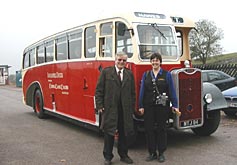 | Will Hamer and Alison Morris
| |
Richard Uridge trundles round the Eden Valley in Cumbria in a vintage red bus with Will Hamer, its driver, and his daughter Alison Morris, who's the conductress. It's a regular summer bus service between Ravenstonedale and the Tuesday market at Hawes.
Richard's first stop is Kirkby Stephen which, despite its population of 1600, still proudly calls itself a village. This year it's the 650th anniversary of its market charter, and it remains the commercial centre of an area long dominated by sheep farming. The village is at the edge of some relatively low-lying land between the Lake District's Cumbrian Mountains, the Yorkshire Dales and The Pennines. However, the inhabitants of the town and surrounding area are West Merian (from Westmorland) and very proud of the fact.
Richard meet Margaret Gowling, from the Upper Eden History Society, who explains that the 1353 charter was granted by Edward III on the understanding that Robert de Clifford, Baron of Westmorland, would supply soldiers to fight the Scots. For local people it was a chance to make money and at the same time throw off the drudgery of their normal lives. At this time Kirkby Stephen was very much on the edge of the kingdom of England. The early wealth and importance of Kirkby Stephen has much to do with the north to south droving routes that passed close by. Some droving routes have existed since Roman times, but there is also evidence to suggest that cattle were being driven south from the Scottish glens to be sold for fattening in the Dales area as early as the 14th century. This trade had increased to fantastic proportions by the 17th-18th centuries, but it was in medieval times that the UK wool market expanded rapidly, thanks to a strong foreign interest in English wool.
Richard takes the bus on to Outhgill where Dick Capel, project officer for East Cumbria Countryside Project, is waiting to show him a Cone Pinfold - one of the sculptures made by the landscape artist Andy Goldsworthy for his sheepfold project. Andy creates sculpture from materials he finds in the landscape. A lot of his work is temporary, left to degrade or fall down once it has been photographed. The sheepfolds he has created in the Kirkby Stephen area are much more permanent. Cumbria Country Council asked Goldsworthy to undertake a major landscape commission in 1996. He picked on the idea of rebuilding or altering sheepfolds (at first the target was 100, but the figure was revised down to 50), many of which were ruined, in disrepair or simply marks on a map. Goldsworthy stamped his own style on the design of all the sheepfolds and has worked with professional dry stone wallers to create an unique mark on the landscape. All the sheepfolds are on private land, but the public has the right of access.
Goldsworthy sheepfolds
At nearby Crosby Garrett, Richard meets Ian Allonby who's passionate about poultry. He's a prize-winning breeder of poultry and waterfowl and started breeding bantams and poultry when he was seven. Amongst his fowl are Peking bantams, a dwarf mini-fowl brought to England after the 1860 sacking of the Summer Palace in Peking; Indian runner ducks, introduced from Malaya in the 19th century, initially by a ship's captain who bought a few home and distributed them among his friends in Dumfriesshire and Cumberland; and Old English peasant fowl, developed in the 18th century and regarded as a capital layer, fine forager and ideal for small holdings.
Poultry Club
Poultry Pages
Will Hamer and Alison Morris drive home, where Richard finds that the red vintage coach he's been travelling on is not the only one in their garage. Will's love of classic buses and coaches started in the 1970s when he was living in Manchester and a builder by profession. Will now has six coaches and Public Service Vehicle licences for four. The scheduled services attract a mix of local people, curious tourists and classic coach enthusiasts - the company has a 400-strong fan club and sends out a regular newsletter. Alison's passed her test to drive the buses and finds it exhilarating to be in charge of these great beasts of vehicles with no synchromesh on the gears. They've all got names, of course: there's Florence and Heather and Richard finds he's been travelling on Lawrence of Arabia all day. But the family are stumped for a name for their little blue and cream coach. Listen to the programme for some clues, and then drop us an email with your suggestions.
Cumbria Classic Coaches
Email Open Country: open.country@bbc.co.uk
The BBC is not responsible for external web sites | | |
RELATED LINKS
BBC Holiday Category
BBC Country file
| |
| | | | | | |  | | | | | | | | | Audio Help | | | | | | PREVIOUS PROGRAMMES | | | | | Current Week
Last Week
The A44
Aberdeenshire
Aberdeenshire, River Don
Aberfan
Alderley Edge, Cheshire
Ancient buildings
Anglesey
Applecross Peninsula
Aran Islands
Armistice Day, Somerset & Sussex
Auxiliary Units
Bardsey Island
Batsford Park Estate, Glos
Berkshire
Berwyn Mountains
Birdsong
Blackwater Estuary, Essex
Blaenafon
The Blean, Kent
Bosworth Field
Brecon Beacons
Buckinghamshire
Butterflies
By Brook Valley
The Cairngorms
Caithness
Cambridgeshire
Carmarthenshire
Cheddar Gorge
Cherwell Valley
Cheshire: Harrop Valley
Chesil Bank
Clee Hills, Shropshire
Climbers
Corfe Castle
Cornwall
Cornwall: Cape Cornwall
Cornwall: Padstow Lifeboat
Cornwall: Roseland Peninsula
Cotswold
Cotswold Way
County Clare, Ireland
Cranbourne Chase
Cumbria: Eden Valley
Cumbria: Coniston Water
Cumbria: Sellafield
Cumbria
Daingean in Glengarry
Dee Estuary
Derbyshire
Devon & Somerset: Grand Western Canal
Donegal
Dorset
Dorset: Cranborne Chase
Dorsetman
Dowsing
Dunalastair
Durham
Durham: Witton Park
East Anglian Churches
Eden Valley in Cumbria
Eigg
Eire: Co. Mayo
Eire: Skibbereen
Eire: West Cork
Elan Valley, Wales
Eshott, Norhumberland
Essex
Essex: coastal
Exmoor, churches
Falkirk
Farne Islands, Part 1
Farne Islands, Part 2
Fenn's, Whixall & Bettisfield Mosses National Nature Reserve
The Fens
Fife
Flanders
Forster Country
Glencoe Mountains
Glencoe
Gloucestershire
Goa
Goodwin Sands
Gower Peninsula, June 2006
Gower Peninsula, October 2005
Grouse shooting
Guernsey
Hadrian's Wall 2003
Hadrian's Wall 2004
Hambledon Cricket Club
Hampshire: Odium
Hampshire: Selborne
Hardcastle Crags
Heart of Wales Railway
Hebden Bridge
Herefordshire
Hertfordshire
Hidden Treasures
High Weald, Sussex
Holy Island
Ilmington
Isle of Gigha 2004
Isle of Gigha, 2005
Isle of Man - Seas
Isle of Man
Isle of Wight, 2003
Isle of Wight, 2005
Izak Walton
Kent: Dover
Kent: Dungeness Peninsular
Kent: North
Kielder Water
Kinver Edge
Kingham, Oxfordshire
Lake District
Leicestershire: Bosworth Field
Leicestershire: death rituals
Lincolshire farming
Lincolnshire
Lincolnshire
Loch Morar
Looe Island
Ludlow
Lunar Influence
Don McCullin
Richard Mabey
Marsden, West Yorkshire
Mary Towneley Loop
Mersea Island
Mersey Marshes
Metal Detectingg
Mid-Wales
Morecambe Bay
Moel Findeg, North Wales
Morecombe Sands
Nant Gwrtheyrn
National Forest
New Forest
Newton Dee, nr Aberdeen
Norfolk Broads
Norfolk: Thetford Forest
Norfolk: North Norfolk coast
North Devon Combes
Northants: Sulgrave Manor
Northants: Underground
Northern Ireland: Belfast
Northern Ireland: Border Counties
Northern Ireland: Moneypenny's Lock
Northern Ireland: Sperrin Mountains
Northern Ireland: Strangford Lough
Northern Ireland: Toomebridge
North Norfolk Coast
Northumberland, part 1
Northumberland, part 2
North Wessex Downs
North Yorkshire
North Yorkshire Moors
North Yorkshire Moors Railway
Nottinghamshire
Nottinghamshire: Sherwood Forest
Oak Trees
Offa's Dyke
Orford Ness
Orkneys
Out Skerries, Shetland
Outward Bound
Oxfordshire
Peak District
Peak District
Pembrokeshire Coast
Pentland Hills
Perthshire
Poachers
Pony Club
River Severn
Romney Marsh
Rutland Water
Scilly
Scotland: Abernethy Forest
Scotland: Loch Morar
Scotland: Shetland
Scotland: Strathclyde
Scotland: What value the countryside?
Scottish Borders
Sefton Coast
Self-sufficient communities
Severn Valley Railway
Shropshire: Ellesmere
Shropshire: Much Wenlock
Shropshire and Wales, Newport
Skegness
Skomer Island
Snowdon
Snowdonia National Park
Somerset Levels
Somerset Levels
Somerset: Montacute House
Somerset writers
South Downs
South Somerset: watermills
Southwold
Spurn Peninsular
Start Bay
Stour Valley
Survival
Sussex
Sutherland, Scotland
Tamar Valley
Thornham Estate, Suffolk
Thurstonland Cricket Club
Twyford Down
Tyntesfield, North Somerset
Village Life
Terry Waite
Wales
Wales: Flatholm Island
Wales: Nant Gwrtheyrn
Wales: Snowdonia
Warwickshire: rare breeds
Wayoh Reservoir
Wenlock Edge
West Sussex
West Yorks: Calder Valley
Weston Common, Surrey
Wild boar
Wiltshire
Wiltshire: Savernake Forest
Women's Institute
Wroxeter
Yorkshire Dales, June 2002
Yorkshire Dales, 1 July 2006
Yorkshire Dales, 8 July 2006
Z to Z Britain
Open Country looks back 2003
| | | | | MESSAGE BOARDS | | | | | Join the discussion:
The Learning Curve
Pick of the Week
Questions, Questions
Woman's Hour
Word of Mouth | | | | | RELATED PROGRAMMES | | | | | Excess Baggage
Changing Places
Similar programmes this week on Radio 4
| | |
|