| | | | | PROGRAMME INFO | | | |
| | | From Shetland to the Scilly Isles, Open Country travels the UK in search of the stories, the people and the wildlife that make our countryside such a vibrant place. Each week we visit a new area to hear how local people are growing the crops, protecting the environment, maintaining the traditions and cooking the food that makes their corner of rural Britain unique.
Email: open.country@bbc.co.uk
Postal address: Open Country,
BBC Radio 4, Birmingham, B5 7QQ.
| | | | | LISTEN AGAIN | | | |
|
|
| | PRESENTER | | | |
|  | | | | More about Helen Mark | | | | |
| | | | | | PROGRAMME DETAILS | | | |
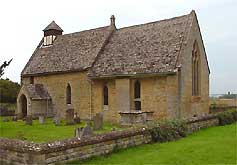 | | The Medieval Church at Hailes Abbey | |
Charlotte Smith walks along the Cotswold Way, a designated footpath and National Trail which stretches for 104 miles: beginning in Chipping Campden, it ends in Bath.
It runs along the western escarpment, starting close to Stratford-upon-Avon and goes through Broadway, Winchcombe, Cleeves Hill, Painswick, Old Sodbury and Castle Coombe amongst others. It includes the rolling hills and classic honey-coloured villages that give the Cotswolds its distinctive identity.
Map
Wool was the most important export commodity during the Middle Ages and the sheep of the Cotswolds were the largest source of fine wool. It is no accident that the Woolsack became the official seat of the Lord Chancellor as wool accounted for 50 per cent of the national economy. The export of fleeces increased after 1066, especially to Flanders and, by the end of the 12th century Italian merchants were making cloth from Cotswold wool. William Camden spoke of "Cotswold hillocks famed for weighty sheep with Golden fleeces clothed" in his Britannica of 1536.
History of wool production
Charlotte begins her journey at Chipping Campden where she meets local historian Alwyn Sampson outside the home of William Grevel, perhaps one of the greatest wool traders. The house is notable for the tall bay window with its delicately moulded and carved stonework, topped with a pair gargoyles. It's beautifully proportioned and human in scale, sitting in a long terrace of later houses built with identical materials.
He was hugely important to the town as a large brass of Grevel and his wife Marion set into the floor of the Chancel of St James attests: "Here lies William Grevel of Campden, formerly a citizen of London and flower of the wool merchants of all England, who died on the first day of October Anno Domini 1401". The church is one of the finest wool churches in the Cotswolds, built from the wealth of the wool trade.
Chipping Camden
Charlotte next meets Mark Campbell, a consultant geologist and chair of the Gloucester Geo-Conservation Society. He takes Charlotte to a limestone quarry to explain how limestone was formed and how the combination of limestone, Fullers Earth and fresh water streams made the area perfect for wool production and cloth making and also how the hills were formed to give us the distinct Cotswold landscape.
Bath Stone quarrying
Charltotte's next stop is at Cutsdean, where Lyn Gibbins of the Cotswold Sheep Society and Derek Hurst, an archaeologist, introduce her to The Cotswold Area of National Beauty where there's a project to restore some of the old sheep washes that are dotted around the villages.
The Cotswold Sheep breed was introduced by the Romans: bigger and heavier than the Celtic breeds, they did not shed their considerably longer wool and the shivering soldiers that came from warmer climes needed the wool for clothes and so an industry was born. Thousands of sheep roamed the hills in the 13th and 14th centuries and the washes were important because clean fleeces meant higher prices. The sheep would be driven down from the hills on wash days and brought to tiny villages such as Cutsdean. Soon merchants from Flanders and Italy were specifying fleeces from Cotswold Sheep and the industry flourished.
Cotswold Sheep Society
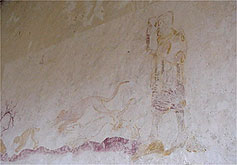 | | Wall painting at Hailes Abbey | |
Stephen Blake is the curator of Cheltenham Art Gallery and Museum and Charlotte meets him
at Hailes Abbey, near Winchcombe. It is a Cistercian house, built on the edge of the Cotswolds during the mid-13th century, founded by Richard, Earl of Cornwall in honour of his life being spared by a tragedy at sea. He brought a small group of monks from Beaulieu Abbey - a monastery founded earlier by his father, King John - to form the core of this small settlement. Stephen takes Charlotte to the little chapel outside the Monastry grounds, which is decorated with medieval wall paintings - mostly heraldic crests but also figures of saints and a hunting scene complete with hounds and a cowering hare.
Hailes Abbey
Historic Buildings
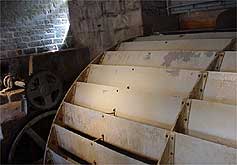 | | The Dunkirk Mill waterwheel | |
As Charlotte journeys further south the valleys become steeper, the rivers flow faster and the wool trade becomes more industrialised. It moves into the industrial age and the dependence upon one breed of sheep ends. The dozens of mills that sprung up around the valleys of Stroud and Nailsworth imported wool from all over Europe. Ian Mackintosh takes Charlotte around Dunkirk Mill: established in 1760 it reached its heyday in the 1800s and still has a working water wheel. Charlotte gets a demonstration of the wheel in full flow.
The mills at Dunkirk are gradually being turned into luxury flats, with a small set of rooms dedicated to preserving relics of their working past. There's Egypt Mill, which is now a family pub and restaurant where diners can relax and watch the old waterwheel turning, or the ducks dabbling in the millpond. Once the waters here ran red from dyes emptied into the stream by local businesses, earning it the title of Red Sea.
At Naunton Charlotte meets Pat Quinn, who has kept Cotswold sheep for 27 years. Although the numbers are now increasing, it was farmers like Pat who helped keep the breed alive - in the 1960s it faced extinction - but the changing needs of the meat industry and the development of natural fibres have almost meant the end for the Cotswold as a breed. Pat is convinced that the qualities that made the breed so valuable will enable it to survive and she's determined that the Cotswold has a future in modern agriculture.
This week's competition
This weeks competition question is set by Ian Mackintosh of Dunkirk Mill: what was the dye used to make Stroud Scarlet - the vivid red colour of Guardsmen's uniforms?
Last week's competition winner is David Lancaster, of Harrogate who knew that there are six sections in a brass band.
-->
Submit your entry by emailing open.country@bbc.co.uk
The BBC is not responsible for external websites | | |
RELATED LINKS
BBC Radio Gloucestershire
BBC Holiday Category
BBC Countryfile
| | | |
| | | | | | |  | | | | | | | | | Audio Help | | | | | | PREVIOUS PROGRAMMES | | | | | Current Week
Last Week
The A44
Aberdeenshire
Aberdeenshire, River Don
Aberfan
Alderley Edge, Cheshire
Ancient buildings
Anglesey
Applecross Peninsula
Aran Islands
Armistice Day, Somerset & Sussex
Auxiliary Units
Bardsey Island
Batsford Park Estate, Glos
Berkshire
Berwyn Mountains
Birdsong
Blackwater Estuary, Essex
Blaenafon
The Blean, Kent
Bosworth Field
Brecon Beacons
Buckinghamshire
Butterflies
By Brook Valley
The Cairngorms
Caithness
Cambridgeshire
Carmarthenshire
Cheddar Gorge
Cherwell Valley
Cheshire: Harrop Valley
Chesil Bank
Clee Hills, Shropshire
Climbers
Corfe Castle
Cornwall
Cornwall: Cape Cornwall
Cornwall: Padstow Lifeboat
Cornwall: Roseland Peninsula
Cotswold
Cotswold Way
County Clare, Ireland
Cranbourne Chase
Cumbria: Eden Valley
Cumbria: Coniston Water
Cumbria: Sellafield
Cumbria
Daingean in Glengarry
Dee Estuary
Derbyshire
Devon & Somerset: Grand Western Canal
Donegal
Dorset
Dorset: Cranborne Chase
Dorsetman
Dowsing
Dunalastair
Durham
Durham: Witton Park
East Anglian Churches
Eden Valley in Cumbria
Eigg
Eire: Co. Mayo
Eire: Skibbereen
Eire: West Cork
Elan Valley, Wales
Eshott, Norhumberland
Essex
Essex: coastal
Exmoor, churches
Falkirk
Farne Islands, Part 1
Farne Islands, Part 2
Fenn's, Whixall & Bettisfield Mosses National Nature Reserve
The Fens
Fife
Flanders
Forster Country
Glencoe Mountains
Glencoe
Gloucestershire
Goa
Goodwin Sands
Gower Peninsula, June 2006
Gower Peninsula, October 2005
Grouse shooting
Guernsey
Hadrian's Wall 2003
Hadrian's Wall 2004
Hambledon Cricket Club
Hampshire: Odium
Hampshire: Selborne
Hardcastle Crags
Heart of Wales Railway
Hebden Bridge
Herefordshire
Hertfordshire
Hidden Treasures
High Weald, Sussex
Holy Island
Ilmington
Isle of Gigha 2004
Isle of Gigha, 2005
Isle of Man - Seas
Isle of Man
Isle of Wight, 2003
Isle of Wight, 2005
Izak Walton
Kent: Dover
Kent: Dungeness Peninsular
Kent: North
Kielder Water
Kinver Edge
Kingham, Oxfordshire
Lake District
Leicestershire: Bosworth Field
Leicestershire: death rituals
Lincolshire farming
Lincolnshire
Lincolnshire
Loch Morar
Looe Island
Ludlow
Lunar Influence
Don McCullin
Richard Mabey
Marsden, West Yorkshire
Mary Towneley Loop
Mersea Island
Mersey Marshes
Metal Detectingg
Mid-Wales
Morecambe Bay
Moel Findeg, North Wales
Morecombe Sands
Nant Gwrtheyrn
National Forest
New Forest
Newton Dee, nr Aberdeen
Norfolk Broads
Norfolk: Thetford Forest
Norfolk: North Norfolk coast
North Devon Combes
Northants: Sulgrave Manor
Northants: Underground
Northern Ireland: Belfast
Northern Ireland: Border Counties
Northern Ireland: Moneypenny's Lock
Northern Ireland: Sperrin Mountains
Northern Ireland: Strangford Lough
Northern Ireland: Toomebridge
North Norfolk Coast
Northumberland, part 1
Northumberland, part 2
North Wessex Downs
North Yorkshire
North Yorkshire Moors
North Yorkshire Moors Railway
Nottinghamshire
Nottinghamshire: Sherwood Forest
Oak Trees
Offa's Dyke
Orford Ness
Orkneys
Out Skerries, Shetland
Outward Bound
Oxfordshire
Peak District
Peak District
Pembrokeshire Coast
Pentland Hills
Perthshire
Poachers
Pony Club
River Severn
Romney Marsh
Rutland Water
Scilly
Scotland: Abernethy Forest
Scotland: Loch Morar
Scotland: Shetland
Scotland: Strathclyde
Scotland: What value the countryside?
Scottish Borders
Sefton Coast
Self-sufficient communities
Severn Valley Railway
Shropshire: Ellesmere
Shropshire: Much Wenlock
Shropshire and Wales, Newport
Skegness
Skomer Island
Snowdon
Snowdonia National Park
Somerset Levels
Somerset Levels
Somerset: Montacute House
Somerset writers
South Downs
South Somerset: watermills
Southwold
Spurn Peninsular
Start Bay
Stour Valley
Survival
Sussex
Sutherland, Scotland
Tamar Valley
Thornham Estate, Suffolk
Thurstonland Cricket Club
Twyford Down
Tyntesfield, North Somerset
Village Life
Terry Waite
Wales
Wales: Flatholm Island
Wales: Nant Gwrtheyrn
Wales: Snowdonia
Warwickshire: rare breeds
Wayoh Reservoir
Wenlock Edge
West Sussex
West Yorks: Calder Valley
Weston Common, Surrey
Wild boar
Wiltshire
Wiltshire: Savernake Forest
Women's Institute
Wroxeter
Yorkshire Dales, June 2002
Yorkshire Dales, 1 July 2006
Yorkshire Dales, 8 July 2006
Z to Z Britain
Open Country looks back 2003
| | | | | MESSAGE BOARDS | | | | | Join the discussion:
The Learning Curve
Pick of the Week
Questions, Questions
Woman's Hour
Word of Mouth | | | | | RELATED PROGRAMMES | | | | | Excess Baggage
Changing Places
Similar programmes this week on Radio 4
| | |
|