| | | | | PROGRAMME INFO | | | |
| | | From Shetland to the Scilly Isles, Open Country travels the UK in search of the stories, the people and the wildlife that make our countryside such a vibrant place. Each week we visit a new area to hear how local people are growing the crops, protecting the environment, maintaining the traditions and cooking the food that makes their corner of rural Britain unique.
Email: open.country@bbc.co.uk
Postal address: Open Country,
BBC Radio 4, Birmingham, B5 7QQ.
| | | | | LISTEN AGAIN | | | |
|
|
| | PRESENTER | | | |
| 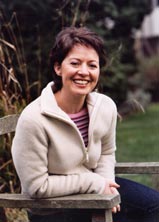 | | | | More about Helen Mark | | | | |
| | | | | | PROGRAMME DETAILS | | | |
| 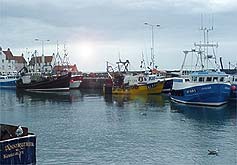 | | Fishing harbour at Pittenweem | |
Helen Mark travels to The Kingdom of Fife, an ancient land steeped in mystery, history and tradition. "Fife" was originally an old Danish word that meant "wooded country. Helen sails to the island of Inchcolm, named after St Columba, who was thought to have lived here in the 6th century. The monastery dates back to 1123, founded by Alexander III after he was rescued and sheltered here by a hermit when the King's boat capsized during a storm. The hermit's cell still exists. The monastery has has a turbulent history: it was raided several times by the English and by pirates. The abbey has also been set on fire and was finally ruined during the reformation. It is still one of the most impressive abbey ruins in Scotland and has been restored in recent times. One can climb the tower to the top floor dovecote. The island has been used as a hospital, quarantine station and fort. Several skeletons have been discovered, including one standing upright inside a wall of the Abbots House. The water off the shore at Inchcolm is known as Mortemeris Deep, a name believed to originate from William de Mortimer, a medieval Lord of Aberdour who upset the monks of Inchcolm so much that they murdered him and dropped his body in the deep waters hereabouts. Helen meets Doreen Grove, from Historic Scotland, who tells her of the island's recent history - its strategic position in the has meant it has been fortified and re-fortified throughout the last century. There are first and second world war gun emplacements. Things are obviously more peaceful now - apart that is from the dive bombing seagulls - as Ron Selly, the present warden who lives on the island for eight months, tells Helen.
History of Fife
Inchcolm Abbey
Helen visits artist and writer Marrianna Lines, who tells her about the Wemyss Caves. Most of the caves are near the village of East Wemyss. Over the centuries, the Wemyss Caves have
been used as dwellings, workplaces, and ceremonial sites for a variety of peoples, including the Picts and Scots. They're best known for their rock art carvings most of which is Pictish and dates from the fourth century. Some, such as the image of the Pictish warrior figure and glyphic symbol, commonly known as "Thor and His Goat" are said to be at least 1200 years old. In 1986, the Save the Ancient Wemyss Caves Society (SAWCS) was formed to help preserve the caves and their legacy and is seeking to get a better footpath established to the caves and, in the future, hopes to erect interpretation charts as part of visitor education.
The Wemyss Caves
Save the Wemyss Caves Society
Gazetteer for Scotland
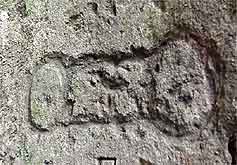 | | Double disc Pictish carving at East Wymess Caves | |
Helen next visits the fishing village of Pittenweem, home to the Fife fishing fleet. John Donaldson and Billy Hughes take Helen on a tour of the harbour and point out that fishing may be in a cycle of decline but they still have hope for the future and villages like Pittenweem are still carrying on the centuries-old tradition of fishing the North Sea. Pittenweem means "place of the cave" and it dates back to when a cave in old Cove Wynd was used as a place of worship by the missionary St Fillan during the seventh century. The cave was restored in 1935 and is still open to visitors. Inside there is the Saint Well and an altar where St Fillan used to write, reputedly aided by a luminous glow from his left arm.
Pittenweem
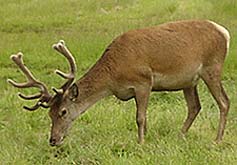 | | Stag at Reediehill Farm | |
Helen meets John and Nichola Fletcher, who established the first commercial deer farm in Europe at Reediehill Farm near Auchtermuchty nearly 30 years ago. The deer are grass fed and as Nichola tells Helen that makes for lean and healthy meat. They tell Helen about their 25 years of experience which has enabled them to build up a unique resource of specialised information.
The Fletchers of Auchtermuchty
This week's competition
What does the word Wymess mean? The prize is one of Marrianna Lines' wall hangings.
Last week's competition winner is Brenda Tillston of Liverpool, who knew that green is associated with Kendal.
Submit your entry by emailing open.country@bbc.co.uk
The BBC is not responsible for external websites | | |
RELATED LINKS
BBC Holiday Category
BBC Countryfile
| | | |
| | | | | | |  | | | | | | | | | Audio Help | | | | | | PREVIOUS PROGRAMMES | | | | | Current Week
Last Week
The A44
Aberdeenshire
Aberdeenshire, River Don
Aberfan
Alderley Edge, Cheshire
Ancient buildings
Anglesey
Applecross Peninsula
Aran Islands
Armistice Day, Somerset & Sussex
Auxiliary Units
Bardsey Island
Batsford Park Estate, Glos
Berkshire
Berwyn Mountains
Birdsong
Blackwater Estuary, Essex
Blaenafon
The Blean, Kent
Bosworth Field
Brecon Beacons
Buckinghamshire
Butterflies
By Brook Valley
The Cairngorms
Caithness
Cambridgeshire
Carmarthenshire
Cheddar Gorge
Cherwell Valley
Cheshire: Harrop Valley
Chesil Bank
Clee Hills, Shropshire
Climbers
Corfe Castle
Cornwall
Cornwall: Cape Cornwall
Cornwall: Padstow Lifeboat
Cornwall: Roseland Peninsula
Cotswold
Cotswold Way
County Clare, Ireland
Cranbourne Chase
Cumbria: Eden Valley
Cumbria: Coniston Water
Cumbria: Sellafield
Cumbria
Daingean in Glengarry
Dee Estuary
Derbyshire
Devon & Somerset: Grand Western Canal
Donegal
Dorset
Dorset: Cranborne Chase
Dorsetman
Dowsing
Dunalastair
Durham
Durham: Witton Park
East Anglian Churches
Eden Valley in Cumbria
Eigg
Eire: Co. Mayo
Eire: Skibbereen
Eire: West Cork
Elan Valley, Wales
Eshott, Norhumberland
Essex
Essex: coastal
Exmoor, churches
Falkirk
Farne Islands, Part 1
Farne Islands, Part 2
Fenn's, Whixall & Bettisfield Mosses National Nature Reserve
The Fens
Fife
Flanders
Forster Country
Glencoe Mountains
Glencoe
Gloucestershire
Goa
Goodwin Sands
Gower Peninsula, June 2006
Gower Peninsula, October 2005
Grouse shooting
Guernsey
Hadrian's Wall 2003
Hadrian's Wall 2004
Hambledon Cricket Club
Hampshire: Odium
Hampshire: Selborne
Hardcastle Crags
Heart of Wales Railway
Hebden Bridge
Herefordshire
Hertfordshire
Hidden Treasures
High Weald, Sussex
Holy Island
Ilmington
Isle of Gigha 2004
Isle of Gigha, 2005
Isle of Man - Seas
Isle of Man
Isle of Wight, 2003
Isle of Wight, 2005
Izak Walton
Kent: Dover
Kent: Dungeness Peninsular
Kent: North
Kielder Water
Kinver Edge
Kingham, Oxfordshire
Lake District
Leicestershire: Bosworth Field
Leicestershire: death rituals
Lincolshire farming
Lincolnshire
Lincolnshire
Loch Morar
Looe Island
Ludlow
Lunar Influence
Don McCullin
Richard Mabey
Marsden, West Yorkshire
Mary Towneley Loop
Mersea Island
Mersey Marshes
Metal Detectingg
Mid-Wales
Morecambe Bay
Moel Findeg, North Wales
Morecombe Sands
Nant Gwrtheyrn
National Forest
New Forest
Newton Dee, nr Aberdeen
Norfolk Broads
Norfolk: Thetford Forest
Norfolk: North Norfolk coast
North Devon Combes
Northants: Sulgrave Manor
Northants: Underground
Northern Ireland: Belfast
Northern Ireland: Border Counties
Northern Ireland: Moneypenny's Lock
Northern Ireland: Sperrin Mountains
Northern Ireland: Strangford Lough
Northern Ireland: Toomebridge
North Norfolk Coast
Northumberland, part 1
Northumberland, part 2
North Wessex Downs
North Yorkshire
North Yorkshire Moors
North Yorkshire Moors Railway
Nottinghamshire
Nottinghamshire: Sherwood Forest
Oak Trees
Offa's Dyke
Orford Ness
Orkneys
Out Skerries, Shetland
Outward Bound
Oxfordshire
Peak District
Peak District
Pembrokeshire Coast
Pentland Hills
Perthshire
Poachers
Pony Club
River Severn
Romney Marsh
Rutland Water
Scilly
Scotland: Abernethy Forest
Scotland: Loch Morar
Scotland: Shetland
Scotland: Strathclyde
Scotland: What value the countryside?
Scottish Borders
Sefton Coast
Self-sufficient communities
Severn Valley Railway
Shropshire: Ellesmere
Shropshire: Much Wenlock
Shropshire and Wales, Newport
Skegness
Skomer Island
Snowdon
Snowdonia National Park
Somerset Levels
Somerset Levels
Somerset: Montacute House
Somerset writers
South Downs
South Somerset: watermills
Southwold
Spurn Peninsular
Start Bay
Stour Valley
Survival
Sussex
Sutherland, Scotland
Tamar Valley
Thornham Estate, Suffolk
Thurstonland Cricket Club
Twyford Down
Tyntesfield, North Somerset
Village Life
Terry Waite
Wales
Wales: Flatholm Island
Wales: Nant Gwrtheyrn
Wales: Snowdonia
Warwickshire: rare breeds
Wayoh Reservoir
Wenlock Edge
West Sussex
West Yorks: Calder Valley
Weston Common, Surrey
Wild boar
Wiltshire
Wiltshire: Savernake Forest
Women's Institute
Wroxeter
Yorkshire Dales, June 2002
Yorkshire Dales, 1 July 2006
Yorkshire Dales, 8 July 2006
Z to Z Britain
Open Country looks back 2003
| | | | | MESSAGE BOARDS | | | | | Join the discussion:
The Learning Curve
Pick of the Week
Questions, Questions
Woman's Hour
Word of Mouth | | | | | RELATED PROGRAMMES | | | | | Excess Baggage
Changing Places
Similar programmes this week on Radio 4
| | |
|