| | | | | PROGRAMME INFO | | | |
| | | From Shetland to the Scilly Isles, Open Country travels the UK in search of the stories, the people and the wildlife that make our countryside such a vibrant place. Each week we visit a new area to hear how local people are growing the crops, protecting the environment, maintaining the traditions and cooking the food that makes their corner of rural Britain unique.
Email: open.country@bbc.co.uk
Postal address: Open Country,
BBC Radio 4, Birmingham, B5 7QQ.
| | | | | LISTEN AGAIN | | | |
|
|
| | PRESENTERS | | | |
|  | | | More about Helen Mark | | | |  | | | More about Richard Uridge | | | | |
| | | | | | PROGRAMME DETAILS | | | |
| 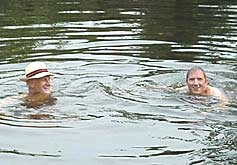 | Rob Fryer and Richard Uridge
| |
Richard Uridge travels to Wiltshire, a county famous for its beautiful landscapes and ancient monuments. He begins by diving into the River Frome with Rob Fryer. Rob has travelled the length and breadth of the country charting the many wild ponds and rivers where swimming has taken place. The Farleigh Hungerford swimming club, Britain's oldest river swimming club, was founded in 1930. He explains how people always swam this way for reasons of economy and because there were no other facilities. He tells Richard how new swimming pools in the 1960s and environmental pollution took people away from the great outdoors. Now anybody thinking of swimming in ponds and rivers is considered weird or eccentric and as acting irresponsibly - which Rob is keen to refute. While he accepts there are dangers, he believes common sense should prevail and people should be given the opportunity to look out for themselves and commune with nature. He's produced a guide to swimming around Britain called Rob's Directory of Cool Places in which he uses personal experience and the advice of locals to describe where it is safe to swim.
Wiltshire Tourist Board
Wild swimming
Richard meets Katy Jordan who's an expert on ancient wells at Bratton. They go down a track to Lady Well. The well-house is built of dressed stone with a squared-off doorway out of which flows a vigorous stream. The roof is pitched with overgrown ivy. Wiltshire has around 19 ancient wells and springs. A small number are holy wells, which would have been used by the church; the rest are healing wells, which would have been used to treat a range of ailments - in some cases right up to the 20th century. Many wells became famous and sought after and attributed with valuable properties. The well at the George Inn in Biddestone was said to have cured the landlady's hysterical fits while Salts Hole at Purton Stoke is described as being good for "digestive, liver and kidney ailments, gout, skin complaints, rheumatism, sciatica, bronchial and glandular illnesses, and being unhinged".
Wells info
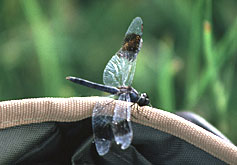 | Dragonfly
| |
Richard meets Wiltshire naturalist Jean Matthews at Priddy Mineries. She's an expert on beautiful flying insects. She has turned her attention to photographing dragonflies. The surface of a pond is alive dragonflies: Emperors, Migrant Hawkers, Southern Hawkers and Common Hawkers, which are the largest of all and quite unique to this part of the county. Britain has lost three species of dragonfly in the last 40 years and a third of the remainder are threatened with extinction. Richard and Jean watch them dart and weave in the sunshine.
British Dragonfly Society
Richard next visits Simon Cain, a bio-engineer who's developed techniques for restoring and improving waterways. Self-taught and based on experience of good natural habitat, he developed a technique of using faggots, or woven branches, which are set into river banks and beds and which slow the flow of water and provide shelter and food for plants, fish and other wildlife. On the Kennet and Avon canal, Simon shows Richard how these "mattresses" soon become colonised with plants which provide an environmentally-friendly shield against the erosion caused by wash from the boats and the burrowing of water voles. Simon thinks many waterways have become sterile and featureless through bad management, neglect and a lack of foresight and that concrete and steel solutions are not the answer.
The River Doctor
Richard can't leave Wiltshire without tasting watercress. John Hurd has been producing watercress for 50 years. He farms 5½ acres on the edge of the Wiltshire Downs and his 47 beds are fed every day with three million gallons of pure spring water pumped up from bore holes 120ft down in the chalky land. Originally the son of a dairy farmer, he hit upon the idea of watercress. Today he produces organic watercress which is sold as far afield as Scotland - taking less than a day from field to market - as well as restaurants and supermarkets. He grows a winter variety and a summer variety, each responds better to different temperatures. His summer variety has been registered as the "John Hurd Special 98". Richard learns that watercress contains more Vitamin C than fresh oranges and more calcium that cow's milk.
Watercress info and recipesThe BBC is not responsible for external websites | | |
RELATED LINKS
BBC Holiday Category
BBC Countryfile
| | |
| | | | | | |  | | | | | | | | | Audio Help | | | | | | PREVIOUS PROGRAMMES | | | | | Current Week
Last Week
The A44
Aberdeenshire
Aberdeenshire, River Don
Aberfan
Alderley Edge, Cheshire
Ancient buildings
Anglesey
Applecross Peninsula
Aran Islands
Armistice Day, Somerset & Sussex
Auxiliary Units
Bardsey Island
Batsford Park Estate, Glos
Berkshire
Berwyn Mountains
Birdsong
Blackwater Estuary, Essex
Blaenafon
The Blean, Kent
Bosworth Field
Brecon Beacons
Buckinghamshire
Butterflies
By Brook Valley
The Cairngorms
Caithness
Cambridgeshire
Carmarthenshire
Cheddar Gorge
Cherwell Valley
Cheshire: Harrop Valley
Chesil Bank
Clee Hills, Shropshire
Climbers
Corfe Castle
Cornwall
Cornwall: Cape Cornwall
Cornwall: Padstow Lifeboat
Cornwall: Roseland Peninsula
Cotswold
Cotswold Way
County Clare, Ireland
Cranbourne Chase
Cumbria: Eden Valley
Cumbria: Coniston Water
Cumbria: Sellafield
Cumbria
Daingean in Glengarry
Dee Estuary
Derbyshire
Devon & Somerset: Grand Western Canal
Donegal
Dorset
Dorset: Cranborne Chase
Dorsetman
Dowsing
Dunalastair
Durham
Durham: Witton Park
East Anglian Churches
Eden Valley in Cumbria
Eigg
Eire: Co. Mayo
Eire: Skibbereen
Eire: West Cork
Elan Valley, Wales
Eshott, Norhumberland
Essex
Essex: coastal
Exmoor, churches
Falkirk
Farne Islands, Part 1
Farne Islands, Part 2
Fenn's, Whixall & Bettisfield Mosses National Nature Reserve
The Fens
Fife
Flanders
Forster Country
Glencoe Mountains
Glencoe
Gloucestershire
Goa
Goodwin Sands
Gower Peninsula, June 2006
Gower Peninsula, October 2005
Grouse shooting
Guernsey
Hadrian's Wall 2003
Hadrian's Wall 2004
Hambledon Cricket Club
Hampshire: Odium
Hampshire: Selborne
Hardcastle Crags
Heart of Wales Railway
Hebden Bridge
Herefordshire
Hertfordshire
Hidden Treasures
High Weald, Sussex
Holy Island
Ilmington
Isle of Gigha 2004
Isle of Gigha, 2005
Isle of Man - Seas
Isle of Man
Isle of Wight, 2003
Isle of Wight, 2005
Izak Walton
Kent: Dover
Kent: Dungeness Peninsular
Kent: North
Kielder Water
Kinver Edge
Kingham, Oxfordshire
Lake District
Leicestershire: Bosworth Field
Leicestershire: death rituals
Lincolshire farming
Lincolnshire
Lincolnshire
Loch Morar
Looe Island
Ludlow
Lunar Influence
Don McCullin
Richard Mabey
Marsden, West Yorkshire
Mary Towneley Loop
Mersea Island
Mersey Marshes
Metal Detectingg
Mid-Wales
Morecambe Bay
Moel Findeg, North Wales
Morecombe Sands
Nant Gwrtheyrn
National Forest
New Forest
Newton Dee, nr Aberdeen
Norfolk Broads
Norfolk: Thetford Forest
Norfolk: North Norfolk coast
North Devon Combes
Northants: Sulgrave Manor
Northants: Underground
Northern Ireland: Belfast
Northern Ireland: Border Counties
Northern Ireland: Moneypenny's Lock
Northern Ireland: Sperrin Mountains
Northern Ireland: Strangford Lough
Northern Ireland: Toomebridge
North Norfolk Coast
Northumberland, part 1
Northumberland, part 2
North Wessex Downs
North Yorkshire
North Yorkshire Moors
North Yorkshire Moors Railway
Nottinghamshire
Nottinghamshire: Sherwood Forest
Oak Trees
Offa's Dyke
Orford Ness
Orkneys
Out Skerries, Shetland
Outward Bound
Oxfordshire
Peak District
Peak District
Pembrokeshire Coast
Pentland Hills
Perthshire
Poachers
Pony Club
River Severn
Romney Marsh
Rutland Water
Scilly
Scotland: Abernethy Forest
Scotland: Loch Morar
Scotland: Shetland
Scotland: Strathclyde
Scotland: What value the countryside?
Scottish Borders
Sefton Coast
Self-sufficient communities
Severn Valley Railway
Shropshire: Ellesmere
Shropshire: Much Wenlock
Shropshire and Wales, Newport
Skegness
Skomer Island
Snowdon
Snowdonia National Park
Somerset Levels
Somerset Levels
Somerset: Montacute House
Somerset writers
South Downs
South Somerset: watermills
Southwold
Spurn Peninsular
Start Bay
Stour Valley
Survival
Sussex
Sutherland, Scotland
Tamar Valley
Thornham Estate, Suffolk
Thurstonland Cricket Club
Twyford Down
Tyntesfield, North Somerset
Village Life
Terry Waite
Wales
Wales: Flatholm Island
Wales: Nant Gwrtheyrn
Wales: Snowdonia
Warwickshire: rare breeds
Wayoh Reservoir
Wenlock Edge
West Sussex
West Yorks: Calder Valley
Weston Common, Surrey
Wild boar
Wiltshire
Wiltshire: Savernake Forest
Women's Institute
Wroxeter
Yorkshire Dales, June 2002
Yorkshire Dales, 1 July 2006
Yorkshire Dales, 8 July 2006
Z to Z Britain
Open Country looks back 2003
| | | | | MESSAGE BOARDS | | | | | Join the discussion:
The Learning Curve
Pick of the Week
Questions, Questions
Woman's Hour
Word of Mouth | | | | | RELATED PROGRAMMES | | | | | Excess Baggage
Changing Places
Similar programmes this week on Radio 4
| | |
|