Richard Uridge visits the North Wessex Downs. The county is an Area of Outstanding Natural Beauty and covers one of the largest expanses of chalk downland in southern England. It stretches from Marlborough across the Berkshire and North Hampshire Downs and ends to the west just above the White Horse Vale.
Countryside Agency info
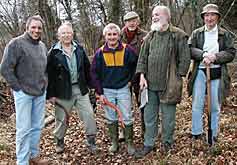
Richard finds that he has to get to work when he meets Dick Greenaway and other members of the Pang Valley Conservation Group, who immediately give him a saw and get him cutting up logs. Dick is Warden of Ancient Woodland at Ashampstead and the volunteers are working in an area which used to be a 13th century deer park. This was an area of woodland, enclosed by a bank and ditch which trapped the animals which were later hunted. The parks were the ultimate status symbol as it was illegal to sell venison and giving venison as a gift, or giving someone a couple of deer to start their own herd was very significant. But the area has become overgrown and over the past three years the volunteers have spent weekends clearing all the scrub. The soil has not been ploughed for years due to the overgrowth and means that seeds and plants from way back in the past will still be present. The idea is to clear the scrub and allow light and water to get to the soil so that these seeds and plants can grow and gradually native flora will return. In turn insects and birds, who perhaps once lived there many years ago, will return.
Pang Valley Conservation
At the Northmoor Trust at Little Wittenham, Richard finds a solution to a different problem with trees. Farmers are encouraged to plant trees, but most new forests don't start to pay their way for 25 years, when the first thinnings appear. Gabriel Hemery says the answer is chickens - they are actually jungle creatures which like to roam and, if let loose in new woodland, can provide a cash crop while the trees grow. Gabriel's team is trialling the Poultry in Natural Environments scheme (PINE). They're studying the effect of the chickens and their droppings on the trees and of course, the life of the chickens themselves. The birds are housed in state-of-the-art arks which feature automated feeders and waterers which are solar and wind powered. Already a major supermarket is selling the birds oven-ready.
PINE Project
Flooding after heavy rains is a common enough story as our climate changes. But at the village of East Ilsley, Richard discovers the inhabitants have a different kind of flooding problem. Lisa Davis had just finished renovating her dream cottage when she discovered water bubbling up from the floor. Before long the whole house was covered in five inches of water and for months the house was completely uninhabitable. It was only later that she was to discover the flooding is due to unique circumstances: much of the North Wessex Downs is built on a chalk aquifer. This makes it very difficult for water to drain away because under the chalk is clay which holds the water in. When the chalk takes on too much water the only place for it to come out is up through the ground, as fellow villager Bob Moulton explains.
 |
Richard Uridge and Jill Scrivener
|  |
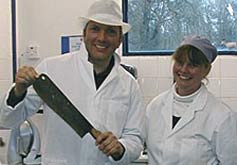
Although it doesn't sound seasonal, Richard visits Christmas Farm where Jill Scrivener appropriately enough raises turkeys, among other things. Jill and her husband started farming more by accident than design - 10 years ago they had some chickens which had to start paying for themselves. So they started egg collecting and selling and things have grown from there. Now they have a wide variety of stock on their free-range farm and they work in seasons like it was half a century ago. They've learnt skills as they go along, including butchery. Richard gets a lesson from Jill on how to cut a pig carcass into suitable portions and ends up with lovely chops for his dinner.
Christmas Farm The BBC is not responsible for external websites |
|
|
RELATED LINKS
Food Programme Food Awards 2002
BBC Holiday Category
BBC Countryfile
| |