| | | | | PROGRAMME INFO | | | |
| | | From Shetland to the Scilly Isles, Open Country travels the UK in search of the stories, the people and the wildlife that make our countryside such a vibrant place. Each week we visit a new area to hear how local people are growing the crops, protecting the environment, maintaining the traditions and cooking the food that makes their corner of rural Britain unique.
Email: open.country@bbc.co.uk
Postal address: Open Country,
BBC Radio 4, Birmingham, B5 7QQ.
| | | | | LISTEN AGAIN | | | |
|
|
| | PRESENTER | | | |
|  | | | | More about Helen Mark | | | | |
| | | | | | PROGRAMME DETAILS | | | |
| 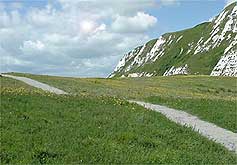 | | Samphire Hoe | | This week's presenter is Charlotte Smith, who visits Dover on the south coast
Dover and the White Cliffs hold iconic status in British history, famous as a symbol of resistance in World War II, they have been central to the history of these islands for the last 2000 years. But what makes them white?
Geologist Paul Haddaway explains that the chalk of north west Europe was deposited on the continental shelf during the early stages of the opening of the Atlantic Ocean. The sea level was higher than present day when the rock in Kent was being laid down in a depths ranging from 100-300m. The rock is part of the Upper Cretaceous and ranges in age from about 65 to 100 million years.
The chalk is comprised of pure fine-grained limestone in layers 300-400m thick. The rock is made up of coccolith biomicrites - the skeletal remains of minute planktonic green algae as well as fragments of bivalves (clams, mussels etc). The plankton lived floating in the upper levels of the oceans and when they died their skeletons sank to the bottom combining with the remains of bottom living bivalves. Seams of flint are often found in upper layers and these are the silica remains of sponges. The rock often shows variations of up to a metre which has been linked to variation in the climate at the time of deposition. The fossil content in NW Europe with its abundance and diversity of the plankton indicates tropical water temperatures of 20ºC or more.
While most people consider chalk to be white in colour, when weathered it can be grey and red (due to iron staining). There are also red chalks, in Norfolk, Yorkshire and the North Sea; grey, Craie Grise in France; and green, in beds containing deposits of glauconite. Chalk also contains varying levels of clay. In England chalk marl was deposited near the base levels and this grey and relatively impermeable level was the main section used in the creation of the Channel Tunnel.
Charlotte goes on to meet archaeologist Brian Philp at the Roman Painted House. Built about AD 200 the site formed part of a large mansion or official hotel for travellers crossing the Channel. It stood outside the great naval fort of the Classis Britannica, but in AD 270 it was demolished by the Roman army during the construction of a larger fort. Three of its main rooms were then buried substantially intact under its ramparts. The burial by the army resulted in the unique survival of over 400 sq ft of painted plaster, the most extensive ever found north of the Alps. Above a lower dado, of red or green, one can still see an architectural scheme of multi-coloured panels framed by fluted columns. The columns sit on projecting bases above a stage, producing a 3D effect. Parts of 28 panels survive, each with a motif relating to Bacchus, the Roman god of wine. The walls in four rooms survive to a height of 4 to 6ft and the hard red concrete floors cover substantially complete central-heating systems. One can also see the large arched flues, the various heating channels and the vertical wall-flues that kept the building warm 1,800 years ago.
Roman Painted House
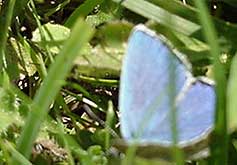 Charlotte next finds out about the regeneration of the Folkstone Downs. Phil Green, Project Officer for White Cliffs, tells her that there are about 60 species of butterfly known in Britain and out of these 32, one of which is the rare Adonis Blue, have been found on the Folkestone Downs. The area was overgrown and neglected until a project began 12 years ago to restore the area and butterflies and wildlife have increased. The Adonis Blue is one of the most characteristic species of southern chalk downland, where it flies low over short-grazed turf. The males have brilliant sky-blue wings while the females are brown and far less conspicuous. Both sexes have distinctive black lines that enter or cross the white fringes to the wings. Charlotte next finds out about the regeneration of the Folkstone Downs. Phil Green, Project Officer for White Cliffs, tells her that there are about 60 species of butterfly known in Britain and out of these 32, one of which is the rare Adonis Blue, have been found on the Folkestone Downs. The area was overgrown and neglected until a project began 12 years ago to restore the area and butterflies and wildlife have increased. The Adonis Blue is one of the most characteristic species of southern chalk downland, where it flies low over short-grazed turf. The males have brilliant sky-blue wings while the females are brown and far less conspicuous. Both sexes have distinctive black lines that enter or cross the white fringes to the wings.
New land has been made from the material dug out for the Channel Tunnel, an area a mile by a third of a mile. It was a huge industrial area while the tunnel was under construction, built at the bottom of the cliffs with huge sea walls at the far edge. A hundred and seventy species of plant, including rare spider orchids, are flourishing and butterflies and skylarks abound. Paul Holt, of the White Cliffs Countryside Project, talks to Charlotte about the ecology of Samphire Hoe, the intentional introduction of species as well as natural colonisation and how continual accession will change the nature and shape of the site.
Samphire Hoe
John Iverson, Curator at Dover Museum, introduces Charlotte to the Napoleonic Defenses. The Grand Shaft, located in Snargate Street, Dover is a unique triple staircase built during the Napolionic Wars and is part of major fortifications on the Western Heights designed to guard against a French Invasion. Designed by Colonel Twiss, the three staircases wind clockwise one above the other down a central brick shaft. Light enters through the open top and through windows in the inside wall. Built between 1806 and 1809 it allowed rapid and safe movement of troops garrisoned in the barracks on the Western Heights, down to the town and harbour to defend it in case of invasion. The staircase could also be used for swift withdrawal to the heavily defended and fortified Western Heights. At the bottom of the shaft there used to be a guardhouse with cells for soldiers too drunk to climb the stairs after a night in the local pubs. After the threat of invasion passed, the three staircases became segregated, and the use of a particular staircase was restricted, it is said, to: "Officers and their Ladies, Sergeants and their Wives and Soldiers and their Women." The staircase was then used as a dumping ground and left in ruins til the 1980s when it was restored to its full engineering marvel.
Alan Edgerton talks to Charlotte about the labyrinth of tunnels leading from the spiral staircase and their variety of uses over the years: including smuggling, the coastguard, military warehouses, air raid shelters, and underground hospital, with graffiti from the War still etched into the walls in some places.
Dover Museum
This week's competition
William Twiss, the army engineer who designed the Great Shaft at Dover, also built a fleet of boats to ferry the British Army across one of the great lakes in Canada - which lake did they cross?
Last week's winner is Penny Beale, from Hastings in East Sussex.
Submit your entry by emailing open.country@bbc.co.uk
The BBC is not responsible for external websites | | |
RELATED LINKS
BBC Holiday Category
BBC Countryfile
| |
| | | | | | |  | | | | | | | | | Audio Help | | | | | | PREVIOUS PROGRAMMES | | | | | Current Week
Last Week
The A44
Aberdeenshire
Aberdeenshire, River Don
Aberfan
Alderley Edge, Cheshire
Ancient buildings
Anglesey
Applecross Peninsula
Aran Islands
Armistice Day, Somerset & Sussex
Auxiliary Units
Bardsey Island
Batsford Park Estate, Glos
Berkshire
Berwyn Mountains
Birdsong
Blackwater Estuary, Essex
Blaenafon
The Blean, Kent
Bosworth Field
Brecon Beacons
Buckinghamshire
Butterflies
By Brook Valley
The Cairngorms
Caithness
Cambridgeshire
Carmarthenshire
Cheddar Gorge
Cherwell Valley
Cheshire: Harrop Valley
Chesil Bank
Clee Hills, Shropshire
Climbers
Corfe Castle
Cornwall
Cornwall: Cape Cornwall
Cornwall: Padstow Lifeboat
Cornwall: Roseland Peninsula
Cotswold
Cotswold Way
County Clare, Ireland
Cranbourne Chase
Cumbria: Eden Valley
Cumbria: Coniston Water
Cumbria: Sellafield
Cumbria
Daingean in Glengarry
Dee Estuary
Derbyshire
Devon & Somerset: Grand Western Canal
Donegal
Dorset
Dorset: Cranborne Chase
Dorsetman
Dowsing
Dunalastair
Durham
Durham: Witton Park
East Anglian Churches
Eden Valley in Cumbria
Eigg
Eire: Co. Mayo
Eire: Skibbereen
Eire: West Cork
Elan Valley, Wales
Eshott, Norhumberland
Essex
Essex: coastal
Exmoor, churches
Falkirk
Farne Islands, Part 1
Farne Islands, Part 2
Fenn's, Whixall & Bettisfield Mosses National Nature Reserve
The Fens
Fife
Flanders
Forster Country
Glencoe Mountains
Glencoe
Gloucestershire
Goa
Goodwin Sands
Gower Peninsula, June 2006
Gower Peninsula, October 2005
Grouse shooting
Guernsey
Hadrian's Wall 2003
Hadrian's Wall 2004
Hambledon Cricket Club
Hampshire: Odium
Hampshire: Selborne
Hardcastle Crags
Heart of Wales Railway
Hebden Bridge
Herefordshire
Hertfordshire
Hidden Treasures
High Weald, Sussex
Holy Island
Ilmington
Isle of Gigha 2004
Isle of Gigha, 2005
Isle of Man - Seas
Isle of Man
Isle of Wight, 2003
Isle of Wight, 2005
Izak Walton
Kent: Dover
Kent: Dungeness Peninsular
Kent: North
Kielder Water
Kinver Edge
Kingham, Oxfordshire
Lake District
Leicestershire: Bosworth Field
Leicestershire: death rituals
Lincolshire farming
Lincolnshire
Lincolnshire
Loch Morar
Looe Island
Ludlow
Lunar Influence
Don McCullin
Richard Mabey
Marsden, West Yorkshire
Mary Towneley Loop
Mersea Island
Mersey Marshes
Metal Detectingg
Mid-Wales
Morecambe Bay
Moel Findeg, North Wales
Morecombe Sands
Nant Gwrtheyrn
National Forest
New Forest
Newton Dee, nr Aberdeen
Norfolk Broads
Norfolk: Thetford Forest
Norfolk: North Norfolk coast
North Devon Combes
Northants: Sulgrave Manor
Northants: Underground
Northern Ireland: Belfast
Northern Ireland: Border Counties
Northern Ireland: Moneypenny's Lock
Northern Ireland: Sperrin Mountains
Northern Ireland: Strangford Lough
Northern Ireland: Toomebridge
North Norfolk Coast
Northumberland, part 1
Northumberland, part 2
North Wessex Downs
North Yorkshire
North Yorkshire Moors
North Yorkshire Moors Railway
Nottinghamshire
Nottinghamshire: Sherwood Forest
Oak Trees
Offa's Dyke
Orford Ness
Orkneys
Out Skerries, Shetland
Outward Bound
Oxfordshire
Peak District
Peak District
Pembrokeshire Coast
Pentland Hills
Perthshire
Poachers
Pony Club
River Severn
Romney Marsh
Rutland Water
Scilly
Scotland: Abernethy Forest
Scotland: Loch Morar
Scotland: Shetland
Scotland: Strathclyde
Scotland: What value the countryside?
Scottish Borders
Sefton Coast
Self-sufficient communities
Severn Valley Railway
Shropshire: Ellesmere
Shropshire: Much Wenlock
Shropshire and Wales, Newport
Skegness
Skomer Island
Snowdon
Snowdonia National Park
Somerset Levels
Somerset Levels
Somerset: Montacute House
Somerset writers
South Downs
South Somerset: watermills
Southwold
Spurn Peninsular
Start Bay
Stour Valley
Survival
Sussex
Sutherland, Scotland
Tamar Valley
Thornham Estate, Suffolk
Thurstonland Cricket Club
Twyford Down
Tyntesfield, North Somerset
Village Life
Terry Waite
Wales
Wales: Flatholm Island
Wales: Nant Gwrtheyrn
Wales: Snowdonia
Warwickshire: rare breeds
Wayoh Reservoir
Wenlock Edge
West Sussex
West Yorks: Calder Valley
Weston Common, Surrey
Wild boar
Wiltshire
Wiltshire: Savernake Forest
Women's Institute
Wroxeter
Yorkshire Dales, June 2002
Yorkshire Dales, 1 July 2006
Yorkshire Dales, 8 July 2006
Z to Z Britain
Open Country looks back 2003
| | | | | MESSAGE BOARDS | | | | | Join the discussion:
The Learning Curve
Pick of the Week
Questions, Questions
Woman's Hour
Word of Mouth | | | | | RELATED PROGRAMMES | | | | | Excess Baggage
Changing Places
Similar programmes this week on Radio 4
| | |
|