| | | | | PROGRAMME INFO | | | |
| | | From Shetland to the Scilly Isles, Open Country travels the UK in search of the stories, the people and the wildlife that make our countryside such a vibrant place. Each week we visit a new area to hear how local people are growing the crops, protecting the environment, maintaining the traditions and cooking the food that makes their corner of rural Britain unique.
Email: open.country@bbc.co.uk
Postal address: Open Country,
BBC Radio 4, Birmingham, B5 7QQ.
| | | | | LISTEN AGAIN | | | |
|
|
| | PRESENTER | | | |
|  | | | | More about Helen Mark | | | | |
| | | | | | PROGRAMME DETAILS | | | |
| 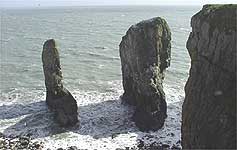 | |
Helen Mark visits the Pembrokeshire Coast, a place of outstanding natural beauty on the western edge of Wales. It's home to some of the most ruggedly beautiful landscape in the world - a county of hidden bays and inlets with golden sandy beaches, spectacular sheer limestone cliffs and rocky islands, such as Skomer - a wildlife haven providing a home to thousands of seabirds such as the puffin and guillemot. Seals bask on its shoreline and it's also a sanctuary for rare wild flowers. Castles such as Pembroke and Manorbier hug the coastline, the remains of Iron Age settlements are buried in almost every field: it seems that everywhere you look in Pembrokeshire, the landscape will offer up a fascinating story.
Pembrokeshire Coast Path
Pembrokeshire Coast
Pembrokeshire Online
Helen begins her journey with Bob Haycocks from the Countryside Council of Wales. He joins her perched on the edge of the cliffs at Stackpole. The cliffs are mainly carboniferous limestone, spectacularly wild and rugged, full of caves with a scattering of arches, blow holes and stacks. This imposing coastline provides a home-from-home for a wide variety of birdlife from pied wagtails to razorbills - but at this time of the year the nesting guillemots are pouring onto the cliffs in their thousands, colonising whole cliff faces and it's the incessant calling of the agitated guillemots as they negotiate a space on the cliff top that begin this week's programme.
Stackpole is also home to the chough, a much rarer bird. A handsome member of the crow family with curved red bill, red legs and finger-like wing tips, they nest in caves and holes in the cliffs and feed on insects - ants and daddy-long-legs larvæ are their favourites - which they poke out of the ground with their bills. Bob and Helen are lucky enough to spot a breeding pair soaring and diving above the cliff tops as they go looking for food.
National Trust, Pembrokeshire Coast
UK Birding
John Baynham has farmed for all of his 70 years at Penlen farm on St David's Head. The farm is owned by the church and John, like his father before him, is a tenant farmer. It boasts 200 acres and John has 160 pedigree Welsh black cattle which he sells to local shops and restaurants. Each animal he sells comes with a certificate guaranteeing to any customer the origin of the beef. Each of John's animals can be traced back not only to the day it was born but to the very cow that gave it life. John inherited his love of Welsh black cattle from his father who began rearing the breed at the turn of the 19th century. In this part of Wales both the farmers and cattle are a hardy breed. Even in such a wild and windy place as the headland at St David's, where the Atlantic comes roaring in during the winter months, the cattle are kept in the fields all year round - a true testament to their ability to survive.
Phil Bennet is an archaeologist and manager of Castell Henllys (Welsh for Castle of the Prince's court) a beautifully conserved Iron Age fort complete with re-constructed thatched roundhouses. He takes Helen on a tour of the site, which has seen excavations 20 years. With the roundhouses at its heart, the fort at Castell Henllys lies in a peaceful river valley surrounded by woodland. It was built both to repel any raiding neighbouring tribe and serve as an impressive reminder of the power of its owner: it has its own chariot trap, or cheveux-de-frise, which was recently discovered, is a pit containing jagged sharpened stones jutting out spear-like in the direction of any attacking enemy. It was designed to stop any direct assault on the fort by chariots, slowing them enough to leave the charioteers exposed to attack from the warriors manning the ramparts, who would then use slingshots to rain down stones and rocks.
Most of the tribe would live outside the fort either farming or looking after livestock. The fort itself was reserved for the chieftain, his or her immediate family and their coterie of retainers. The re-constructed roundhouses were built from oak and water reeds criss-crossed with narrow bands of wattle designed to hold the shape together.
Castell Henllys
Finally Helen travelled to the North Pemrokeshire port of Fishguard. There she met teacher and historian Bill Fowler. They stood on a hill overlooking the harbour where, on Wednesday 22 February 1797, 1400 French troops landed in the last invasion of mainland Britain. It was all part of a grander French plan to invade Ireland. The French main force was to land in Ireland and with the help of the locals begin a revolt that would see the British forced out. As part of the plan two smaller forces were sent to mainland Britain: they were to attack and ransack the strategic ports of Liverpool and Bristol to stop any re-inforcements leaving for Ireland. But the weather, as usual, came to the aid of the British and the main French force was blown off course as was one of the two smaller French forces - leaving the invasion of Fishguard as the only part of the plan to survive.
Fishguard wasn't heavily defended, but the French mistook the women standing on the hillside dressed in traditional Welsh costume - red tunics and tall black hats - as British redcoats and, thinking they were hopelessly outnumbered, they surrendered. To late they realised that they in fact out-numbered the British soldiers by three to one.
Historic UK Accommodation Guide
Next week Helen will be in the Calder valley.
This week's competition: which maritime film was made in Fishguard in the 1960s?
Submit your entry by emailing open.country@bbc.co.uk
Last week's winner is Sughra Nazir of Bradford, who correctly said that myrtle, a favourite plant of Roman gardeners, and still used in bridal bouquets, was associated by the Romans with Venus, goddess of Love.
The BBC is not responsible for external websites | | |
RELATED LINKS
BBC Holiday Category
BBC Countryfile
| |
| | | | | | |  | | | | | | | | | Audio Help | | | | | | PREVIOUS PROGRAMMES | | | | | Current Week
Last Week
The A44
Aberdeenshire
Aberdeenshire, River Don
Aberfan
Alderley Edge, Cheshire
Ancient buildings
Anglesey
Applecross Peninsula
Aran Islands
Armistice Day, Somerset & Sussex
Auxiliary Units
Bardsey Island
Batsford Park Estate, Glos
Berkshire
Berwyn Mountains
Birdsong
Blackwater Estuary, Essex
Blaenafon
The Blean, Kent
Bosworth Field
Brecon Beacons
Buckinghamshire
Butterflies
By Brook Valley
The Cairngorms
Caithness
Cambridgeshire
Carmarthenshire
Cheddar Gorge
Cherwell Valley
Cheshire: Harrop Valley
Chesil Bank
Clee Hills, Shropshire
Climbers
Corfe Castle
Cornwall
Cornwall: Cape Cornwall
Cornwall: Padstow Lifeboat
Cornwall: Roseland Peninsula
Cotswold
Cotswold Way
County Clare, Ireland
Cranbourne Chase
Cumbria: Eden Valley
Cumbria: Coniston Water
Cumbria: Sellafield
Cumbria
Daingean in Glengarry
Dee Estuary
Derbyshire
Devon & Somerset: Grand Western Canal
Donegal
Dorset
Dorset: Cranborne Chase
Dorsetman
Dowsing
Dunalastair
Durham
Durham: Witton Park
East Anglian Churches
Eden Valley in Cumbria
Eigg
Eire: Co. Mayo
Eire: Skibbereen
Eire: West Cork
Elan Valley, Wales
Eshott, Norhumberland
Essex
Essex: coastal
Exmoor, churches
Falkirk
Farne Islands, Part 1
Farne Islands, Part 2
Fenn's, Whixall & Bettisfield Mosses National Nature Reserve
The Fens
Fife
Flanders
Forster Country
Glencoe Mountains
Glencoe
Gloucestershire
Goa
Goodwin Sands
Gower Peninsula, June 2006
Gower Peninsula, October 2005
Grouse shooting
Guernsey
Hadrian's Wall 2003
Hadrian's Wall 2004
Hambledon Cricket Club
Hampshire: Odium
Hampshire: Selborne
Hardcastle Crags
Heart of Wales Railway
Hebden Bridge
Herefordshire
Hertfordshire
Hidden Treasures
High Weald, Sussex
Holy Island
Ilmington
Isle of Gigha 2004
Isle of Gigha, 2005
Isle of Man - Seas
Isle of Man
Isle of Wight, 2003
Isle of Wight, 2005
Izak Walton
Kent: Dover
Kent: Dungeness Peninsular
Kent: North
Kielder Water
Kinver Edge
Kingham, Oxfordshire
Lake District
Leicestershire: Bosworth Field
Leicestershire: death rituals
Lincolshire farming
Lincolnshire
Lincolnshire
Loch Morar
Looe Island
Ludlow
Lunar Influence
Don McCullin
Richard Mabey
Marsden, West Yorkshire
Mary Towneley Loop
Mersea Island
Mersey Marshes
Metal Detectingg
Mid-Wales
Morecambe Bay
Moel Findeg, North Wales
Morecombe Sands
Nant Gwrtheyrn
National Forest
New Forest
Newton Dee, nr Aberdeen
Norfolk Broads
Norfolk: Thetford Forest
Norfolk: North Norfolk coast
North Devon Combes
Northants: Sulgrave Manor
Northants: Underground
Northern Ireland: Belfast
Northern Ireland: Border Counties
Northern Ireland: Moneypenny's Lock
Northern Ireland: Sperrin Mountains
Northern Ireland: Strangford Lough
Northern Ireland: Toomebridge
North Norfolk Coast
Northumberland, part 1
Northumberland, part 2
North Wessex Downs
North Yorkshire
North Yorkshire Moors
North Yorkshire Moors Railway
Nottinghamshire
Nottinghamshire: Sherwood Forest
Oak Trees
Offa's Dyke
Orford Ness
Orkneys
Out Skerries, Shetland
Outward Bound
Oxfordshire
Peak District
Peak District
Pembrokeshire Coast
Pentland Hills
Perthshire
Poachers
Pony Club
River Severn
Romney Marsh
Rutland Water
Scilly
Scotland: Abernethy Forest
Scotland: Loch Morar
Scotland: Shetland
Scotland: Strathclyde
Scotland: What value the countryside?
Scottish Borders
Sefton Coast
Self-sufficient communities
Severn Valley Railway
Shropshire: Ellesmere
Shropshire: Much Wenlock
Shropshire and Wales, Newport
Skegness
Skomer Island
Snowdon
Snowdonia National Park
Somerset Levels
Somerset Levels
Somerset: Montacute House
Somerset writers
South Downs
South Somerset: watermills
Southwold
Spurn Peninsular
Start Bay
Stour Valley
Survival
Sussex
Sutherland, Scotland
Tamar Valley
Thornham Estate, Suffolk
Thurstonland Cricket Club
Twyford Down
Tyntesfield, North Somerset
Village Life
Terry Waite
Wales
Wales: Flatholm Island
Wales: Nant Gwrtheyrn
Wales: Snowdonia
Warwickshire: rare breeds
Wayoh Reservoir
Wenlock Edge
West Sussex
West Yorks: Calder Valley
Weston Common, Surrey
Wild boar
Wiltshire
Wiltshire: Savernake Forest
Women's Institute
Wroxeter
Yorkshire Dales, June 2002
Yorkshire Dales, 1 July 2006
Yorkshire Dales, 8 July 2006
Z to Z Britain
Open Country looks back 2003
| | | | | MESSAGE BOARDS | | | | | Join the discussion:
The Learning Curve
Pick of the Week
Questions, Questions
Woman's Hour
Word of Mouth | | | | | RELATED PROGRAMMES | | | | | Excess Baggage
Changing Places
Similar programmes this week on Radio 4
| | |
|