| | | | | PROGRAMME INFO | | | |
| | | From Shetland to the Scilly Isles, Open Country travels the UK in search of the stories, the people and the wildlife that make our countryside such a vibrant place. Each week we visit a new area to hear how local people are growing the crops, protecting the environment, maintaining the traditions and cooking the food that makes their corner of rural Britain unique.
Email: open.country@bbc.co.uk
Postal address: Open Country,
BBC Radio 4, Birmingham, B5 7QQ.
| | | | | LISTEN AGAIN | | | |
|
|
| | PRESENTERS | | | |
|  | | | More about Helen Mark | | |  | | |
Richard Uridge | | | | |
| | | | | | PROGRAMME DETAILS | | | |
| 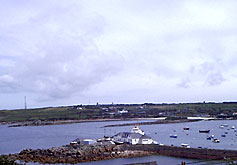 | St Mary's, Isles of Scilly
| |
Richard Uridge finds himself the westernnmost person in the land when he visits the Isles of Scilly. Part of the Duchy of Cornwall, 28 miles off the coast of Cornwall, the archipelago consists of a number of inhabited islands and a whole range of uninhabited smaller islands and rocks - the number of which varies depending on who's counting, but it's certainly several hundred. The main five islands are St Martin's, Tresco, Bryher, St Agnes and the largest - St Mary's. The Isles are known for their extremely mild climate, frost only occurs every hundred years or so, and sub-tropical plants flourish in public and private gardens. It means that its famous flower industry can flourish: growers can produce spring flowers as early as November. Tourism is now the biggest industry for the islanders and 40 per cent of visitors come back year after year.
Isles of Scilly info
Richard begins his visit on a boat, bobbing around Annet, one of the small rocky islands. There may be no people there, but it's inhabited by hundreds of seabirds. Ornithologist and electrician for the five islands, Paul Stancliffe shows Richard the amazing puffins - much smaller than imagined, but birds with a whole range of wonderful habits - they spend the whole winter on the stormy seas of the Atlantic; the barbs on their bills secure their cargo of fish; they starve their chicks to make them leave the burrows deep in the cliffs.
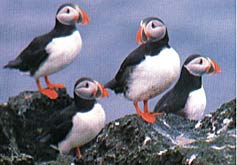 | Puffins on Scilly - a painting by A Blackwell
| |
Back on dry land on St Mary's, Richard meets Liz Davey, the officer in charge of this Area of Outstanding Natural Beauty and, with Julian Ould, the Chaplain for all the Isles, they go to Bar Point. Here they can see the ring of the main islands across the sea from a wonderful sandy beach. Liz says the islands are made from granite which were formed at the same time as other granite lands in Cornwall, like Bodmin and Land's End. The geology of the isles is reflected under the water: the four bigger islands were once joined when the sea level was a lot lower and, at very low tide, you can see pre-historic field-boundaries: lines of stones forming regular patterns. On a really low tide, you can still walk between the islands.
Julian explains that the islanders have a strong sense of community. The 28 miles of water between the Isles and Cornwall is very isolating. He is one of the few clergy who knows everyone who lives in his parish.
Scilly is known for its flowers and each year thousands of people flock to the famous gardens on Tresco. Richard finds an amazing community garden, which was once a blot on the landscape, in the middle of St Mary's. Carreg Dhu Gardens (Cornish for black rock) was not so long ago a derelict quarry full of rubbish. In 1986, June Lethbridge and her husband, Richard, decided to turn the area into a garden for everyone in the community. When her husband died, June started a committee of volunteers who run the garden and they now pay two part-time gardeners. Sue Milligan is now in charge of fund-raising and she shows off the wonderful sub-tropical plants in the garden - palm trees, geranium maderense, lampranthus, bottle brush, acacias, camellias, proteas. They have many plants from Australia and New Zealand which co-exist in a happy tangle.
Carreg Dhu Gardens
Narcissi info
Where there are flowers, there's fragrance, and Richard follows his nose to the Perfumery on St Mary's. Run by Pete Hobson, it's where the flowers and fruits and even honey and pollen of the islands are made into soaps and perfumes. Pete was trained by perfumiers in Grasse in France, and explains to Richard how to make soap by the old cold method, though he doesn't divulge his secret recipe.
Isles of Scilly Perfumery
Then it's back on a boat, this time to follow a boat race. Ted Mulson is the vice-captain of the Islands' Gig Team. Gigs are very much part of Island life: the boats are 30 ft long and each carries six rowers and a coxswain. They're made of elm and are very heavy. The oldest boat, Bonnet, was built in 1830 and is still racing twice a week, every week. The boats were originally called pilot gigs and there were over 100 in the Isles of Scilly. The gigs raced out to the big boats, clippers and trading vessels that were coming in, competing for the job of bringing them into port. Forty years ago, someone decided that it was a shame that they were rotting in a shed and so the sport of gig racing began - it's now one of the biggest west-country sports. St Mary's has just hosted the World Championships and Richard follows a women's race - from the safe distance of a motorboat.
Gig racingThe BBC is not responsible for external websites | | |
RELATED LINKS
Food Programme Food Awards 2002
BBC Holiday Category
BBC Countryfile
| | |
| | | | | | |  | | | | | | | | | Audio Help | | | | | | PREVIOUS PROGRAMMES | | | | | Current Week
Last Week
The A44
Aberdeenshire
Aberdeenshire, River Don
Aberfan
Alderley Edge, Cheshire
Ancient buildings
Anglesey
Applecross Peninsula
Aran Islands
Armistice Day, Somerset & Sussex
Auxiliary Units
Bardsey Island
Batsford Park Estate, Glos
Berkshire
Berwyn Mountains
Birdsong
Blackwater Estuary, Essex
Blaenafon
The Blean, Kent
Bosworth Field
Brecon Beacons
Buckinghamshire
Butterflies
By Brook Valley
The Cairngorms
Caithness
Cambridgeshire
Carmarthenshire
Cheddar Gorge
Cherwell Valley
Cheshire: Harrop Valley
Chesil Bank
Clee Hills, Shropshire
Climbers
Corfe Castle
Cornwall
Cornwall: Cape Cornwall
Cornwall: Padstow Lifeboat
Cornwall: Roseland Peninsula
Cotswold
Cotswold Way
County Clare, Ireland
Cranbourne Chase
Cumbria: Eden Valley
Cumbria: Coniston Water
Cumbria: Sellafield
Cumbria
Daingean in Glengarry
Dee Estuary
Derbyshire
Devon & Somerset: Grand Western Canal
Donegal
Dorset
Dorset: Cranborne Chase
Dorsetman
Dowsing
Dunalastair
Durham
Durham: Witton Park
East Anglian Churches
Eden Valley in Cumbria
Eigg
Eire: Co. Mayo
Eire: Skibbereen
Eire: West Cork
Elan Valley, Wales
Eshott, Norhumberland
Essex
Essex: coastal
Exmoor, churches
Falkirk
Farne Islands, Part 1
Farne Islands, Part 2
Fenn's, Whixall & Bettisfield Mosses National Nature Reserve
The Fens
Fife
Flanders
Forster Country
Glencoe Mountains
Glencoe
Gloucestershire
Goa
Goodwin Sands
Gower Peninsula, June 2006
Gower Peninsula, October 2005
Grouse shooting
Guernsey
Hadrian's Wall 2003
Hadrian's Wall 2004
Hambledon Cricket Club
Hampshire: Odium
Hampshire: Selborne
Hardcastle Crags
Heart of Wales Railway
Hebden Bridge
Herefordshire
Hertfordshire
Hidden Treasures
High Weald, Sussex
Holy Island
Ilmington
Isle of Gigha 2004
Isle of Gigha, 2005
Isle of Man - Seas
Isle of Man
Isle of Wight, 2003
Isle of Wight, 2005
Izak Walton
Kent: Dover
Kent: Dungeness Peninsular
Kent: North
Kielder Water
Kinver Edge
Kingham, Oxfordshire
Lake District
Leicestershire: Bosworth Field
Leicestershire: death rituals
Lincolshire farming
Lincolnshire
Lincolnshire
Loch Morar
Looe Island
Ludlow
Lunar Influence
Don McCullin
Richard Mabey
Marsden, West Yorkshire
Mary Towneley Loop
Mersea Island
Mersey Marshes
Metal Detectingg
Mid-Wales
Morecambe Bay
Moel Findeg, North Wales
Morecombe Sands
Nant Gwrtheyrn
National Forest
New Forest
Newton Dee, nr Aberdeen
Norfolk Broads
Norfolk: Thetford Forest
Norfolk: North Norfolk coast
North Devon Combes
Northants: Sulgrave Manor
Northants: Underground
Northern Ireland: Belfast
Northern Ireland: Border Counties
Northern Ireland: Moneypenny's Lock
Northern Ireland: Sperrin Mountains
Northern Ireland: Strangford Lough
Northern Ireland: Toomebridge
North Norfolk Coast
Northumberland, part 1
Northumberland, part 2
North Wessex Downs
North Yorkshire
North Yorkshire Moors
North Yorkshire Moors Railway
Nottinghamshire
Nottinghamshire: Sherwood Forest
Oak Trees
Offa's Dyke
Orford Ness
Orkneys
Out Skerries, Shetland
Outward Bound
Oxfordshire
Peak District
Peak District
Pembrokeshire Coast
Pentland Hills
Perthshire
Poachers
Pony Club
River Severn
Romney Marsh
Rutland Water
Scilly
Scotland: Abernethy Forest
Scotland: Loch Morar
Scotland: Shetland
Scotland: Strathclyde
Scotland: What value the countryside?
Scottish Borders
Sefton Coast
Self-sufficient communities
Severn Valley Railway
Shropshire: Ellesmere
Shropshire: Much Wenlock
Shropshire and Wales, Newport
Skegness
Skomer Island
Snowdon
Snowdonia National Park
Somerset Levels
Somerset Levels
Somerset: Montacute House
Somerset writers
South Downs
South Somerset: watermills
Southwold
Spurn Peninsular
Start Bay
Stour Valley
Survival
Sussex
Sutherland, Scotland
Tamar Valley
Thornham Estate, Suffolk
Thurstonland Cricket Club
Twyford Down
Tyntesfield, North Somerset
Village Life
Terry Waite
Wales
Wales: Flatholm Island
Wales: Nant Gwrtheyrn
Wales: Snowdonia
Warwickshire: rare breeds
Wayoh Reservoir
Wenlock Edge
West Sussex
West Yorks: Calder Valley
Weston Common, Surrey
Wild boar
Wiltshire
Wiltshire: Savernake Forest
Women's Institute
Wroxeter
Yorkshire Dales, June 2002
Yorkshire Dales, 1 July 2006
Yorkshire Dales, 8 July 2006
Z to Z Britain
Open Country looks back 2003
| | | | | MESSAGE BOARDS | | | | | Join the discussion:
The Learning Curve
Pick of the Week
Questions, Questions
Woman's Hour
Word of Mouth | | | | | RELATED PROGRAMMES | | | | | Excess Baggage
Changing Places
Similar programmes this week on Radio 4
| | |
|