| | | | | PROGRAMME INFO | | | |
| | | From Shetland to the Scilly Isles, Open Country travels the UK in search of the stories, the people and the wildlife that make our countryside such a vibrant place. Each week we visit a new area to hear how local people are growing the crops, protecting the environment, maintaining the traditions and cooking the food that makes their corner of rural Britain unique.
Email: open.country@bbc.co.uk
Postal address: Open Country,
BBC Radio 4, Birmingham, B5 7QQ.
| | | | | LISTEN AGAIN | | | |
|
|
| | PRESENTERS | | | |
|  | | | More about Helen Mark | | | |  | | | More about Richard Uridge | | | | |
| | | | | | PROGRAMME DETAILS | | | |
| 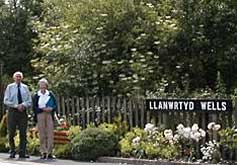 | Ainsley Jones and Norwen Davies at Llanwrtyd Wells Station
| |
In the second of our two-part railway special, Richard Uridge travels on the Heart of Wales line which runs the 121 miles from Shrewsbury to Swansea. It's a proper commercial railway, with little trains carrying commuters, shoppers and tourists through some of the most beautiful scenery in Britain.
It was originally built in the mid-19th century to connect the north-west of England with the ports of South Wales and the flourishing steel and coal industries. The line includes seven bridges and six tunnels and Richard explores the some of the small communities alongside the line around the old spa towns in the middle, for whom the railway provides a lifeline in an area which would otherwise be devoid of public transport.
Powys Digital History Project
Heart of Wales Line
Richard's first port of call is the pretty station of Llanwrtyd Wells - but it wasn't always so. Gateway to the smallest town in the UK, it used to be a dilapidated and rubbish-strewn site - the platforms were overgrown and the whole area had been sadly neglected. One resident decided that enough was enough and the community must do something about it. Chairman of the local council at the time was Ainsley Jones, who snapped into action and the first local collection raised just £200 - but it was enough to get the ball rolling and an action group was formed. They sought grants from a huge range of sources, co-opted the army to clear a particularly unpleasant patch of ground and the entire area was transformed - platforms weeded, hedges trimmed, new fences erected and flower beds redesigned. The work has been ongoing, hundreds of daffodil bulbs have been planted, with the help of the local cub scouts, and an avenue of trees planted along the fence on the down platform. The area to the rear of the station building was paved and has become a popular picnic area. The community has been so inspired that a gardening club has grown up from this tiny beginning. Today, after work totalling around £10,000, the station is immaculate with fresh paint and lots of flowers and flourishing wildlife. They enter the Wales in Bloom competition every year and have come second for three years running. Ainsley says they'll never win, because the station is still a bit on the wild side, but that's how they like it.
Wales in Bloom
At Pen-y-bont, Elizabeth Turner and her husband are restoring Maesyfed, a row of historic cottages. The first building on the site was a medieval farmhouse, but it was continually built on and eventually became a ramshackle row of cottages which show the variety of different local building styles down the centuries. The range of industry at Maesyfed was extraordinary: tailoring, a tearoom, a blacksmith, cobbling, a seed merchant, a garage, chick rearing, etc. There was even a state-of-the-art laundry in 1905 when the hotels in the new spa town of Llandrindod Wells needed to have their sheets and pillowcases dealt with - the laundry arrived on the railway.
Continuing the tradition of adapting the buildings to meet the needs of the time, the Turners are busy with plans for the next stage. They've already converted the old pressing room into a gallery space with a wonderful floor. This is a demonstration and trial for tiles made of end grain timber which, it's hoped, will reinvigorate the Welsh timber industry. Jorge Ordonnez designed the floor to reflect the weaving patterns within laundry baskets, and his brother Fernando now makes and plays traditional Colombian musical instruments which are on sale there. Eventually Elizabeth says she hopes the place will become a centre that encourages artists, craftsmen and designers to work together collaboratively.
Maesyfed
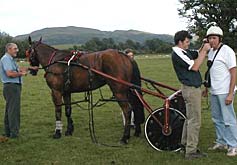 | Mark Bevan kits out Richard Uridge
| |
Richard finally gets his chance to play at Wembley - the Penybont race track has been called the Wembley of Wales! It lies on a small grassy floodplain, traditionally the meadow would have been a place where local employers would hire villagers from the surrounding area. Today the area is used for grazing sheep, but it also has a grandstand and mud track which is used for Harness racing. Sometimes referred to as trotting, this involves competitors sitting astride simple two wheeled carts known as sulkys and racing them around an oval track at high speed. Still a largely rural country, Wales has the highest number of competitors and followers. Originally the animals would be traditional working Welsh cobs which were raced at weekends. These days most people race American Standardbreds which have a very different galloping gait. The Bevan family have been racing here for three generations, and Mark and Jane give Richard a taste of just how fast the horses can go - with Colin Davies providing the commentary.
Wales & Border Counties Racing Association
Harness Racing
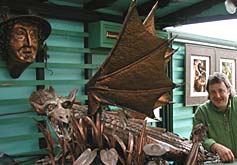 | Richard Taylor
| |
Arts and crafts seem to thrive along the Heart of Wales Railway. At Crossgates, Richard follows the sound of tapping to discover coppersmith Richard Taylor hard at work. He went to art college but is largely self-taught and began originally sculpting wood. Around 10 years ago he started incorporating copper into his work and has moved increasingly into the metal side. The designs follow natural, mythical themes influenced by European folklore and reflect Richard's love of nature and interest in environmental issues. All the works are beaten by hand and soldered. The copper is usually polished and then left to develop a patina, the colour of which varies from place to place around the country. Richard is also involved in the ARCADY project, in conjunction with the Heart of Wales Railway, which aims to bring people to rural parts of Wales by rail to learn arts and craft skills.
Richard Taylor
Long before the railway ever came to the area, the countryside was criss-crossed with drovers' roads, where large numbers of animals were driven on foot overland from North Wales to the markets in London. Local historian Dai Gealy takes Richard on a ramble on one such road, which is made from stones laid on their edges to give the drovers and their animals better grip. This whole part of Wales is laced with old drove routes and many old barns and houses would once have been droving inns - which is why there are so many Drover's Arms still today. Droving is thought to have started in the Middle Ages, but the busiest period was probably the late 1800s. Many different kinds of animals were moved this way - pigs, cattle, sheep and geese would be driven depending on the time of year - and the working dog was the corgi. Drovers were often regarded as brigands or unruly wild men, with a fearsome reputation - so much so that other travellers would often join them for protection. It's ironic that the road Richard is on today overlooks not only magnificent scenery, but also a viaduct which carries the Heart of Wales Railway - the coming of which spelled the end for the drovers.
Welsh Drovers
Walks in WalesThe BBC is not responsible for external websites | | |
RELATED LINKS
BBC Holiday Category
BBC Countryfile
| | | |
| | | | | | |  | | | | | | | | | Audio Help | | | | | | PREVIOUS PROGRAMMES | | | | | Current Week
Last Week
The A44
Aberdeenshire
Aberdeenshire, River Don
Aberfan
Alderley Edge, Cheshire
Ancient buildings
Anglesey
Applecross Peninsula
Aran Islands
Armistice Day, Somerset & Sussex
Auxiliary Units
Bardsey Island
Batsford Park Estate, Glos
Berkshire
Berwyn Mountains
Birdsong
Blackwater Estuary, Essex
Blaenafon
The Blean, Kent
Bosworth Field
Brecon Beacons
Buckinghamshire
Butterflies
By Brook Valley
The Cairngorms
Caithness
Cambridgeshire
Carmarthenshire
Cheddar Gorge
Cherwell Valley
Cheshire: Harrop Valley
Chesil Bank
Clee Hills, Shropshire
Climbers
Corfe Castle
Cornwall
Cornwall: Cape Cornwall
Cornwall: Padstow Lifeboat
Cornwall: Roseland Peninsula
Cotswold
Cotswold Way
County Clare, Ireland
Cranbourne Chase
Cumbria: Eden Valley
Cumbria: Coniston Water
Cumbria: Sellafield
Cumbria
Daingean in Glengarry
Dee Estuary
Derbyshire
Devon & Somerset: Grand Western Canal
Donegal
Dorset
Dorset: Cranborne Chase
Dorsetman
Dowsing
Dunalastair
Durham
Durham: Witton Park
East Anglian Churches
Eden Valley in Cumbria
Eigg
Eire: Co. Mayo
Eire: Skibbereen
Eire: West Cork
Elan Valley, Wales
Eshott, Norhumberland
Essex
Essex: coastal
Exmoor, churches
Falkirk
Farne Islands, Part 1
Farne Islands, Part 2
Fenn's, Whixall & Bettisfield Mosses National Nature Reserve
The Fens
Fife
Flanders
Forster Country
Glencoe Mountains
Glencoe
Gloucestershire
Goa
Goodwin Sands
Gower Peninsula, June 2006
Gower Peninsula, October 2005
Grouse shooting
Guernsey
Hadrian's Wall 2003
Hadrian's Wall 2004
Hambledon Cricket Club
Hampshire: Odium
Hampshire: Selborne
Hardcastle Crags
Heart of Wales Railway
Hebden Bridge
Herefordshire
Hertfordshire
Hidden Treasures
High Weald, Sussex
Holy Island
Ilmington
Isle of Gigha 2004
Isle of Gigha, 2005
Isle of Man - Seas
Isle of Man
Isle of Wight, 2003
Isle of Wight, 2005
Izak Walton
Kent: Dover
Kent: Dungeness Peninsular
Kent: North
Kielder Water
Kinver Edge
Kingham, Oxfordshire
Lake District
Leicestershire: Bosworth Field
Leicestershire: death rituals
Lincolshire farming
Lincolnshire
Lincolnshire
Loch Morar
Looe Island
Ludlow
Lunar Influence
Don McCullin
Richard Mabey
Marsden, West Yorkshire
Mary Towneley Loop
Mersea Island
Mersey Marshes
Metal Detectingg
Mid-Wales
Morecambe Bay
Moel Findeg, North Wales
Morecombe Sands
Nant Gwrtheyrn
National Forest
New Forest
Newton Dee, nr Aberdeen
Norfolk Broads
Norfolk: Thetford Forest
Norfolk: North Norfolk coast
North Devon Combes
Northants: Sulgrave Manor
Northants: Underground
Northern Ireland: Belfast
Northern Ireland: Border Counties
Northern Ireland: Moneypenny's Lock
Northern Ireland: Sperrin Mountains
Northern Ireland: Strangford Lough
Northern Ireland: Toomebridge
North Norfolk Coast
Northumberland, part 1
Northumberland, part 2
North Wessex Downs
North Yorkshire
North Yorkshire Moors
North Yorkshire Moors Railway
Nottinghamshire
Nottinghamshire: Sherwood Forest
Oak Trees
Offa's Dyke
Orford Ness
Orkneys
Out Skerries, Shetland
Outward Bound
Oxfordshire
Peak District
Peak District
Pembrokeshire Coast
Pentland Hills
Perthshire
Poachers
Pony Club
River Severn
Romney Marsh
Rutland Water
Scilly
Scotland: Abernethy Forest
Scotland: Loch Morar
Scotland: Shetland
Scotland: Strathclyde
Scotland: What value the countryside?
Scottish Borders
Sefton Coast
Self-sufficient communities
Severn Valley Railway
Shropshire: Ellesmere
Shropshire: Much Wenlock
Shropshire and Wales, Newport
Skegness
Skomer Island
Snowdon
Snowdonia National Park
Somerset Levels
Somerset Levels
Somerset: Montacute House
Somerset writers
South Downs
South Somerset: watermills
Southwold
Spurn Peninsular
Start Bay
Stour Valley
Survival
Sussex
Sutherland, Scotland
Tamar Valley
Thornham Estate, Suffolk
Thurstonland Cricket Club
Twyford Down
Tyntesfield, North Somerset
Village Life
Terry Waite
Wales
Wales: Flatholm Island
Wales: Nant Gwrtheyrn
Wales: Snowdonia
Warwickshire: rare breeds
Wayoh Reservoir
Wenlock Edge
West Sussex
West Yorks: Calder Valley
Weston Common, Surrey
Wild boar
Wiltshire
Wiltshire: Savernake Forest
Women's Institute
Wroxeter
Yorkshire Dales, June 2002
Yorkshire Dales, 1 July 2006
Yorkshire Dales, 8 July 2006
Z to Z Britain
Open Country looks back 2003
| | | | | MESSAGE BOARDS | | | | | Join the discussion:
The Learning Curve
Pick of the Week
Questions, Questions
Woman's Hour
Word of Mouth | | | | | RELATED PROGRAMMES | | | | | Excess Baggage
Changing Places
Similar programmes this week on Radio 4
| | |
|