| | | | | PROGRAMME INFO | | | |
| | | From Shetland to the Scilly Isles, Open Country travels the UK in search of the stories, the people and the wildlife that make our countryside such a vibrant place. Each week we visit a new area to hear how local people are growing the crops, protecting the environment, maintaining the traditions and cooking the food that makes their corner of rural Britain unique.
Email: open.country@bbc.co.uk
Postal address: Open Country,
BBC Radio 4, Birmingham, B5 7QQ.
| | | | | LISTEN AGAIN | | | |
|
|
| | PRESENTERS | | | |
|  | | | More about Helen Mark | | | |  | | | More about Richard Uridge | | | | |
| | | | | | PROGRAMME DETAILS | | | |
| 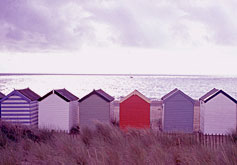 | Southwold beach huts
| |
Richard Uridge travels to Southwold in Suffolk, a pretty little seaside town with a harbour, a traditional pier and a cluster of brightly-painted beach huts, it boasts over a thousand hours of sunshine a year. It's long been a fashionable place to spend the summer and its charm lies in its unspoilt quality.
Southwold info
Suffolk info
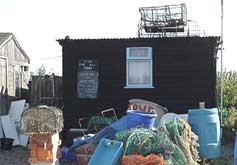 | Traditional beach huts
| |
Southwold was once a very busy fishing port (it is mentioned in the Domesday Book as such) but today the harbourside area is a eclectic collection of fishermen's huts, boat builders, sailing boats and artists. The area is unsophisticated and faces the continual threat of development due to moneyed incomers. In contrast to the expensive beach-huts on the sand, the locals work in the traditional ones, all painted black, in a ramshackle collection of buildings in the Blackshore area. Here Richard meets fisherman Roger Day and his sister Sandy. Roger has been fishing out of Southwold for over 20 years. He always had a fascination with boats and eventually got signed up with a local fisherman to learn his trade. He now runs his own boat and for the last couple of years he and Sandy have been selling fish from one of the traditional fishing huts. The catch varies with the season. At the moment he is net fishing close in shore for Dover sole but in the winter he long lines for cod much farther out. When he started there were around 20 full-time boats operating out of the harbour. These days there are just four full time and a handful of angling charters and part timers.
Southwold history
The River Blythe separates Southwold from Walberswick. You can either drive round the road for several miles, or get the ferry across and here Richard meets the ferrywoman, Dani Church. This is very much a family business and Dani took the job on two years ago after the death of her father. Records show that a ferry has existed here for centuries and Dani's family took the service over in the 1920s when it consisted of a chain system which could take two cars at a time over. In the past many people would use the ferry to commute and the postman and paperboy would be a daily passengers. In war years soldiers based at Walberswick would catch the ferry over to go to the Southwold cinema. On one occasion a circus set up at Walberswick and Dani's grandfather took two elephants across the river - they apparently refused to make the journey separately. These days the ferry is just a rowing boat which takes roughly seven people at a time.
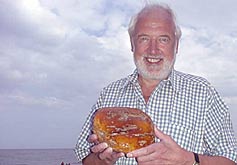 | Robin Fournel with his largest piece of amber
| |
Hunting for treasures on the beach is a popular pastime with children and adults alike and on the Walberswick side of the river, Richard meets jeweller Robin Fournel. Robin's particular area of interest is amber - he buys and sells amber from all over the world and has opened a small museum in the town. Amber is petrified tree resin going back 40 million years. There are a handful of key deposits laid down around the world and the colour changes depending on where it's found. Burmese is a red colour, Mexico yields green whilst Dominican amber is blue. Britain's deposits are found only along the east coast and this is a seam that stretches across from the Baltic, moved over millions of years by glacial action. Richard learns that you can tell the difference between pebbles and amber by the weight (amber is light) and by tapping your find on your teeth. Storms and shifting sandbanks periodically uncover pieces of particular interest and Robin shows Richard the biggest single piece found in Britain, which weighs 2kg.
Robin Fournel
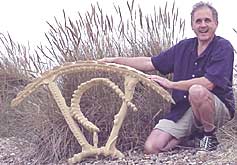 | Patrick Elder with his sandwork Parasols at Walberswick - an expression of love
| |
Sculptor Patrick Elder uses the sand to create imaginative works of art. He began studying furniture making, but was very quickly drawn to sculpture. Most of his current work is with sand either as sandworks or as sandcarvings, although he also works increasingly with bronze and aluminium. He demonstrates how, working with hands and simple tools, he moulds and shapes the sand and when he's finished, pours in casting plaster. The resulting work has a layer of sand on the surface and is a reverse of the original working. He explains that his process of working was one of releasing thoughts and preconceived notions of what he was trying to achieve, allowing a piece to develop and unfold as as a work of pure abstraction. Vipassana meditation is a keystone of his life and he says "my purpose is to help to create and promote a loving and peaceful world in which all may live happily and harmoniously together. To achieve this way, I endeavour to work in a spontaneously creative manner, from a balanced centre of unconditional love, peace and harmony."
Patrick Elder
Richard meets Chris Iredale on the pier. He loved it so much, he bought it. A city boy from London, Chris and his wife Helen finally realised the dream the 1980s. It was in a neglected and sorry state and it was some years before they could start work on renovations. After years of storm damage and neglect, the pier itself has been completely rebuilt. The first wooden pile for the original pier was driven in 1899. When finished in the summer of 1900, the pier extended to approximately 810ft and its main purpose was as a landing stage for the Belle steamships that would bring holidaymakers to the town en route from Great Yarmouth to Southend. Chris's new pier was the first to be built in Britain for over 40 years and costs escalated into seven figures. Now it's open all year and has the old-world charm of the original, with a fascinating water clock which performs every 30 minutes.
Southwold PierThe BBC is not responsible for external websites | | |
RELATED LINKS
BBC Holiday Category
BBC Countryfile
| | | | |
| | | | | | |  | | | | | | | | | Audio Help | | | | | | PREVIOUS PROGRAMMES | | | | | Current Week
Last Week
The A44
Aberdeenshire
Aberdeenshire, River Don
Aberfan
Alderley Edge, Cheshire
Ancient buildings
Anglesey
Applecross Peninsula
Aran Islands
Armistice Day, Somerset & Sussex
Auxiliary Units
Bardsey Island
Batsford Park Estate, Glos
Berkshire
Berwyn Mountains
Birdsong
Blackwater Estuary, Essex
Blaenafon
The Blean, Kent
Bosworth Field
Brecon Beacons
Buckinghamshire
Butterflies
By Brook Valley
The Cairngorms
Caithness
Cambridgeshire
Carmarthenshire
Cheddar Gorge
Cherwell Valley
Cheshire: Harrop Valley
Chesil Bank
Clee Hills, Shropshire
Climbers
Corfe Castle
Cornwall
Cornwall: Cape Cornwall
Cornwall: Padstow Lifeboat
Cornwall: Roseland Peninsula
Cotswold
Cotswold Way
County Clare, Ireland
Cranbourne Chase
Cumbria: Eden Valley
Cumbria: Coniston Water
Cumbria: Sellafield
Cumbria
Daingean in Glengarry
Dee Estuary
Derbyshire
Devon & Somerset: Grand Western Canal
Donegal
Dorset
Dorset: Cranborne Chase
Dorsetman
Dowsing
Dunalastair
Durham
Durham: Witton Park
East Anglian Churches
Eden Valley in Cumbria
Eigg
Eire: Co. Mayo
Eire: Skibbereen
Eire: West Cork
Elan Valley, Wales
Eshott, Norhumberland
Essex
Essex: coastal
Exmoor, churches
Falkirk
Farne Islands, Part 1
Farne Islands, Part 2
Fenn's, Whixall & Bettisfield Mosses National Nature Reserve
The Fens
Fife
Flanders
Forster Country
Glencoe Mountains
Glencoe
Gloucestershire
Goa
Goodwin Sands
Gower Peninsula, June 2006
Gower Peninsula, October 2005
Grouse shooting
Guernsey
Hadrian's Wall 2003
Hadrian's Wall 2004
Hambledon Cricket Club
Hampshire: Odium
Hampshire: Selborne
Hardcastle Crags
Heart of Wales Railway
Hebden Bridge
Herefordshire
Hertfordshire
Hidden Treasures
High Weald, Sussex
Holy Island
Ilmington
Isle of Gigha 2004
Isle of Gigha, 2005
Isle of Man - Seas
Isle of Man
Isle of Wight, 2003
Isle of Wight, 2005
Izak Walton
Kent: Dover
Kent: Dungeness Peninsular
Kent: North
Kielder Water
Kinver Edge
Kingham, Oxfordshire
Lake District
Leicestershire: Bosworth Field
Leicestershire: death rituals
Lincolshire farming
Lincolnshire
Lincolnshire
Loch Morar
Looe Island
Ludlow
Lunar Influence
Don McCullin
Richard Mabey
Marsden, West Yorkshire
Mary Towneley Loop
Mersea Island
Mersey Marshes
Metal Detectingg
Mid-Wales
Morecambe Bay
Moel Findeg, North Wales
Morecombe Sands
Nant Gwrtheyrn
National Forest
New Forest
Newton Dee, nr Aberdeen
Norfolk Broads
Norfolk: Thetford Forest
Norfolk: North Norfolk coast
North Devon Combes
Northants: Sulgrave Manor
Northants: Underground
Northern Ireland: Belfast
Northern Ireland: Border Counties
Northern Ireland: Moneypenny's Lock
Northern Ireland: Sperrin Mountains
Northern Ireland: Strangford Lough
Northern Ireland: Toomebridge
North Norfolk Coast
Northumberland, part 1
Northumberland, part 2
North Wessex Downs
North Yorkshire
North Yorkshire Moors
North Yorkshire Moors Railway
Nottinghamshire
Nottinghamshire: Sherwood Forest
Oak Trees
Offa's Dyke
Orford Ness
Orkneys
Out Skerries, Shetland
Outward Bound
Oxfordshire
Peak District
Peak District
Pembrokeshire Coast
Pentland Hills
Perthshire
Poachers
Pony Club
River Severn
Romney Marsh
Rutland Water
Scilly
Scotland: Abernethy Forest
Scotland: Loch Morar
Scotland: Shetland
Scotland: Strathclyde
Scotland: What value the countryside?
Scottish Borders
Sefton Coast
Self-sufficient communities
Severn Valley Railway
Shropshire: Ellesmere
Shropshire: Much Wenlock
Shropshire and Wales, Newport
Skegness
Skomer Island
Snowdon
Snowdonia National Park
Somerset Levels
Somerset Levels
Somerset: Montacute House
Somerset writers
South Downs
South Somerset: watermills
Southwold
Spurn Peninsular
Start Bay
Stour Valley
Survival
Sussex
Sutherland, Scotland
Tamar Valley
Thornham Estate, Suffolk
Thurstonland Cricket Club
Twyford Down
Tyntesfield, North Somerset
Village Life
Terry Waite
Wales
Wales: Flatholm Island
Wales: Nant Gwrtheyrn
Wales: Snowdonia
Warwickshire: rare breeds
Wayoh Reservoir
Wenlock Edge
West Sussex
West Yorks: Calder Valley
Weston Common, Surrey
Wild boar
Wiltshire
Wiltshire: Savernake Forest
Women's Institute
Wroxeter
Yorkshire Dales, June 2002
Yorkshire Dales, 1 July 2006
Yorkshire Dales, 8 July 2006
Z to Z Britain
Open Country looks back 2003
| | | | | MESSAGE BOARDS | | | | | Join the discussion:
The Learning Curve
Pick of the Week
Questions, Questions
Woman's Hour
Word of Mouth | | | | | RELATED PROGRAMMES | | | | | Excess Baggage
Changing Places
Similar programmes this week on Radio 4
| | |
|