| | | | | PROGRAMME INFO | | | |
| | | From Shetland to the Scilly Isles, Open Country travels the UK in search of the stories, the people and the wildlife that make our countryside such a vibrant place. Each week we visit a new area to hear how local people are growing the crops, protecting the environment, maintaining the traditions and cooking the food that makes their corner of rural Britain unique.
Email: open.country@bbc.co.uk
Postal address: Open Country,
BBC Radio 4, Birmingham, B5 7QQ.
| | | | | LISTEN AGAIN | | | |
|
|
| | PRESENTERS | | | |
|  | | | More about Helen Mark | | |  | | |
Richard Uridge | | | | |
| | | | | | PROGRAMME DETAILS | | | |
| 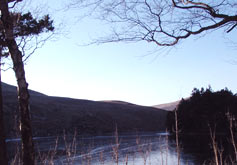 | Glencorse Reservoir
| |
The Pentland Hills are a quaint collection of small hills seven miles south-west of Edinburgh. On a clear day there's a good view of the city, the Forth and its bridges and the Southern Coast of Fife. The hills were shaped by ancient glaciers and water is very much a feature of the area. Its valleys and peaks are criss-crossed with lakes and rivers, natural burns and 11 man-made reservoirs.
The Gazetteer for Scotland
The area has been the prime source of water for Edinburgh since the 17th century and Richard Uridge begins his visit at Glencorse, one of the oldest reservoirs in the hills, which he finds iced over. Susan Manson, of Scottish Water, explains that there used to be a number of mills on the Water of Leith, the major river running from the Pentlands into Edinburgh. The mill owners complained that in the summer months the water level was running low due to abstraction up-stream. The compensation reservoir stored winter water and released it during the summer. Nowadays the reservoirs prevent too much water flowing down and flooding Edinburgh. A system of manually operated sluices does this job.
Bill Elliott was born in a cottage at the side of the reservoir. He works for the water company, monitoring and adjusting water levels to prevent flooding on the Water of Leith. He keeps the reservoirs three or four feet below maximum level and carefully checks weather forecasts against historical records.
Scottish Water
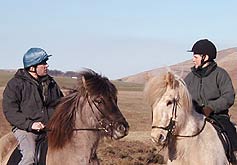 | Richard Uridge and Jill Noble
| |
Richard meets Jill Noble, who has loved Icelandic ponies since she was a child and now has a herd of 70 (Britain's largest). They're an unusual breed with a fascinating history: the purest breed in the world, they decend from Viking horses living on Iceland in total isolation for over a 1000 years. Icelandic law prevents the importing of new strains to prevent disease: any horse which leaves Iceland can never return. They come in a range of sizes and colours and have a wonderful shaggy coat. Jill says they're fantastic horses and show great stamina and intelligence as they negotiate burns, bogs, steep banks and gullies. As well as walking, trotting and cantering they also tölt, which is the same speed as trotting, but with a totally smooth ride: it's said you can carry a glass of champagne without spilling any. And finally there's skeid, or flying pace, which gives the rider a real sensation of floating.
Pentland Hills Icelandics
More about the horses
It's still icy when Richard gets to Harperrig Reservoir, the favourite walking haunt of Professor Brian Edwards. He's been walking round it for over 30 years and says it's important for spiritual repair to be so close to nature and it's a wonderful antidote to his job in Edinburgh. There's the remains of Cairns Castle (which gave its name to the other Cairns in Australia and Canada) which is now home to bats and owls. The reservoir is an important place for birds and, even on such a cold day, there are ducks and geese aplenty. Brian talks about coming to listen to the strange sounds the ice makes and likens it to contemporary music. Today, it sounds like breaking china or tinkling windchimes as it breaks up at the edge of the water.
Richard next visits Garvald Special Needs Farm at Dolphinton. Colum Beagan's parents began the farm and it's very much a family concern, a home to adults with learning disabilities and an educational cenre for schoolchildren. Colum was a teacher but feels strongly that children today need a chance to reconnect to the real world. They come here to learn where their food comes from and how to make shelter, still the two basic needs of mankind. It's a mixed farm, run on biodynamic lines and everyone takes turn with the jobs, even milking the cows by hand.
Garvald Home Farm
Richard ends at North Esk Reservoir, which is privately owned by Michael Jones. He had plans for a fish farm, but now is proud of it as a wildlife and conservation area. As owner of the reservoir, Michael still has to maintain the water levels and there is a safety inspection every 10 years to make sure that anti-flooding measures are in place. In the past, waterboard employees would have maintained the site, part of which includes a grassy bank that acts as a water runoff. This is starting to revert to wildflowers and plants, but needs routine maintenance as it's part of the safety inspection. One downside is the increase in reeds and Michael has experimented with grazing a handful of neighbours' cattle to try and suppress the spread. Again, the ice which holds centre stage as it cracks and booms - sounding for all the world like a laser gun in Star Wars.
The BBC is not responsible for external websites | | |
RELATED LINKS
Food Programme Food Awards 2002
BBC Holiday Category
BBC Countryfile
| | |
| | | | | | |  | | | | | | | | | Audio Help | | | | | | PREVIOUS PROGRAMMES | | | | | Current Week
Last Week
The A44
Aberdeenshire
Aberdeenshire, River Don
Aberfan
Alderley Edge, Cheshire
Ancient buildings
Anglesey
Applecross Peninsula
Aran Islands
Armistice Day, Somerset & Sussex
Auxiliary Units
Bardsey Island
Batsford Park Estate, Glos
Berkshire
Berwyn Mountains
Birdsong
Blackwater Estuary, Essex
Blaenafon
The Blean, Kent
Bosworth Field
Brecon Beacons
Buckinghamshire
Butterflies
By Brook Valley
The Cairngorms
Caithness
Cambridgeshire
Carmarthenshire
Cheddar Gorge
Cherwell Valley
Cheshire: Harrop Valley
Chesil Bank
Clee Hills, Shropshire
Climbers
Corfe Castle
Cornwall
Cornwall: Cape Cornwall
Cornwall: Padstow Lifeboat
Cornwall: Roseland Peninsula
Cotswold
Cotswold Way
County Clare, Ireland
Cranbourne Chase
Cumbria: Eden Valley
Cumbria: Coniston Water
Cumbria: Sellafield
Cumbria
Daingean in Glengarry
Dee Estuary
Derbyshire
Devon & Somerset: Grand Western Canal
Donegal
Dorset
Dorset: Cranborne Chase
Dorsetman
Dowsing
Dunalastair
Durham
Durham: Witton Park
East Anglian Churches
Eden Valley in Cumbria
Eigg
Eire: Co. Mayo
Eire: Skibbereen
Eire: West Cork
Elan Valley, Wales
Eshott, Norhumberland
Essex
Essex: coastal
Exmoor, churches
Falkirk
Farne Islands, Part 1
Farne Islands, Part 2
Fenn's, Whixall & Bettisfield Mosses National Nature Reserve
The Fens
Fife
Flanders
Forster Country
Glencoe Mountains
Glencoe
Gloucestershire
Goa
Goodwin Sands
Gower Peninsula, June 2006
Gower Peninsula, October 2005
Grouse shooting
Guernsey
Hadrian's Wall 2003
Hadrian's Wall 2004
Hambledon Cricket Club
Hampshire: Odium
Hampshire: Selborne
Hardcastle Crags
Heart of Wales Railway
Hebden Bridge
Herefordshire
Hertfordshire
Hidden Treasures
High Weald, Sussex
Holy Island
Ilmington
Isle of Gigha 2004
Isle of Gigha, 2005
Isle of Man - Seas
Isle of Man
Isle of Wight, 2003
Isle of Wight, 2005
Izak Walton
Kent: Dover
Kent: Dungeness Peninsular
Kent: North
Kielder Water
Kinver Edge
Kingham, Oxfordshire
Lake District
Leicestershire: Bosworth Field
Leicestershire: death rituals
Lincolshire farming
Lincolnshire
Lincolnshire
Loch Morar
Looe Island
Ludlow
Lunar Influence
Don McCullin
Richard Mabey
Marsden, West Yorkshire
Mary Towneley Loop
Mersea Island
Mersey Marshes
Metal Detectingg
Mid-Wales
Morecambe Bay
Moel Findeg, North Wales
Morecombe Sands
Nant Gwrtheyrn
National Forest
New Forest
Newton Dee, nr Aberdeen
Norfolk Broads
Norfolk: Thetford Forest
Norfolk: North Norfolk coast
North Devon Combes
Northants: Sulgrave Manor
Northants: Underground
Northern Ireland: Belfast
Northern Ireland: Border Counties
Northern Ireland: Moneypenny's Lock
Northern Ireland: Sperrin Mountains
Northern Ireland: Strangford Lough
Northern Ireland: Toomebridge
North Norfolk Coast
Northumberland, part 1
Northumberland, part 2
North Wessex Downs
North Yorkshire
North Yorkshire Moors
North Yorkshire Moors Railway
Nottinghamshire
Nottinghamshire: Sherwood Forest
Oak Trees
Offa's Dyke
Orford Ness
Orkneys
Out Skerries, Shetland
Outward Bound
Oxfordshire
Peak District
Peak District
Pembrokeshire Coast
Pentland Hills
Perthshire
Poachers
Pony Club
River Severn
Romney Marsh
Rutland Water
Scilly
Scotland: Abernethy Forest
Scotland: Loch Morar
Scotland: Shetland
Scotland: Strathclyde
Scotland: What value the countryside?
Scottish Borders
Sefton Coast
Self-sufficient communities
Severn Valley Railway
Shropshire: Ellesmere
Shropshire: Much Wenlock
Shropshire and Wales, Newport
Skegness
Skomer Island
Snowdon
Snowdonia National Park
Somerset Levels
Somerset Levels
Somerset: Montacute House
Somerset writers
South Downs
South Somerset: watermills
Southwold
Spurn Peninsular
Start Bay
Stour Valley
Survival
Sussex
Sutherland, Scotland
Tamar Valley
Thornham Estate, Suffolk
Thurstonland Cricket Club
Twyford Down
Tyntesfield, North Somerset
Village Life
Terry Waite
Wales
Wales: Flatholm Island
Wales: Nant Gwrtheyrn
Wales: Snowdonia
Warwickshire: rare breeds
Wayoh Reservoir
Wenlock Edge
West Sussex
West Yorks: Calder Valley
Weston Common, Surrey
Wild boar
Wiltshire
Wiltshire: Savernake Forest
Women's Institute
Wroxeter
Yorkshire Dales, June 2002
Yorkshire Dales, 1 July 2006
Yorkshire Dales, 8 July 2006
Z to Z Britain
Open Country looks back 2003
| | | | | MESSAGE BOARDS | | | | | Join the discussion:
The Learning Curve
Pick of the Week
Questions, Questions
Woman's Hour
Word of Mouth | | | | | RELATED PROGRAMMES | | | | | Excess Baggage
Changing Places
Similar programmes this week on Radio 4
| | |
|