| | | | | PROGRAMME INFO | | | |
| | | From Shetland to the Scilly Isles, Open Country travels the UK in search of the stories, the people and the wildlife that make our countryside such a vibrant place. Each week we visit a new area to hear how local people are growing the crops, protecting the environment, maintaining the traditions and cooking the food that makes their corner of rural Britain unique.
Email: open.country@bbc.co.uk
Postal address: Open Country,
BBC Radio 4, Birmingham, B5 7QQ.
| | | | | LISTEN AGAIN | | | |
|
|
| | PRESENTERS | | | |
|  | | | More about Helen Mark | | |  | | |
Richard Uridge | | | | |
| | | | | | PROGRAMME DETAILS | | | |
| 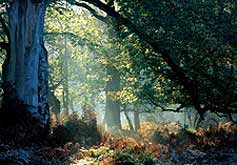 | The New Forest
| |
Helen Mark visits the New Forest, large areas of unspoilt countryside which also feature an elaborate system of rural trade and governance.
Helen begins her journey with four New Forest Keepers as they hunt down a number of rabbits that have been destroying newly planted oak trees. Keeper Graham Wilson explains the history of The New Forest Keepers, who were first mentioned in the Doomsday book.
Helen hitches a ride to Ashley Walk with New Forest Verderer Anthony Pasmore. He describes how Verderers are elected members of The New Forest whose job it is to manage the use of the land and protect the rights of the Commoners, whose ponies roam free on the heath.
Helen discovers that Ashley Park is the site of a former World War II weapons centre which tested bouncing and fragmentation bombs and a mighty "earthquake" bomb, known as The Grand Slam. It was the largest bomb exploded in Britain and left a crater 130 feet across and 30 feet deep. Ashley Walk was a secret place covering 4000 acres surrounded by a high wire fence. Bombing targets included 200 slit trenches containing dummies; submarine pens that cost £250,000 to build; aircraft pens where brand new American Airacobra fighters were used as targets; two massive walls 40 feet high, which resembled tower blocks and a "ship" with steel plates 40 feet long and 20 feet high, which was fired on with rockets. Over 400 craters were visible when the range closed in 1946 and most are still traceable today.
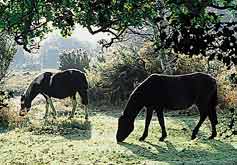 | New Forest Ponies
| |
Helen meets New Forest Commoner Jenny Tillier, who explains that one of the most important features of the forest are its semi-wild ponies. The ponies are generally left to roam together on common land. Each animal is owned by a Commoner and must be marked with an individual brand before being left to wander the open forest. They are sold a number of times a year at a dedicated market which has just been modernised with the help of local money and an EU grant. Despite this, the market for ponies is poor and they fetch next to nothing. Last year prices were rock bottom and all the stallions were take off to prevent unwanted births. Commoners have to pool efforts to round up and manage the ponies, which are essentially wild. Ponies sold at market have some semblance of training, whereas in the past they would be sold completely wild. The market is mainly to dealers who sell the horses on up country or to experienced riders. Few would be sold as children’s rides, as they can still be a bit of a handful. Jenny refutes the suggestion often made by welfare groups or pony sanctuaries that a lot of animals are sold for meat, although this is the case with older animals past their best.
The pony or horse was an important part of the rural economy before the car, and the tradition of keeping them provided valuable income. Today the demand is for riding ponies, and only a handful of commoners are able to make a living keeping stock.
Helen ends her journey with Bruce Rothney, a conservation and recreation officer for The Forestry Commision. As they walk through the woodlands, he explains how the work of The Forestry Commission has developed since it was first set up after World War I to ensure Britain stayed supplied with stocks of timber. One of the Commission’s main objectives is to increase habitat diversity and, in the case of The New Forest, this means less pine and more mixed broadleaf. They are also introducing more recreation into The New Forest which, as Helen discovers, is an increasing concern to many of the indigenous people.
The BBC is not responsible for external websites | | |
RELATED LINKS
Food Programme Food Awards 2002
BBC Holiday Category
BBC Countryfile
| | |
| | | | | | |  | | | | | | | | | Audio Help | | | | | | PREVIOUS PROGRAMMES | | | | | Current Week
Last Week
The A44
Aberdeenshire
Aberdeenshire, River Don
Aberfan
Alderley Edge, Cheshire
Ancient buildings
Anglesey
Applecross Peninsula
Aran Islands
Armistice Day, Somerset & Sussex
Auxiliary Units
Bardsey Island
Batsford Park Estate, Glos
Berkshire
Berwyn Mountains
Birdsong
Blackwater Estuary, Essex
Blaenafon
The Blean, Kent
Bosworth Field
Brecon Beacons
Buckinghamshire
Butterflies
By Brook Valley
The Cairngorms
Caithness
Cambridgeshire
Carmarthenshire
Cheddar Gorge
Cherwell Valley
Cheshire: Harrop Valley
Chesil Bank
Clee Hills, Shropshire
Climbers
Corfe Castle
Cornwall
Cornwall: Cape Cornwall
Cornwall: Padstow Lifeboat
Cornwall: Roseland Peninsula
Cotswold
Cotswold Way
County Clare, Ireland
Cranbourne Chase
Cumbria: Eden Valley
Cumbria: Coniston Water
Cumbria: Sellafield
Cumbria
Daingean in Glengarry
Dee Estuary
Derbyshire
Devon & Somerset: Grand Western Canal
Donegal
Dorset
Dorset: Cranborne Chase
Dorsetman
Dowsing
Dunalastair
Durham
Durham: Witton Park
East Anglian Churches
Eden Valley in Cumbria
Eigg
Eire: Co. Mayo
Eire: Skibbereen
Eire: West Cork
Elan Valley, Wales
Eshott, Norhumberland
Essex
Essex: coastal
Exmoor, churches
Falkirk
Farne Islands, Part 1
Farne Islands, Part 2
Fenn's, Whixall & Bettisfield Mosses National Nature Reserve
The Fens
Fife
Flanders
Forster Country
Glencoe Mountains
Glencoe
Gloucestershire
Goa
Goodwin Sands
Gower Peninsula, June 2006
Gower Peninsula, October 2005
Grouse shooting
Guernsey
Hadrian's Wall 2003
Hadrian's Wall 2004
Hambledon Cricket Club
Hampshire: Odium
Hampshire: Selborne
Hardcastle Crags
Heart of Wales Railway
Hebden Bridge
Herefordshire
Hertfordshire
Hidden Treasures
High Weald, Sussex
Holy Island
Ilmington
Isle of Gigha 2004
Isle of Gigha, 2005
Isle of Man - Seas
Isle of Man
Isle of Wight, 2003
Isle of Wight, 2005
Izak Walton
Kent: Dover
Kent: Dungeness Peninsular
Kent: North
Kielder Water
Kinver Edge
Kingham, Oxfordshire
Lake District
Leicestershire: Bosworth Field
Leicestershire: death rituals
Lincolshire farming
Lincolnshire
Lincolnshire
Loch Morar
Looe Island
Ludlow
Lunar Influence
Don McCullin
Richard Mabey
Marsden, West Yorkshire
Mary Towneley Loop
Mersea Island
Mersey Marshes
Metal Detectingg
Mid-Wales
Morecambe Bay
Moel Findeg, North Wales
Morecombe Sands
Nant Gwrtheyrn
National Forest
New Forest
Newton Dee, nr Aberdeen
Norfolk Broads
Norfolk: Thetford Forest
Norfolk: North Norfolk coast
North Devon Combes
Northants: Sulgrave Manor
Northants: Underground
Northern Ireland: Belfast
Northern Ireland: Border Counties
Northern Ireland: Moneypenny's Lock
Northern Ireland: Sperrin Mountains
Northern Ireland: Strangford Lough
Northern Ireland: Toomebridge
North Norfolk Coast
Northumberland, part 1
Northumberland, part 2
North Wessex Downs
North Yorkshire
North Yorkshire Moors
North Yorkshire Moors Railway
Nottinghamshire
Nottinghamshire: Sherwood Forest
Oak Trees
Offa's Dyke
Orford Ness
Orkneys
Out Skerries, Shetland
Outward Bound
Oxfordshire
Peak District
Peak District
Pembrokeshire Coast
Pentland Hills
Perthshire
Poachers
Pony Club
River Severn
Romney Marsh
Rutland Water
Scilly
Scotland: Abernethy Forest
Scotland: Loch Morar
Scotland: Shetland
Scotland: Strathclyde
Scotland: What value the countryside?
Scottish Borders
Sefton Coast
Self-sufficient communities
Severn Valley Railway
Shropshire: Ellesmere
Shropshire: Much Wenlock
Shropshire and Wales, Newport
Skegness
Skomer Island
Snowdon
Snowdonia National Park
Somerset Levels
Somerset Levels
Somerset: Montacute House
Somerset writers
South Downs
South Somerset: watermills
Southwold
Spurn Peninsular
Start Bay
Stour Valley
Survival
Sussex
Sutherland, Scotland
Tamar Valley
Thornham Estate, Suffolk
Thurstonland Cricket Club
Twyford Down
Tyntesfield, North Somerset
Village Life
Terry Waite
Wales
Wales: Flatholm Island
Wales: Nant Gwrtheyrn
Wales: Snowdonia
Warwickshire: rare breeds
Wayoh Reservoir
Wenlock Edge
West Sussex
West Yorks: Calder Valley
Weston Common, Surrey
Wild boar
Wiltshire
Wiltshire: Savernake Forest
Women's Institute
Wroxeter
Yorkshire Dales, June 2002
Yorkshire Dales, 1 July 2006
Yorkshire Dales, 8 July 2006
Z to Z Britain
Open Country looks back 2003
| | | | | MESSAGE BOARDS | | | | | Join the discussion:
The Learning Curve
Pick of the Week
Questions, Questions
Woman's Hour
Word of Mouth | | | | | RELATED PROGRAMMES | | | | | Excess Baggage
Changing Places
Similar programmes this week on Radio 4
| | |
|