Blizzards, thaw, then relentless rain. Why is the north east getting such a soaking?

 BBC
BBCThe first 10 days of 2026 brought heavy snow to the north east of Scotland. Since then it has barely stopped raining.
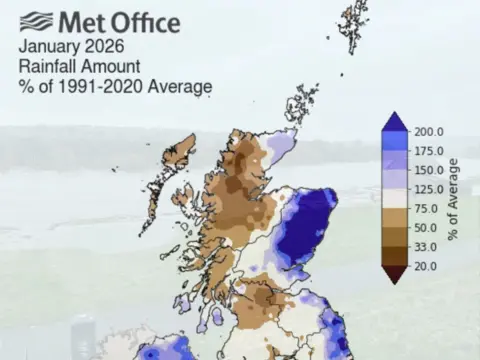
More than 277mm of rain fell on Aboyne in Aberdeenshire during January - about four times the monthly average.
And in Aberdeen there has been no reported sunshine since 21 January - the longest sunless period in the area since Met Office records began in 1957.
It's affected football matches, North Sea oil workers, farmers and even pothole repairs.
So why has it been raining so much?
Experts are blaming what is described as a "blocked weather pattern".
It has been preventing any significant shift in the position of the jet stream, and limiting the chance of more settled, drier conditions.
Scientists say climate changes means periods of more intense rainfall can be expected.
Figures from the Met Office suggest that 1.5C of warming could bring up to 16% more winter rainfall to Aberdeen and 13% more in Aberdeenshire, compared with levels in the 1980s and 90s.
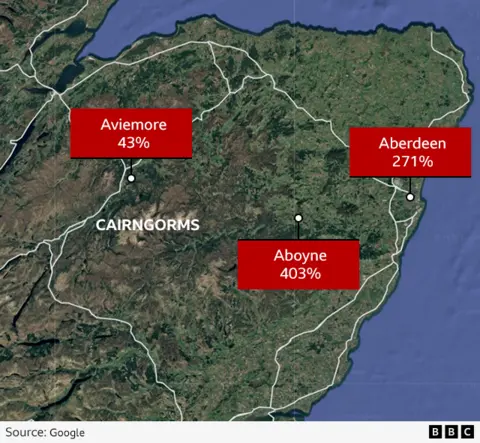
For residents of Aboyne, it has been the wettest January since records began there in 1989.
By contrast, Aviemore - 40 miles (65km) west of Aboyne - saw less than half its January average.
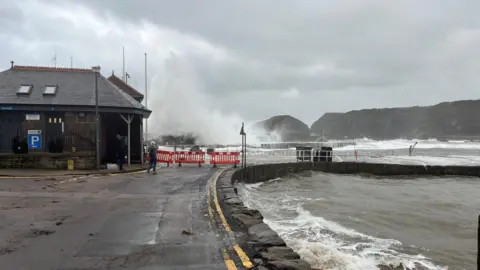
The continuous heavy rainfall - often coupled with high winds - in the north east corner of Scotland has affected many walks of life in recent weeks.
A number of North Sea oil companies have removed staff from their installations because bad weather has hampered efforts to get supplies to them.
Aberdeenshire Council said it had been "challenging" dealing with pothole repairs while faced with ongoing weather warnings and flood alerts.
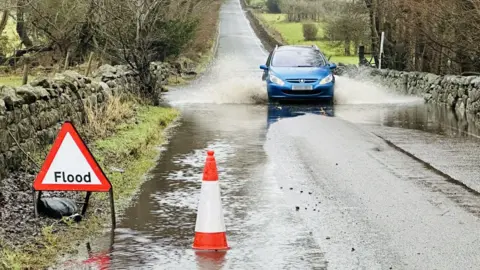
The local authority said: "The region continues to experience persistent heavy rainfall which is affecting parts of our road network with areas of localised flooding.
"We are urging everyone to take extra care when travelling - so please drive to the conditions and never ignore road closure signs."
Meanwhile puffins have been struggling to survive because they cannot find food. The birds have been washing up dead up on beaches, and others are being rescued.
 Kelly Michie
Sport has also been hit, with Celtic's Scottish Premiership visit to Aberdeen on Wednesday postponed, along with Dundee's match with Motherwell, after the heavy rain.
Celtic described it as "extremely regrettable" the match in the Granite City was postponed - "particularly at such a late stage".
The club said: "While we understand the decision, clearly, we sympathise with our supporters, many of whom had begun making their journeys or had arrived in Aberdeen already.
"In our view, there must be the ability to make earlier decisions on matches."
On Friday afternoon it was also announced that Aberdeen hosting Motherwell on Saturday evening in the fifth round of the Scottish Cup had also been postponed.
Aberdeen's annual Spectra festival of light event is now under way in the city, with organisers encouraging people to "stick to plans, wrap up warm, grab your wellies, and enjoy the festival".
Kevin Gilbert, the north east chairman of NFU Scotland, said the "record levels of rainfall" were having a serious impact for farmers.
"Any low-lying fields are completely submerged," Gilbert - who farms near Kintore in Aberdeenshire - told BBC Scotland News.
"Farmers have to move their livestock to higher ground, and you can't get ploughing done.
"It's a horrendous situation. It's such a prolonged time, the whole of January, we're not seeing it relenting, that's the worry. It makes it more difficult to plan."
He added: "As farmers we've always moaned about the weather, but these extremes are a real challenge."
The Scottish Environment Protection Agency (Sepa) said January saw it issue 81 local flood warnings.
"Currently there are eight regional flood alerts and five local flood warnings in force for coastal flood risk along the east coast due to a combination of high tides and large waves," a spokesperson added.
 SKatieShore
BBC Scotland Weather presenter Gillian Smart said the outlook remained unsettled.
"Wet and wintry weather in January is, of course, not unusual in Scotland, but the start of this year has been remarkable, due to a blocked weather pattern," she said.
"The jet stream - the fast-moving ribbon of winds high in the atmosphere that's responsible for so much of our weather - has been strengthened by the recent cold conditions in North America.
"This powerful jet has been propelling Atlantic low pressure systems towards our shores, while at the same time, high pressure has become anchored over Scandinavia.
"This has created a block, preventing weather systems from passing through, and leading to persistent, slow-moving bands of rain."
Is Scotland going to get more snow?
She said this pressure pattern has also brought persistent southeasterly winds for Scotland, meaning eastern parts of the country - especially the north east - have borne the brunt of the rain and snowfall.
Because the ground is not getting time to dry out between systems, even moderate amounts of rainfall are causing further flooding and disruption.
"Friday will bring blustery east winds again, with further rain and hill snow for eastern Scotland," she said.
"The weekend brings an easing in the winds for most of Scotland, though it will remain blustery over the Northern Isles and north eastern coasts.
"There'll be plenty of cloud and patchy rain, though any snow will be confined to the mountains. Next week, however, brings the chance of more significant snowfall, as the air turns colder."
How can you lift your mood in all the rain and dark?
Prof Hester Parr, from the University of Glasgow, is a cultural geographer, and studies Seasonal Affective Disorder (SAD).
"We're all affected by the weather in different ways," she said.
"But for people who have a profound effect at this time of year, when they get significantly depressed, then those are the kinds of people that we might say are experiencing seasonal affective."
Parr said that people will be increasingly leading wet lives.
"We just want to hunker down, close the curtains, and stay inside," she said. "And actually, that's probably the worst thing that we can do for our mental health.
"When we get outside, and build a daily light routine into our lives, we find that we're feeling more energized, and that this is better for raising a lower mood.
"Once we do get outside, we realise that winter is not as grey and grim as we actually think it is, and that there's light all around.
"Even on the darkest day, there will still be some light, and receiving that light out outdoors in the natural environment is the most beneficial thing we can do for our mental health."
