Like a screwdriver in my face - Life with 'the world's most painful known medical condition'

 BBC
BBCIt felt like a screwdriver in the side of his face, with the pain so bad Gerwyn Tumelty contemplated not being around any more.
The 52-year-old said his three children became used to him leaving the table mid-meal after a piece of food would leave him in agony.
He was suffering from "the most painful condition that is known in the medical world", according to charity the Trigeminal Neuralgia Association UK.
It happens when a nerve is strangled by a blood vessel in the face, with it often misdiagnosed as toothache, and attacks caused by something as simple as a gust of wind.
About eight in every 100,000 people are affected by trigeminal neuralgia (TN) annually, according to Nice.
Another sufferer said it took seven years to diagnose her, and despite describing "lightning" going through her face, was told by doctors there was nothing wrong with her.
"I had sharp pains in the jaw, like electric shocks," is how Gerwyn, from Pontarddulais, Swansea, described it.
"It felt like someone putting a screwdriver in to the side of my face and it was really horrible."
A successful businessman, for two years from 2017 he faced a new challenge that came to dominate his life.
"I'd have thoughts of not being around. Not being here," Gerwyn said.
"What kept me going was that I couldn't imagine what effect that would have on my family.
"But, I couldn't see an end to it. It was a desperate time."
What is trigeminal neuralgia?
Trigeminal neuralgia is usually caused by compression of the trigeminal nerve - which transmits sensations of pain and touch from your face, teeth and mouth to the brain.
This happens when a nearby blood vessel presses on part of the nerve inside the skull.
Attacks can be brought on by lightly touching your face, through washing, eating and brushing your teeth.
But they can also be triggered by even a slight breeze.
Attacks can last from a few seconds to about two minutes, and in severe cases happen hundreds of times a day.
 Gerwyn Tumelty
After being left in severe pain just by eating, Gerwyn had neurosurgery in 2019.
Carried out under general anaesthetic, the procedure involves opening the skull and removing a small section of bone to relieve pressure on the nerve which is causing the pain.
It carries a risk of potentially serious complications, such as facial numbness, hearing loss, stroke, and even death in around one in every 1,000 cases.
But it provides the longest lasting relief, with some studies suggesting that pain returns in about three out of 10 cases within 10 to 20 years of surgery.
But surgery worked for Gerwyn and he made a remarkable recovery.
Although the treatment dealt with the physical pain, the effect on his mental health was still there.
In 2022, dark thoughts came back to haunt him and he initially kept his feelings hidden.
"I felt really low and lonely," he added.
"I was lucky to have friends about that I could talk to and that helped. I hadn't talked to anyone about it before then. I opened up."
It was while having a few drinks with former Navy colleagues that he decided to talk about his feelings, which he said transformed his life.
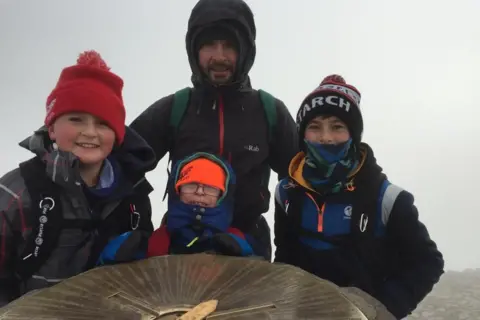
Since then, he has been able to focus on healthy living, exercise and outdoor life.
He has completed the London Marathon as well as hikes in countries such as Morocco.
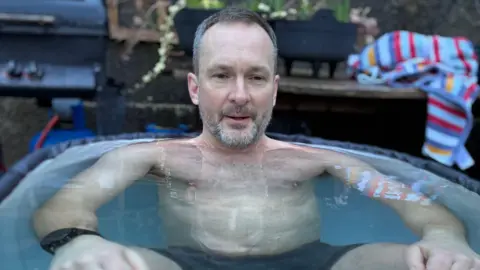
But the biggest change is closer to home, by doing "something difficult" every morning, in particular ice baths on his patio.
He says it requires routine and self-discipline and leaves him ready to "face the day and to face life".
 The Content Creators
Aneeta Prem hasn't been so lucky.
Despite undergoing the same procedure as Gerwyn, it was not successful.
She lives with Bilateral TN, a very rare form of the disease where the flashes of pain can occur on both sides of the face, sometimes simultaneously.
But it took seven years to be diagnosed.
"I was having severe facial pain. It felt like lightning going through my face," she said.
"I initially thought it was toothache and had a wisdom tooth removed and that could have continued.
"I could have lost every tooth in my head."
But she stopped talking about it after being told there "was nothing wrong with me".
In the end her diagnosis only came after seeing a locum at her GP surgery who sent her for additional tests.
Even now, she struggles to go outdoors in winter, as cold wind can trigger an attack.
 Aneeta Prem
She is now chief executive of the Trigeminal Neuralgia Association.
Helping with early diagnosis and providing support is vital, especially at GP practices and dental surgeries, Aneeta believes.
She said Wales has a successful system which involves a multi-disciplinary team that "are really good at diagnosing it".
"Once people are diagnosed they can then be fast-tracked through the system to get the best possible care," she added.
However, the charity says it sees the effects on people living with pain that can "take over their lives".
"Very sadly we see many people that are talking about taking their own life - 33% of people have thought about it, but over 80% have never sought any help," Aneeta said.
"People have extreme pains but almost feel ashamed to talk about the pain and how it makes them feel.
"The isolation, the loneliness, not being able to go out because the pain just takes your breath away."
Additional reporting by Gareth Bryer
The Trigeminal Neuralgia Association holds meetings in Wales, either in person or virtually. You can contact Admin@tna.org.uk for more details
If you have been affected by any issues in this story, you can contact the BBC Action line
