Chicken in many school dinners imported from China and Thailand

 Getty Images
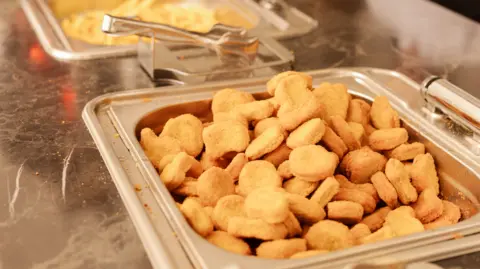
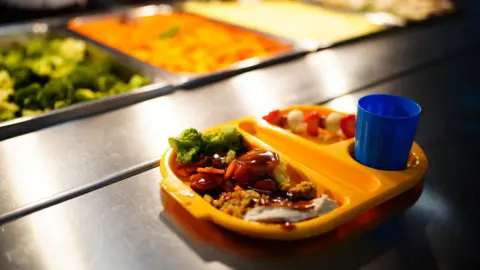
Chicken from as far away as China and Thailand is being served to hundreds of children in Welsh schools, data has revealed.
Poultry from countries thousands of miles away is particularly prevalent in some local authority areas, including Merthyr Tydfil where 99% of chicken served originates from outside the EU.
The statistics, released by the Countryside Alliance and shared with BBC-produced Newyddion S4C, include the proportion of chicken used in products such as nuggets and burgers.
The Welsh Local Government Association (WLGA) said all chicken served in schools - whether sourced from the UK or overseas - had to meet strict UK food safety and hygiene standards.
But parents of schoolchildren expressed their shock at the findings, with one saying: "Our country should be providing the school meals from Wales. I don't think they should be coming from abroad."
Councils in Wales procure food for school meals through formal public sector contracts.
Roberta Sonnino, professor of sustainable food systems at the University of Surrey and a former Cardiff University professor, called the sourcing of overseas chicken for school canteens "common across the UK", adding it was "really difficult to prove" how prevalent it is in other public canteens.
The Countryside Alliance sent Freedom of Information (FOI) requests to Wales' 22 local authorities asking what proportion of chicken used in their school meals was produced and reared in Wales, the UK, EU, and outside the EU.
The query requested data for the most recent academic year in which statistics were available and for all chicken products served in schools.
Of the 20 responses received, three local authorities said more than 85% of chicken served in school meals in their areas was sourced from countries outside the EU such as Thailand and China.
Merthyr Tydfil Council had the highest percentage of chicken in school meals from outside the EU at 99.35%, in the form of frozen poultry.
It said it worked with local suppliers and followed criteria aligned with Welsh government regulations.
Conwy Council, which said 94% of its chicken was from outside the EU, said it used Welsh produce in school meals when that was viable, sustainable and offered best value.
In Caerphilly, the council reported 87.32% of chicken in school meals was sourced from outside the EU.
But it said that as of September 2025, no chicken used in school meals was produced and reared outside the UK and EU.
 PA Media
Both Ynys Mon and Bridgend councils said they sourced 100% of chicken from the UK.
Ceredigion said it was "unknown" whether chicken used in its school meals was sourced anywhere apart from within the EU.
The councils in Wales where chicken is sourced from outside the EU, according to FOI responses:
- Merthyr Tydfil: Thailand and China (99.35%)
- Conwy: Thailand and Brazil (94%)
- Caerphilly: 87.32%, but 0% since September 2025
- Vale of Glamorgan: Thailand and China (68.13%)
- Newport: Thailand (35%) and China (18%)
- Blaenau Gwent: Thailand (41.36%)
- Swansea: Thailand, China and Brazil (31.96%)
- Cardiff: 31.37%, but no country specified
- Torfaen: Croatia, China and Thailand (9.8%)
- Rhondda Cynon Taf: Chargrilled chicken fillets from outside EU used in secondary schools, no percentage given
- Carmarthenshire: Frozen chicken used from outside EU, no country or percentage specified
- Monmouthshire: All meat sourced from the UK except halal meat from Thailand, no percentage given
Rachel Evans, director for the Countryside Alliance in Wales, said the Welsh government needed to take "urgent action to ensure that public money spent on school meals supports Welsh farming, high food standards and sustainability".
The Welsh government said it was working with local authorities, producers and wholesalers to reduce supply chains and food miles and to support farmers, food growers and manufacturers.
It added it was committed to increasing "the use of Welsh food produced locally in schools".
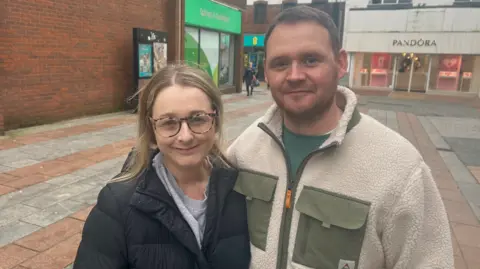
Leah Wright, who has an eight-year-old who attends a school in Merthyr Tydfil, said: "I'm shocked.
"I assumed with something as important as school meals that everything would be locally sourced. Especially with the economy as it is now, keeping our economy stable and keeping everything local is really important - supporting local businesses."
Megan Ellis, who is from Merthyr Tydfil and has a two-year-old, said: "Our country should be providing the school meals from Wales. I don't think they should be coming from abroad and different countries.
"When my little girl starts school in September, she'll be having packed lunch if it's still like this or I'll be removing her from school for dinner.
"Before this, I would have fed her on the free school meals."
'Culture shift needed'
In 2017, a BBC investigation found councils in Scotland were importing chicken from Thailand and turkey from Brazil for school dinners.
Sonnino said councils bought chicken from far away to save money.
She called on Welsh councils to review their contracts with food suppliers for school dinners.
"There's absolutely no need to import what we produce at home," she said.
"It's frozen chicken that's travelled very long distances, generating lots of greenhouse gas emissions.
"There's a culture shift that's needed here. It's realising value means value for the environment, value for the economy, for people's health and society.
"It's a form of investment, you don't need to go for cheap food on the market."
The WLGA said imported chicken was used in some schools due to availability and cost pressures, particularly where budgets were tight and local supply was insufficient to meet demand at an affordable price.
It said councils must still ensure all products meet the same food safety standards, regardless of origin.
A spokesman added: "Councils in Wales procure food for school meals through formal public sector contracts and all chicken served in schools must meet strict UK food safety and hygiene standards, regardless of where it is sourced.
"Councils are working to improve sustainability and support local supply chains where possible, while ensuring school meals remain safe, affordable and consistently available."
Additional reporting by Eleri Griffiths
