Can we save travel's most beloved tradition?

 Asia London Palomba
Digital communication and social media let us stay in instant touch when we travel, but snail-mailed postcards are still uniting travellers.
It was a sweltering morning on the Thai island of Koh Chang and I was sitting at a cafe, sweating over a small, rectangular piece of cardboard. My eyes had zeroed in on it, shelved on a dusty postcard rack in the corner, while walking past, juggling a plastic container of sticky rice and diced mango. I'd been searching for days for one to send to my best friend in North Carolina – our custom for more than 10 years, since her family moved away when we were in secondary school.
I'd plucked my favourite image from the rack, a shot of the white-sand beach where I was staying, paid for the card and a stamp, scrawled a message in purple marker, then slipped it into the red postbox stationed outside on the island's main street. In less than five minutes, and for around ฿50 (£1.13), I had continued our beloved tradition; linking us across continents and time.
A vintage kind of love
My friend and I are part of an increasingly rare breed. The instant nature of digital communication, including the ability to send a "wish you were here" text or upload a carousel of photos to social media, has relegated snail-mailed postcards to a bit character in the theatre of travel. Call it a sign of the times: the US Post Office is currently $15bn in debt and has lost more than $9bn in 2025 alone. First-class post, which includes letters and postcards, has declined by 50% in the last 15 years in the US and is expected to decline an additional 29% in the next decade. In 2024, Americans sent roughly 325 million stamped cards and postcards, a staggering decline from the more than 2.7 billion sent in 2000. In Denmark, the country’s state-run postal service PostNord announced earlier this year that it would end letter deliveries by the end of 2025. Citing a 90% decline in letter volumes since 2000, the country has started removing its iconic red post boxes, ending a 400-year-old legacy.
To many, postcard-sending has become a relic of a bygone era. But while this retro travel tradition may be endangered, it is still quietly doing what it has always done best: uniting loved ones. Calls to save postcards have been spreading across social media channels like TikTok and Instagram, where the hashtag #postcard calls up 6.5 million posts announcing swaps and tips for card decorating. It's clear that travellers, from baby boomers to millennials to Gen Z, are still using them as a way to engage with their loved ones in a more purposeful way.
 Asia London Palomba
The bite-sized travel experience
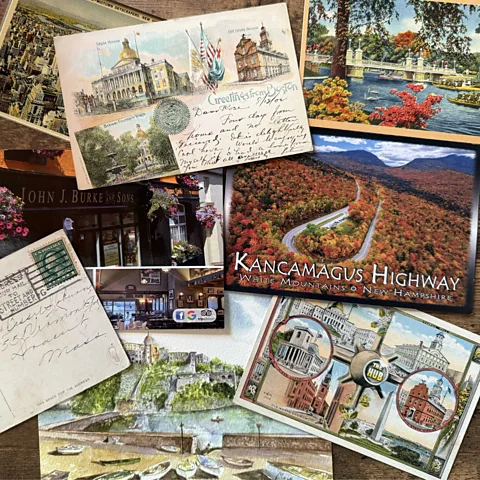
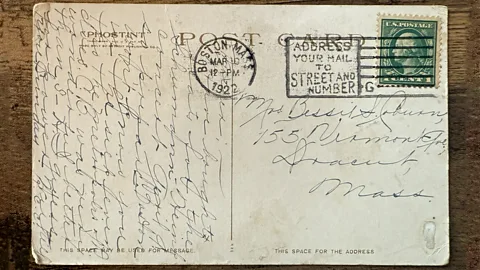
Postcards came into existence in the mid-19th Century, alongside the developing tourism industry. As an entire economy was being built around travel experiences, postcards quickly became popular as a cheap and easy way to communicate, explains Jordan Girardin, a travel and tourism historian. Early postcards featured a visual with a small space for a message on the front; the back dedicated to a stamp and address. "Postcards were meant to promote the tourism experience," says Girardin, a millennial who sends postcards to family members when travelling. "It had a lot to do with publicity, advertising a certain place with a certain reputation… having a visual effect was really, really important."
In the UK, some 75 million postcards were sent in 1871, and by 1910 the country was sending more than 800 million a year. The postcards we know today, with an image on one side and space for a message and address on the other, appeared in the early 20th Century, jump-starting what was known in the US as the "Golden Age of Postcards"; a craze of collecting and mailing postcards that lasted between 1907 and 1915. By 1913, Americans were sending more than 900 million a year.
San Francisco-area artist Ginger Slonaker, a baby boomer who came of age when postcards were still the quickest – and cheapest – means of sharing travel experiences, remembers how bars, restaurants and art galleries used to literally gave them away. When living overseas, she wrote and sent several a week to her parents and mother-in-law. "I just wanted [them] to be a little slice of what's happening in my life," she explains. "Receiving a postcard was special… because they were associated with travelling to a new place."
Fast-forward to the rise of the internet in the 1990s, and postcards began losing their appeal – but not for all. While Slonaker now sends more texts than postcards, she still posts a few to friends every month. After all, texting can only go so far: "Certainly your personality doesn't come across. And how many times can you send a smiling emoji?"
Melissa McGibbon, a millennial travel writer and editor who has been sending postcards for 30 years, calls them the "best souvenir. Everyone has the impression that it's gone out of style and that not a lot of people are doing it anymore. However, I think there's still a lot of us out there."
 Getty Images
McGibbon, who has visited nearly 60 countries and almost all 50 states, has haggled for postcards in a Cairo bazaar, hunted for them near Tokyo's Shibuya Crossing and even posted them from the Galápagos Islands and Antarctica. What started out as a childhood ritual shared between her and her grandparents has ballooned; over the years, she's created a 75-person-long list of travel pen pals. "It's a very affordable way to say, 'I'm thinking of you'," she says. "It kind of gives me a purpose, like a mission, to hunt for a postcard for every place that I go to."
For millennial travel writer and content creator James Barrett, postcards are "kind of like a time capsule. [They're] the perfect gift to show that you're thinking of someone while on vacation without taking up too much space in their home." Barrett, who has been to all seven continents, always sends postcards to his boyfriend and family members when he travels, whether it's from far-flung destinations like Fiji and Churchill, the polar bear capital of the world, or Greece and Disneyland. He'll also occasionally send one to himself if the destination is particularly special. "There's so much more impact to simply getting a postcard than a text message. It's arguably the most thoughtful gift someone can receive," he says.
Back to basics
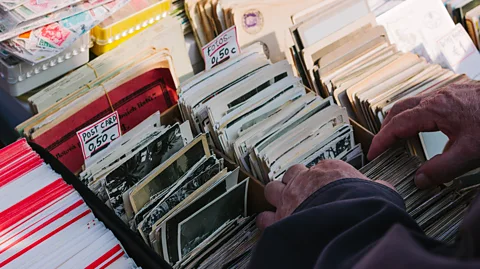
In a time when social media is an oversaturated platter of picture-perfect snapshots and curated moments, the tangibility of putting pen to paper to share quiet moments with loved ones has never been so profound. For Sofía Korous Vázquez, a freelance creative and interpreter, this is the humble postcard's exact appeal.
 Getty Images
"It offers something more intentional, communication-wise. These days, because of the immediacy of messages and the urgency culture around it, it feels less intimate," she says. "There's something romantic and fun about keeping that tradition alive." Vázquez, who is Gen Z, first started writing postcards as a child to her baby boomer grandparents. Today, she sends them to her friends.
She believes her generation may not send postcards as often as millennials or baby boomers do, but they still hold appeal, as documented on social media and seen through projects like Postcrossing, a global postcard exchange programme with more than 800,000 members in 210 countries; now in its 20th year. "An email quickly gets lost in the deluge of emails we get," says Postcrossing founder Paulo Magalhães. "But a postcard? It stands out – and immediately wins the placement on the fridge door or on our desks."
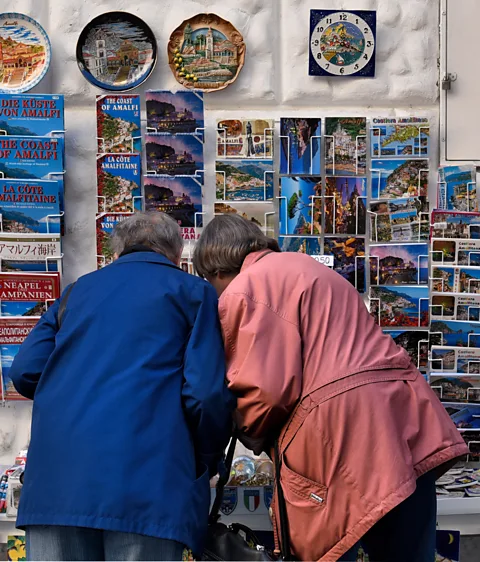
Despite the joys of receiving and sending postcards, today the ritual comes with challenges. McGibbon has noticed that the simple act of locating a mail-worthy postcard can be difficult. She believes that if souvenir shops prioritise selling aesthetically pleasing postcards and stamps, more travellers will become invested in the practice. "It would be a gold mine," she says.
The lack of funding wracking the global post office system has also left travellers like Vázquez and Barrett leery of sending postcards from abroad. Barrett usually mails his postcards when he returns home to the US, or in some cases will hand-deliver them. "I'm a bit paranoid, I'd rather just make sure that it gets to the person," he explains.
More like this:
• Why urban sketching retreats are taking off
• The quiet travel solution to a noisy world
• Is it time to change how we buy travel souvenirs?
Despite the challenges, McGibbon has sent thousands in her lifetime with no plans to stop. "It's maybe not the smartest financial decision long-term, because the cost of stamps keeps going up, but it's an investment in relationships."
While writing and sending postcards may no longer be the way humans most communicate while travelling, Girardin believes that they still have a future, especially among people who appreciate what they stand for: "What people were doing in the past and what they're doing now, yes, it's different. But it's also the same: we're trying to describe a moment of discovery whilst travelling and share it with people".
It would take nearly six weeks for my friend in North Carolina to receive my Thai postcard, by which point my message was a distant memory, surprising and delighting us both, like developing film from an old camera. Writing postcards reminds me to be more intentional with my time and my loved ones when I travel. And that will always beat an Instagram photo.
--
If you liked this story, sign up for The Essential List newsletter – a handpicked selection of features, videos and can't-miss news, delivered to your inbox twice a week.
For more Travel stories from the BBC, follow us on Facebook and Instagram.
