'I sensed an enormous inner desolation': The darkness behind British artist LS Lowry's famous city scenes

 The Estate of L.S. Lowry
The celebrated painter liked to call himself a simple man who created his work with simple materials. In 1957, he showed the BBC how he built up his pictures of industrial urban life from his imagination, and described the loneliness that informed them.
When Laurence Stephen Lowry died on 23 February 1976 at the age of 88, few people knew that he had led a double life as a full-time rent collector, even after his depictions of northern England's sooty industrial landscapes had made him one of Britain's most beloved artists. Success came to him late but he was determined not to let it change him, turning down a knighthood because he didn't want people to think he was too fancy. He left the bulk of his vast fortune to a young woman who, as a 13-year-old, had written to him asking for advice on becoming an artist.
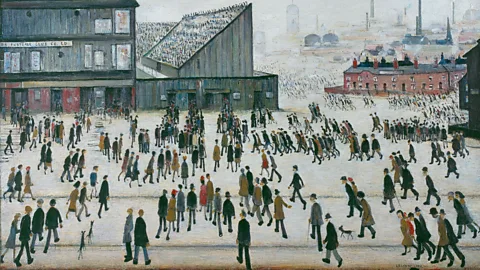
In 1957, the BBC made a short documentary showing Lowry at his easel. In the film, he revealed his ways of working, his creative habits and why he painted his distinctive matchstick figures. "I see them like that so I paint them like that, that's all there is to it," he said. While he liked to describe himself as a simple man, the apparent naivety of his work was a mask that hid inner complexity and decades of deep artistic learning.
Lowry was aged 69 when the BBC film was shown, having retired from his day job five years earlier. Because he never made a profit from his paintings until he was 58, it's hardly surprising that he needed a steady income. His role involved trudging around the poorer areas of Salford and Manchester to pick up payments from tenants. These were the same pavements walked a century earlier by Karl Marx and Friedrich Engels, when the harsh industrial conditions helped shape their revolutionary ideas. Salford was also the Dirty Old Town of legend in Ewan MacColl's folk song made famous by the Dubliners and the Pogues.
But Lowry insisted he had no reason to focus on its gasworks walls and old canals, apart from there being "something about them that attracts me in the pictorial sense". He told the BBC: "I'm not a social reformer; I don't think there's any propaganda in my work. I just paint the scenes that I see." All he cared about was how to truthfully depict life in the shadows of England's austere factories, warehouses and mills.
How he has been misunderstood
The romantic origin story of how Lowry became an artist is that, one day in 1916, he missed his train. He told John Read, the maker of the BBC film, about how having found himself at a loose end in a Manchester suburb, he happened upon some streets of terraced houses at the foot of an immense mill. As he took in the scene, he was filled with the urge to paint it, and at that moment he decided to become an artist. When it emerged after his death that he had held down a day job for years, it led some critics to dismiss him as a so-called "Sunday painter". The truth is that he had studied painting and drawing for at least 20 years, taking classes at the Manchester Municipal and Salford Schools of Art.
Just as some of Picasso's work may look crude to the untutored eye, Lowry's pictures could seem naïve, but both artists had to first master the traditional rules before finding new ways to break them. Lowry bristled at being thought of as an amateur artist. One of his biggest inspirations was the painter Adolphe Valette, who turned up in Manchester in 1906 to teach art and introduce French Impressionism to the city. Valette's paintings of modern industrial life had an important influence on Lowry's subject matter and early style. While Lowry was a talented painter of landscapes, he produced fewer of them as time went on. Perhaps he felt that what he witnessed as a rent collector was more urgent and compelling.
Although Lowry is identified with Lancashire's industrial landscapes, his scenes were mostly drawn from his imagination rather than real life. "I start on an empty canvas and prefer to paint from my mind's eye," he said. The blank page held no terror for him. While he would have no preconceived notion of what to paint, he would begin by painting the buildings and the rest would suggest itself. "It sometimes comes very well and sometimes for no apparent reason, not at all well, but it could take a couple of years to paint a picture quite easily from start to finish. Of course, they're intricate pictures and they're full of figures and detail – it all takes balancing, which is not easy to do."
In History
In History is a series which uses the BBC's unique audio and video archive to explore historical events that still resonate today. Sign up to the accompanying weekly newsletter.
"I'm a simple man," Lowry once said, "and I use simple materials: ivory black, vermilion, Prussian blue, yellow ochre, flake white, and mix them with no medium – that's all I ever use for my painting." Lowry did not believe in sitting around and waiting for inspiration to strike. In the 1957 short film, he said that painting was a habit, whether he was in the mood or not. He did not want his creativity to be clouded by overthinking. "I find that when I'm very anxious to do a thing well, I don't do it at all well, and when I don't seem to mind very much at all and nothing matters about it, it comes out all right," he said.
He would continue working steadily on the painting until he was satisfied he could do nothing more with it. He refused to be bound by precise notions of central composition and perspective, often stretching or compressing his buildings to heighten the bustle of his matchstick crowds. "After all, it's only a picture – it's all make-believe, it's not reality," he said.
 Getty Images
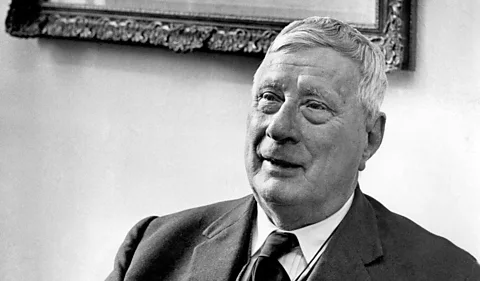
The BBC's short film adopted what has since become a familiar approach, blending Lowry's own voiceover with scenes of him at work. The footage was shot in Lowry's clock‑filled house in a leafy village near Manchester where he lived alone. Producer John Read later recalled: "In spite of his awkward figure, he had the dignity and the bearing of a gentleman. But when I saw him sitting in this room, staring into the fire… I sensed an enormous inner desolation in the man." An eternal observer of life, Lowry's work captured the melancholy of large crowds. "I'm bound to reflect myself in the figures – I'm a very lonely sort of person," he told the BBC.
The 'matchstick men' association
Lowry hid behind a down-to-earth facade, but this unpretentious attitude may have led some to dismiss his work as unskilled. Asked about why his pictures were filled with so many matchstick figures, he said he would begin with just a few but, "for the sake of design," by the end "you've got a picture full of people". In the 1957 film, he insisted he didn't mind that people called his figures matchstick men, but in later years, he came to resent this as a patronising way to look at a trained artist's work.
Despite this, the idea struck a chord with the British record-buying public when two years after Lowry's death, musical duo Brian and Michael's tribute to the artist, Matchstalk Men and Matchstalk Cats and Dogs, topped the UK charts for three weeks. This sentimental one‑hit wonder, complete with children's choir and key change, includes a lyrical twist, as the line "Now he takes his brush and he waits outside them factory gates" becomes "pearly gate" in the final chorus.
More like this:
• Why critics scorned Beryl Cook's 'saucy' paintings
• The mystery of stolen racehorse Shergar
• Why this iconic 19th Century painting is not what it seems
In the same year that the BBC broadcast its short film, Lowry received a letter from 13-year-old Carol Ann Lowry who said that since they shared a surname, did he have any advice on how she could become an artist. He didn't reply, but turned up unannounced at her Rochdale home a few months later. After her initial alarm at this strange man on her doorstep, she would become a sort of adoptive goddaughter. When he died in February 1976 aged 88, the unmarried artist left the bulk of his fortune to her.
A few months after his death, the Royal Academy staged a retrospective exhibition of his work to great acclaim. In the exhibition catalogue, Poet Laureate Sir John Betjeman wrote that Lowry's collected works would dispel any idea of him as "just another self-taught 'primitive' with a passion for industrial archaeology". According to him, "All over his work broods a menacing melancholy. He is the painter of loneliness."
While Lowry valued the recognition that his Royal Academy membership bestowed, he remained suspicious of the art establishment that it represented. The Queen tried to honour Lowry a record five times, including with an OBE in 1955, a CBE in 1961 and a knighthood in 1968, but he turned them all down. According to fellow artist Harold Riley, his friend told him that this was because he didn't want to change how people saw him, not because he had "anything against the system".
Although he struggled to sell his paintings for years, they now fetch millions at auction. In 2024, Sunday Afternoon, a painting that he completed in the same year the BBC broadcast its short film, was sold for almost £6.3m ($8.5m). His 1953 painting Going to the Match went for even more, selling for £7.8m ($10.5m) two years earlier.
In 2000, the opening in Salford of the Lowry Centre confirmed his status as one of the city's favourite sons. Built as part of a project to renovate the old canal, the sleek £106m theatre and gallery complex has become one of the most visited attractions in the area. Today, Manchester and Salford bear little resemblance to the world LS Lowry once captured, yet the poetry he found in what he called the everyday "battle of life" continues to resonate with people.
--
If you liked this story, sign up for the Essential List newsletter – a handpicked selection of features, videos and can't-miss news, delivered to your inbox twice a week.
For more Culture stories from the BBC, follow us on Facebook and Instagram.
