The illustrator who became a national catchphrase

 Getty Images
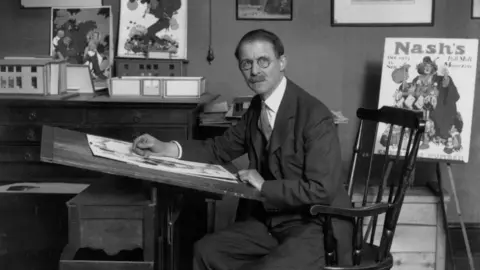
A beloved British artist made some of his most creative illustrations in a Surrey village, which led to him becoming a national catchphrase.
William Heath Robinson relocated from London to Cranleigh in 1918, where he lived for 11 years. It is believed that the village's tranquillity helped refine the visual language that would define his reputation.
His early work included editions of The Arabian Nights and Hans Christian Andersen, but it was during the World War One that he found his distinctive style.
By the 1920s, the phrase "a bit Heath Robinson" had entered the national vocabulary, used to describe anything charmingly improvised or unnecessarily complicated.
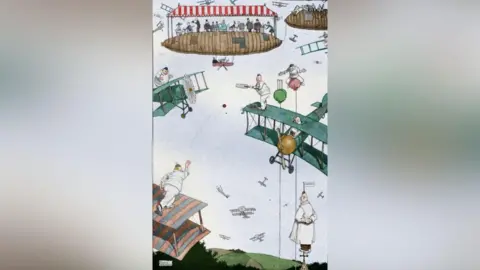
His cartoons of improbable military machines – pulleys, pipes and teetering platforms – offered a gentle, satirical counterpoint to the grim realities of war and helped to make him a household name.
Speaking to the Secret Surrey series, Moira MacQuaide, a historian and writer who gives talks on William Heath Robinson, said: "The house he lived in is still here in Cranleigh, which is nice.
"I don't know how the phrase came about, but it was certainly around in his time as one of his cartoons was titled something like, 'Heath Robinson doing a Heath Robinson of a Heath Robinson drawing'," she said.
"It is quite convoluted with people doing different things, up ladders, paintworks."
 The Print Collector/Getty Images
Robinson initially trained as a landscape painter and went to an art school in London.
When he moved to Cranleigh, he built himself a garden studio so he could work undisturbed.
MacQuaide said: "He invented a speaking tube into the house for when he wanted a cup of tea or for when dinner was ready – other than that, people could not go in the studio.
"You can see his love for everything through his drawings. They covered everything. What he saw or thought about went into his drawings."
He may have died in 1944, but his influence continued long after that.
Engineers, designers and cartoonists have cited him as an inspiration, and his name remains part of everyday speech for some.
The opening of the Heath Robinson Museum in Pinner in 2016 cemented his status as a cultural icon.
Follow BBC Surrey on Facebook, on X. Send your story ideas to southeasttoday@bbc.co.uk or WhatsApp us on 08081 002250.
