'There is a feeling of the greatest outrage': The mystery of stolen champion racehorse Shergar

 Alamy
AlamyShergar was the world's most famous and valuable stallion. When armed men seized him from an Irish stud farm on 8 February 1983, the BBC reported on a sensational true crime saga.
It was on a cold winter's night in 1983 that a prize stallion named Shergar was stolen from a stud farm in Ireland. "The racing world is used to the occasional doping or fixing scandal, but this is something quite different," said the BBC's Nicholas Witchell. "There is a feeling of the greatest outrage that a gang of armed criminals should spirit away one of their greatest heroes."
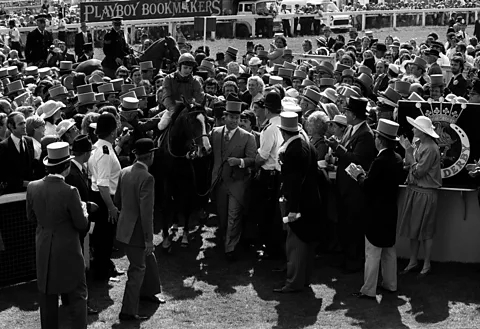
At the time, Shergar had been settling into a new life at stud after his stunning sporting exploits. The stronger a stallion's track record, the higher the price commanded for his services. Shergar was hot property thanks to his win in the 1981 Epsom Derby, which remains one of the greatest moments in the race's 246-year history. As the colt streaked towards victory by a record 10 lengths, BBC commentator Peter Bromley marvelled: "There's only one horse in it. You need a telescope to see the rest."
Shergar's emerald-green silks with red epaulets were the racing colours of his owner, the billionaire spiritual leader the Aga Khan. He told the BBC in 2011 how the sight of Shergar's victory remained etched in his memory. "Two things I found stunning: one was the ease with which that horse moved and second was the fact that during the finishing straight he just kept going away, going away, going away. That was really remarkable."
Further victories in the Irish Derby and the King George VI Chase confirmed Shergar's status as a global racing superstar. The Aga Khan valued his prized possession at £10m (£36m or $49m today) and sold 34 shares at £250,000 each, keeping six for himself. The rest were bought by wealthy international investors gambling on Shergar's ability to sire future champions. After his miracle season, Shergar's reward was to be retired to the Republic of Ireland to begin life as a stud horse – a major coup for the increasingly lucrative Irish thoroughbred industry where pedigree counts for everything.
As the world's most expensive stallion, Shergar "covered" 44 mares in 1982 at £80,000 apiece (equivalent to £290,000 or $396,000 today). By early 1983, his second season at the Aga Khan's Ballymany Stud Farm in County Kildare was fully booked and his shareholders were on track for another profitable year. But on 8 February, masked kidnappers armed with handguns broke in.
For such a valuable asset, security was minimal. Head groom James Fitzgerald's family was held at gunpoint while he was ordered to load Shergar into a trailer. Fitzgerald was bundled into a separate van and driven around for a few hours. Before he was abandoned about 40 miles away, the kidnappers gave him the password "King Neptune", which they would use in ransom negotiations to confirm that they were genuine. Because they intimidated him into keeping quiet, he did not raise the alarm until hours later.
In the ensuing confusion, a series of urgent phone calls were made. Bizarrely, two Irish cabinet ministers knew about the kidnapping before the police were told eight hours later. By then, because of that crucial early delay, the trail had already gone cold. Chief Superintendent James Murphy became the public face of the police investigation. With remarkable candour, the trilby-wearing detective memorably told one news conference: "A clue? That is something we haven't got."
Masked men with machine-guns
Speculation about possible motives was everywhere. BBC racing correspondent Julian Wilson told Sportsnight's Des Lynam: "Any horse thief would be very tempted to put Shergar on top of his mare… but there's such a skilful process now of foal identification and blood-typing that it would be very hard to slip a renegade Shergar foal into the Irish racing scene."
Another far-fetched theory had the horse being transported from Ireland to Libya's Colonel Gaddafi in return for weapons for the IRA. The cash-strapped Irish republican paramilitary group was the prime suspect, having been behind a series of human kidnaps to fund its violent campaign.
In History
In History is a series which uses the BBC's unique audio and video archive to explore historical events that still resonate today. Sign up to the accompanying weekly newsletter.
It turned out that the motive was simply money. Less than 24 hours after Shergar was taken, the kidnappers rang Ballymany Stud using the King Neptune code to demand a ransom of £2m (£7m or $9.5m today). The shareholders were split on whether to pay out. US trainer Brian Sweeney was in favour, telling the BBC, "If you ask a mother who has had a child kidnapped whether or not a ransom should be paid, I think the answer would be yes, and quickly." But Lord Derby, a descendent of the 18th-Century English aristocrat who gave the famous race its name, insisted that if a ransom was paid, "there's a danger of other horses being kidnapped in the years to come, and that simply cannot be tolerated."
The search took a turn when, a day later, a call came into the BBC's newsroom in Belfast, about 130 miles north of where Shergar was snatched. An anonymous caller said that negotiations would only be conducted with three prominent English horseracing journalists. By the following evening, they had to make it to Belfast's Europa Hotel, reputed during the Northern Ireland Troubles to be the world's most bombed hotel. One of them was ITV racing presenter Derek Thompson, who told the BBC's Witness History in 2013 that almost as soon as they arrived, a phone call allegedly from the kidnappers came through.
They were directed to the isolated farmhouse of racehorse breeder Jeremy Maxwell, about 30 miles outside Belfast near Downpatrick. On the way, they were in the countryside when five masked men carrying machine-guns stopped their car. Thompson said that when he wound down his window, one of them asked him if he was Derek Thompson. "I looked at him and said, 'Yes,' and he said, 'We're the police.' To which I replied: 'Thank God for that!'"
Over the next eight hours Thompson took between 10 and 12 more phone calls, each beginning with a different password, while police tried to trace the calls. The talks never moved beyond the kidnappers' demand for an initial £40,000 (£137,000 or $187,000 today) and Thompson's request for photographic proof that Shergar was alive. After hours of silence, the final call came at 06:55 the next morning. The caller said: "The horse has had an accident. He's dead." He then hung up.
Getting help from clairvoyants
According to the 2018 BBC documentary Searching for Shergar, these calls were thought to be an elaborate hoax used as a decoy for negotiations going on elsewhere. The real kidnappers were now in direct contact with the Aga Khan's office, but negotiations were going nowhere fast. In one call taped by police, a man says: "If the phone number is not answered tonight at nine o'clock, you can forget about the horse – you will never see him again." Three days after the kidnap, there was one chilling final message: if ransom demands were not met, "that's it."
As the police search for Shergar continued, journalists needed fresh angles on the story to satisfy public demand, and Ch Supt Murphy kept delivering the goods. Nicholas Witchell, the BBC's Ireland correspondent at the time, told the 2018 documentary: "Supt Murphy became this delightful character, turning up every morning with his trilby hat on, telling us absolutely nothing, really, but doing so in a charming and delightful way. And in the absence of any definite information, we were forced to use our imagination as to how we were going to cover this."
A week after Shergar's disappearance, Murphy told amused reporters that the only offers of help he was getting were from clairvoyants. "Well, between diviners, clairvoyants and psychic persons – there are three different categories – they must be running into the 50 now," he said. Witchell, following this potential lead, travelled west to County Galway where English mediums Bob and Eileen Ison claimed they had a vision of Shergar in a ruined abbey. When he finally reached the rural townland of Duniry, as pinpointed by the Isons, he did find a ruined abbey, "but definitely no sign of a horse."
More like this:
The whereabouts of Shergar had entered the realm of great unsolved mysteries, spoken of alongside Lord Lucan's vanishing act, the Loch Ness Monster and the perennial "Elvis lives" rumours; as much a source of dark humour as of intrigue. Sean O'Callaghan, a former IRA member turned informer, wrote in his autobiography that the horse had been killed by his abductors soon after he was taken because they were unable to handle him. But no-one has ever been convicted of any crime related to the kidnapping of Shergar. The case remains open and unsolved to this day.
A few months after the abduction, the Aga Khan named his speedy new superyacht Shergar in honour of his beloved horse. Many years later, he admitted to having watched the film of Shergar's remarkable Derby win hundreds of times. "It's a memory that can never, never go away," he said.
--
For more stories and never-before-published radio scripts to your inbox, sign up to the In History newsletter, while The Essential List delivers a handpicked selection of features and insights twice a week.
