Dolma: The stuffed dish the world fell in love with

 Getty Images
This labour-intensive dish has crossed empires, borders and belief systems, becoming a shared language of generosity around the world.
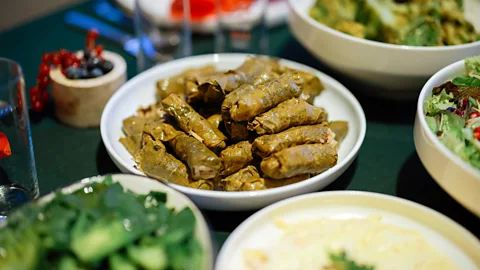
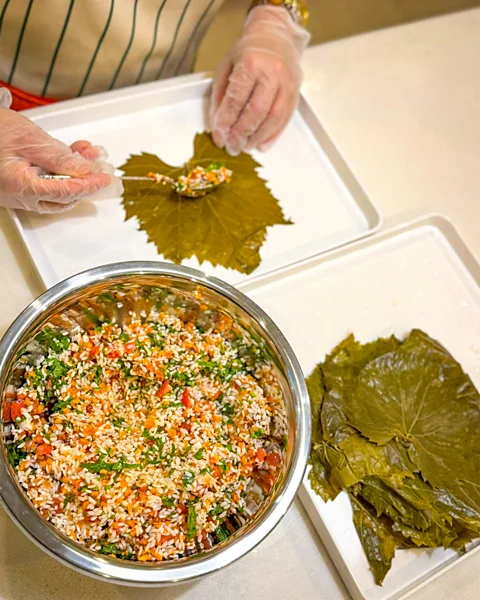
When Fatima Oliyan hosts guests for a traditional Saudi holiday meal at her home in Riyadh, her menu almost always features waraq enab, or stuffed grape leaves, also known as dolma. Neatly rolled and topped with a dash of lemon juice, the leaves are filled with a spiced mixture of rice, meat and vegetables, then carefully arranged on a wide platter.
"I love making dolma at home," says Oliyan. "We have been making these for ages in our family. I cannot even imagine a festive platter without it." For her, dolma is not just food; it is love, togetherness and hospitality wrapped into one bite.
I've lived in the Middle East for more than five years, and the tangy grape-leaf dolma, often reserved for celebrations, has become one of my favourites, too. I love it especially during the holy month of Ramadan, when the city's food scene comes alive after sunset. Although I don't fast myself, I enjoy hopping from one restaurant to another and shuttling between friends' homes, tasting slightly different versions of dolma every night at iftar – sometimes spicier, sometimes slightly more piquant and sometimes simply vegetarian.
However, these small differences at dinner tables in Riyadh point to a much larger story: the tale of a dish that travelled across continents and cultures to become a symbol of generosity and welcome around the world.
The timeless global story of dolma
Dolma – named after the Turkish verb dolmak, meaning "to fill" or "to stuff" – refers to a broad family of dishes in which rice, meat, vegetables and spices are wrapped in pre-cooked leaves or stuffed into hollowed fruits and vegetables, and then baked, cooked or served as is. The concept is believed to have originated in the 15th-Century kitchens of the Ottoman Empire.
"The Ottomans really became obsessed with stuffing," says Priscilla Mary Işın, author of Bountiful Empire – A History of Ottoman Cuisine. "Stuffing vegetables and animals was nothing new; people had done it for centuries. But between the 15th and 19th Centuries, everything from lamb, game birds and mackerel to onions, apples and vine leaves was stuffed. That gave rise to an extraordinary range of dolma dishes."
 Fatima Oliyan
Religious practice played a key role in shaping that obsession. The empire was home to large populations of Byzantine Christians, who fasted for nearly 180 days a year and followed dietary rules that prohibited the consumption of animal products. "Stuffed leaves and vegetables became increasingly common during this time," Işın explains, as cooks found creative ways to make filling meals without meat.
Innovation was also driven by the imperial court. The establishment of Matbah-ı Âmire, or the palace kitchen, created a highly competitive environment where cooks constantly experimented with flavours and techniques to impress the Sultan and his council. The sheer size of the Ottoman Empire further accelerated this creativity. Stretching from Algeria in the west and Vienna in the north to the Persian Gulf in the east and Yemen in the south, it connected vastly different geographies and agricultural traditions. "Vegetables from across these regions flowed into Istanbul's kitchens, where they were hollowed out, filled and reimagined," says Işın.
The pace of innovation was so intense that food historian Charles Perry later described it as a "creative explosion of dolma recipes" across the empire.
By the 17th Century, dolma had become both a beloved dish and a marker of status. "Rich men and high-ranking state officials began employing specialist 'dolma' cooks," says Işın. "And dedicated dolma restaurants started cropping up in Istanbul around this time."
Its association with festive occasions developed gradually. Rice, a key ingredient in dolma fillings, was considered a luxury in Ottoman cuisine and was often reserved for the elite. Over time, rice-based dishes such as pilaf and dolma became closely linked to special meals, including those of Eid and Ramadan evenings, signifying abundance and celebration.
How dolma travelled the Ottoman world
Under centuries of Ottoman rule, dolma spread across imperial territories, finding new homes in the Mediterranean, the Caucasus, the Balkans and the Middle East. As communities adapted it to local tastes and ingredients, it took on new names and new identities.
Stuffed grape leaves became waraq enab in Arabic-speaking regions, yaprakh in Kurdish communities, yarpaq dolması in Azerbaijan and dolmades in Greece. Stuffed vegetables came to be known as mahshi in the Levant and Egypt. In colder regions, cabbage replaced vine leaves, giving rise to dishes such as gołąbki in Poland and sarmi in Bulgaria.
 Getty Images
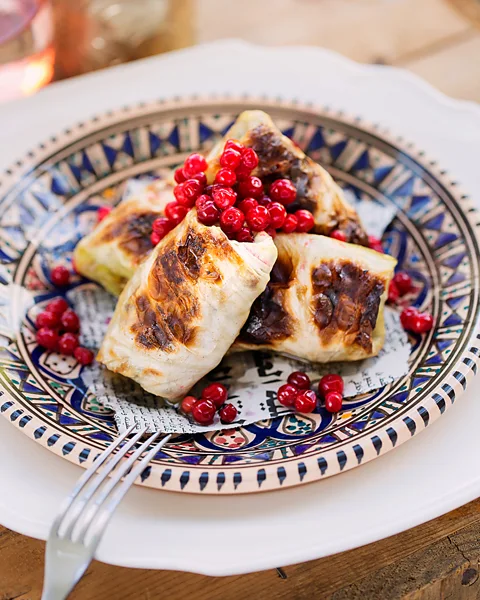
One of dolma's most unexpected journeys took it as far as Sweden in the north. After losing the Battle of Poltava to Russia in 1709, Swedish King Charles XII spent five years in exile in Ottoman lands. He returned home with a taste for stuffed dishes and a retinue of chefs who created stuffed cabbage rolls and adapted them to local tastes, giving birth to the Swedish kåldolmar.
"We like our kåldolmar sweeter than Turkish dolma," says Stefan Ekengren, chef, restaurateur and cookbook author. "Ours are often dressed with the ljus sirap – traditional Swedish syrup used for baking and flavouring – and served with lingonberries."
To the east, dolma found a new home in India. Armenian merchants who settled in Kolkata in the 16th Century introduced the idea of stuffed vegetables to local kitchens. Bengali cooks took it a step further by filling potala – a pointy gourd native to the region – with fish, prawns, potatoes, poppy seed paste, raisins and cottage cheese, and cooking it in a fragrant curry. The result, potoler dolma, is a dish that evokes a million emotions in West Bengal.
A dish for celebrations
Wherever dolma travelled, it adapted to local climates, crops and culture. What remained constant, however, was its place as a festive dish reserved for celebrations and family gatherings, symbolising love and togetherness.
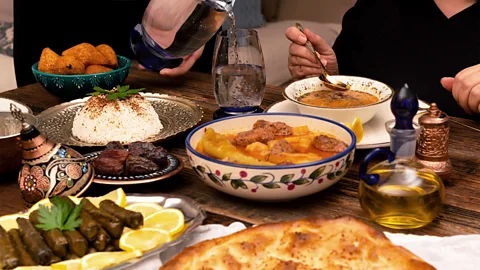
Today, waraq enab remains the centrepiece of iftar platters in Turkey and the Middle East during Ramadan. In Kurdistan, yaprakh is integral to Newroz feasts. "In Sweden, people love to have this hearty dish for family lunches, when everyone gathers around the table," says Ekengren.
In Bulgaria, sarmi are prepared for Christmas Eve and New Year's; while in India, potoler dolma is often the highlight of family meals during Durga Puja, the region's most important Hindu festival.
"I can't even think of a feast where potoler dolma isn't served with rice," says Tanayesh Talukdar, a Kolkata resident and founder of travel blog Shoestring Travel, reflecting how deeply this Ottoman-inspired dish has become woven into Bengali culture.
 Getty Images
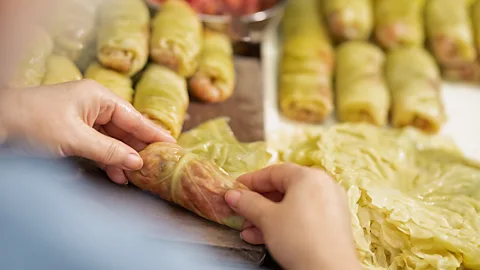
One reason dolma retains its special status is because of the work involved in making it. "Making the stuffing, hollowing the vegetables carefully and filling them takes patience," says Talukdar. "That's why we reserve it for celebrations and festivities." According to Işın, this labour-intensive nature is also why dolma featured prominently on Ottoman palace guest menus between the 17th and 19th Centuries.
More like this:
During Ramadan, Oliyan rarely prepares dolma alone. "My in-laws and I usually gather around a table," she says. "Some prepare the leaves, others make the filling and the rest roll. It is fun to do it together and gives us time to talk and catch up."
This tradition of communal dolma-making – recognised as a Unesco Intangible Cultural Heritage practice in Azerbaijan – is deeply rooted in collective culture, often passed down through generations by family elders at festive gatherings.
For many, dolma also evokes nostalgic memories. "I love potoler dolma stuffed with fish and raisins; this is the version that my grandmother used to make," says Talukdar. "Whenever I visited her, I would ask for extra servings and eat only this with rice, even if there were other dishes."
His grandmother passed away several years ago, but he still remembers her dolma. "I am always searching for the same taste," he adds.
 Getty Images
For Işın, the dish brings back memories of her mother-in-law and uncle-in-law, who helped her perfect the art of dolma-making when she first moved to Istanbul.
For Isabelle Fredborg, food writer at Swedish Spoon, the dish brings back memories of her grandfather, who once competed in a kåldolmar eating contest against a schoolmate. "They both managed to eat 12 kåldolmar before giving up," she says with a smile. "By then, both were far too nauseous to continue."
After centuries of crossing borders and adapting to new lands, dolma continues to do what it has always done best: bring people together and build a sense of belonging. Whether served at iftar during Ramadan, prepared for a Christmas feast or cooked for a family reunion, the message behind a plate of dolma remains simple and consistent – you are welcome and you are loved.
--
If you liked this story, sign up for The Essential List newsletter – a handpicked selection of features, videos and can't-miss news, delivered to your inbox twice a week.
