How the sound of sport is being reimagined for deaf fans

 Alamy
AlamyNew technologies tested at the Deaflympics in Tokyo are creating new ways of experience the atmosphere at sporting events.
For fans of live sport, the experience is as much about the atmosphere – the sights, smells and sounds – as the drama unfolding in front of them.
Think about the crack of a bat, the blast of a whistle, thump of a ball and the roar of the crowd. Would there be something missing without them? At the Deaflympics in Tokyo in November 2025, sound has been reimagined to ensure no-one misses out.
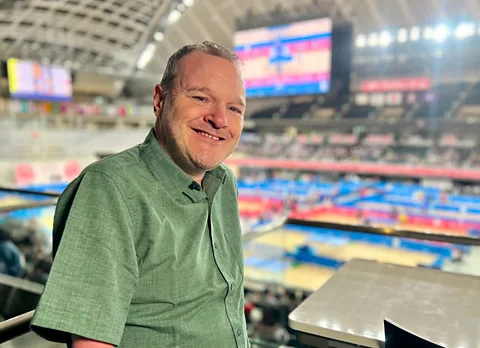
Filming recently for BBC TechXplore, I learned that, at the Deaflympics, sound doesn't have to just be something you hear. It can be something you see. Something you feel. Sometimes, something you hold.
For more than a century, the Deaflympics has been the pinnacle of elite competition for deaf athletes. Now, it is also one of the world's most important testing grounds for inclusive technology, where engineers, designers and deaf users collaborate to redefine how sport is experienced.
From on-screen onomatopoeia to AI-powered announcements and vibrations delivered into the audience, Tokyo's Deaflympics offers a glimpse of a future where sound no longer belongs only to those who can hear.
Seeing sound at the table tennis table
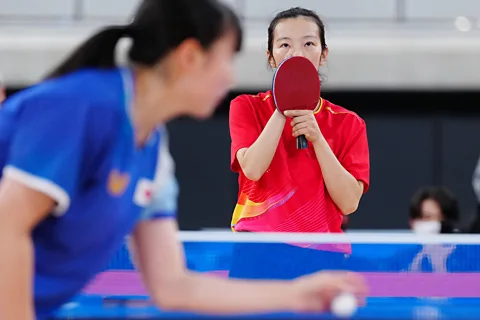
Sometimes, the simplest technologies are the most powerful. Inside the table tennis arena, I felt the electricity in the atmosphere as fans rallied behind Japan, a global powerhouse in the sport. But instead of focusing on the ball's rhythmic rally, deaf spectators are invited to look up.
Above the court, giant animated graphics flash across a screen: bold Japanese onomatopoeic words that mirror the rhythm of play. Each strike is matched with expressive characters that visually represent sound effects – the impact of the ball, the speed of the rally, the power of a smash. Sound, translated into language you can see.
Onomatopoeia – words that imitate sounds – plays a unique role in Japanese culture, where visual sound expressions are widely used in manga and media. At the Deaflympics, that cultural familiarity becomes an accessibility tool. For some fans, especially newcomers to the sport, the system provides instant context: how fast the rally is, when a point is decisive, when momentum shifts.
 Kitty Knowles/ Electric Eel
Ito Maki of Japan's Deaf Table Tennis Association, has seen technology evolve over the years. "I used to be a table tennis player, so I prefer to watch the matches themselves," he says. "But for people who don't play, or who are deaf, this helps them understand better. Being able to hold an event like this now – it moves me deeply."
Onomatopoeia beyond sport
With 19 Deaflympics venues both in and around Tokyo, thousands of deaf visitors from around the world have helped to turn the city into a living laboratory for accessible urban technology.
Station-hopping between venues, I tested Toppan's transparent sound-to-text translation screens. Deployed in 19 Toei Metro stations, these make travel communication easy for deaf and hearing visitors, whether they speak Japanese or not.
At Deaflympics Square, a central hub for athletes and fans, I was struck by an AI-powered transport display developed by technology giant Fujitsu. Already piloted in major stations by Japan Rail, it listens for platform announcements, approaching trains, warning buzzers, and background music. The cacophony of environmental noise is categorised and converted into text and sign language.
Once again, onomatopoeia plays a role. Certain sounds are represented visually to convey urgency, movement or emotion – helping users understand not just what is happening, but how it feels.
Importantly, this device was created with the deaf community, specifically children from Kawasaki Municipal School for the Deaf.
"In Japan, many students use trains every day," says Tatsuya Honda from Fujitsu's Converging Technologies Laboratory. "We designed this device with deaf students – to be fun, safe and useful."
I experienced the device alongside Finnish Deaflympian Sara-Elise Ruokonen, who said it was important deaf people were involved in the design "because we know best what we need".
Feeling action through vibration
Back in the sporting arenas, sound was also brought to life through touch.
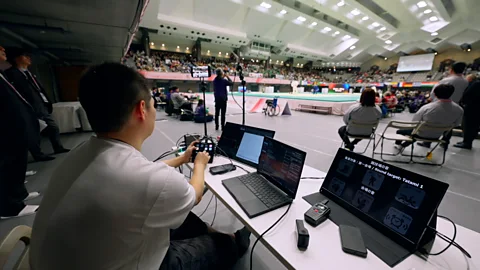
At Tokyo Budokan, home of the deaf judo, spectators wore vibration devices developed by Hapbeat, a company originally known for immersive music technology.
As judo fighters grip, shuffle and throw, every movement is captured by microphones and sensors in the mat. Footwork produces light vibrations. Collisions produce stronger ones. A full throw lands as a deep, unmistakable sensation to the chest.
Fans do not simply watch a match – they feel it.
 Kitty Knowles/ Electric Eel
"Shuffling feet felt like a lighter vibration, while collisions were stronger," says deaf judo fan Eri Terada, from Japan. "When someone was thrown, it was a heavy thud. Each one was different. I thought, 'Wow – this is amazing. It's so easy to understand.'"
The Hapbeat device also delivers match cues, like the start and end of bouts, often signaled only by voice or gesture. A former swimmer, Sano Akira, explained how transformative this is: "The simplest thing is knowing when a match starts or ends. Since I can't hear that, having this device notify me is really helpful. It gives a sense of realism – like being right there."
Some aspects of sound remain hard to automate. "Detecting nuance is difficult," says Hapbeat chief executive Yusuke Yamazaki. Crowd reactions – clapping, cheering, buzzers – are adjusted in real time by a human operator. Cultural understanding matters too, as deaf audiences often wave their hands instead of clapping.
Interestingly, the device also drew hearing fans as well. What began as an accessibility tool became a shared sensory experience. "Even though I can hear, the device really conveyed the atmosphere," said Nana Watanabe, a hearing spectator from Japan. "It felt like we could share the intensity together."
Holding the music
The Deaflympics doesn't just promote inclusive design in sports; it promotes accessible experiences everywhere. My personal highlight came at a music event with Indian golfer Diksha Dagar, a Deaflympics gold medalist, Olympian and two-time Ladies European Tour champion.
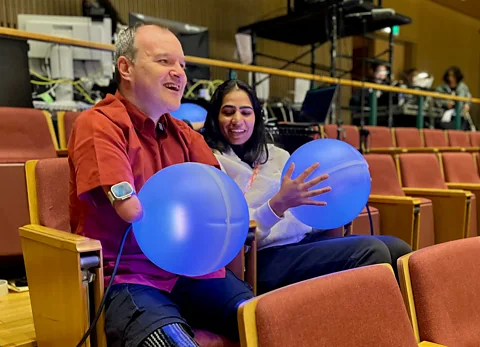
After watching her make her final putts, we tried out Sound Hug devices from Tokyo startup Pixie Dust Technologies.
Holding a football-sized orb each, sound transformed into something to embrace. The orbs pulsed light and vibrated in response to music – not only translating tone and beat but emotion. Experiencing traditional performances from hundreds of years ago, brought to life with modern immersive technologies, was incredibly moving.
"We can feel the music and the vibrations," said Dagar. "It tells us about the sound, so it's interpreted for deaf people."
 Kitty Knowles/ Electric Eel
Designing a different future for sound
The Deaflympics demonstrates the power of shared, universal experiences. And, with so many deaf users present, it serves as a unique testbed for refining accessible technology.
A pair of smart glasses I tried in the stands with Team USA swimmer Brooke Thompson weren't perfect yet, but the Deaflympics is the ideal proving ground for early-stage testing.
When accessibility is the starting point, not an afterthought, sound is transformed. When deaf people lead design, sound becomes visible. When engineers listen differently, sound becomes tactile. When inclusion drives innovation, everyone benefits.
At the Deaflympics, the future of sport is not silent – it is vividly, powerfully alive.
* Paul Carter is the presenter of TechXplore: Tokyo Deaflympics, which was broadcast on BBC News on 14 February 2026.
--
For more technology news and insights, sign up to our Tech Decoded newsletter, while The Essential List delivers a handpicked selection of features and insights to your inbox twice a week.
For more science, technology, environment and health stories from the BBC, follow us on Facebook and Instagram.
