'As long as it's in Scotland I'm happy': The 1950 heist to reclaim the ancient Stone of Destiny

 Alamy
AlamyThe Stone of Destiny, an ancient symbol of the Scottish kings, was taken by four university students in an audacious Christmas raid 75 years ago. This was more than a prank: they said they were in fact reclaiming a beloved treasure stolen by an English monarch more than six centuries before.
Early on Christmas morning in 1950, the Dean of London's Westminster Abbey woke up to discover his home had been visited overnight. Rather than leaving him a nice present, the mystery intruders had made off with one of the Abbey's most prized possessions. Since the 1066 Coronation of William the Conqueror, the Abbey had served as venue for royal occasions; the focal point of these ceremonies was the wooden Coronation Chair, which had a stone fitted into its base. This was no sparkling gem; the Stone of Destiny, also known as the Stone of Scone, was a 150kg (330lb) red-sandstone block – but it had heavy symbolic significance. And now it had been forcibly removed.
Two days later, the outraged Dean, Alan Don, made a solemn appeal on BBC radio over this "senseless crime". He said: "It had been in the Abbey for over 600 years, and not until this week has anyone dared to lay sacrilegious hands upon it. This precious relic… is treasured by millions throughout the British Commonwealth and Empire and not least by those who, like myself, see in it the symbol of the Scottish descent of our beloved King." He vowed: "I will go to the ends of the Earth to fetch it back."
Two days later, the BBC's Newsreel reported a potential clue; the initials JFS, "apparently newly scratched on the chair, are thought to stand for 'Justice for Scotland' and support the theory that the stone's disappearance is the work of extreme Scottish nationalists".
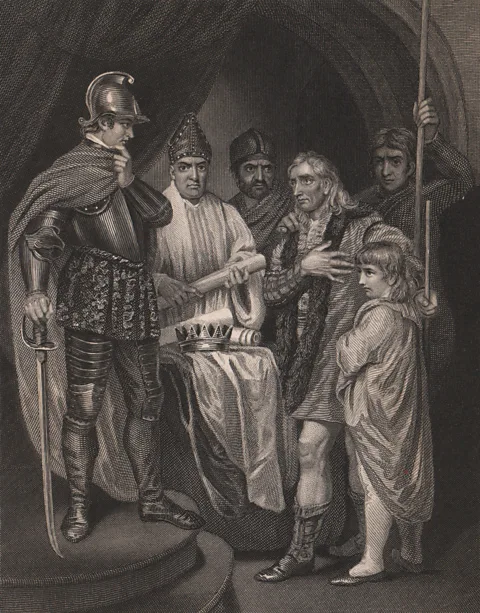
The looting of the stone by King Edward I in 1296 was still a sore point for some Scottish people, who believed it had no place being kept in England. After all, the stone had been used in the coronations of Scottish kings for hundreds of years before it was taken and lodged in Edward's carved-oak coronation throne.
 Alamy
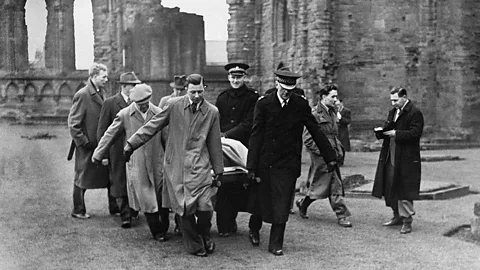
AlamyEvidence of the Christmas morning raid was visible when the BBC's cameras visited. The narrator noted "the trail of damage" showing how the stone was dislodged from the chair and hauled out. The trail led to Poet's Corner, where writers from Geoffrey Chaucer to Charles Dickens are buried or memorialised. A padlocked door there had been forced open, and the stone was thought to have been dragged outside to Millbank, a nearby road beside the River Thames. "There, the trail was lost," he said.
Police set up roadblocks and closed the border between Scotland and England for the first time in 400 years. Detectives at Scotland Yard, London's police headquarters, worked on the theory that the stone had been dumped in water. Based on an anonymous tip, the Serpentine lake in Hyde Park was dragged twice. As the report was broadcast, extra hauling gear was brought in to recover an item they thought might be the stone. But it was already long gone.
The Scottish Covenant Association, founded to petition for Scotland to have its own parliament, quickly denied involvement. In the Newsreel report, its chairman John MacCormick is shown grinning and raising a toast with what is presumably Scotch whisky. He makes no pretence of being upset, and that's no surprise. It later turned out that four of the Association's young members had carried out the audacious raid.
An audacious plan
In May 1951, the Glasgow University students – Ian Hamilton, Kay Matheson, Gavin Vernon and Alan Stuart – confessed all in a BBC radio interview about just what had happened that night. It all began late on Christmas Eve, when the three men broke into the Abbey while Matheson waited outside in one of their two getaway cars.
"The first thing we did was move away the barrier that keeps away the rest of the public from the stone," recalled Vernon. They prised the stone from underneath the Coronation Chair and laid it on the floor. Ian Hamilton's coat became an improvised drag mat. Vernon added: "Alan and I took an arm of a coat each, and Ian took one of the chains of the stone. And as soon as he pulled, the stone gave way."
 Alamy
AlamyBut the triumph was short-lived. As they dragged the heavy stone, it broke in two. "I remember how terrified I was," Hamilton admitted. "We had come 400 miles and there, just as we dragged the stone along, it had come apart." Unknown to them, almost four decades earlier a suffragette bomb attack may have weakened it. In the chaos, Hamilton seized the smaller fragment, still weighing about 41kg (90lb), and bolted through the Abbey carrying it like a rugby ball.
Outside, Matheson moved the car forward to warn that a policeman was approaching. Within moments he was in front of them. Hamilton leapt in beside her, covered the broken stone with an old coat and improvised a story about them being young lovers with nowhere to go on Christmas Eve. The officer, far from suspicious, removed his helmet, lit a cigarette and chatted amiably, then let them go.
A relieved Matheson drove off alone, but at traffic lights about two miles from the Abbey, she made a sudden stop that sent the stone tumbling out on to the street. "Luckily it was all wrapped up in the rag, so it wasn't damaged," she said. Hamilton marvelled: "How you picked up that stone weighing 90 pounds and put it into the boot of the car, I don't know."
Matheson was shaken but drove on, dropping off the stone segment with an English friend in Birmingham. Meanwhile, with great difficulty, the three men got the bigger part of the stone into the second car and fled the scene. Unsure what to do next, they buried it near some woods in Rochester, Kent and returned home. But they began to worry the stone that had been kept indoors for 654 years wouldn't react well to the winter cold.
Hamilton told the BBC's Witness History in 2018 that when they returned to retrieve it on New Year's Eve, or Hogmanay, they found a Traveller encampment set up "just exactly where the stone was". They persuaded them to help carry the stone to their car, and the Travellers never told the police about them.
'A secret is a secret'
The stone crossed the border to Scotland for the first time since 1296 and was handed to John Rollo, a businessman from High Bonnybridge near Falkirk. He agreed with one condition: "No one but myself will ever know where it is, because a secret is a secret when it's with one person only." Police never discovered his true story. When he was interviewed by BBC Radio Scotland in 1971, he insisted the tapes must be kept secret until his death. True to their word, the interview wasn't broadcast until 1986. As vice-chairman of the Scottish Covenant Association, detectives suspected he might be involved and visited his factory several times. Little did they know, he was hiding the smaller broken part of the stone in his office under his desk.
Both parts had to be reunited and the restoration was overseen by Bertie Gray, a nationalist politician who was fortunately also a stonemason. It emerged in November this year that Gray gifted leftover fragments to personal and political associates.
In History
In History is a series which uses the BBC's unique audio and video archive to explore historical events that still resonate today. Sign up to the accompanying weekly newsletter.
As the repairs continued, arguments raged about what to do once it was fixed. MacCormick reasoned that the Covenant campaign had already received priceless publicity but feared alienating supporters who respected King George VI, and exposing the Association if criminal proceedings followed. A symbolic location was chosen for the return on 11 April 1951. The stone was left at the ruined Arbroath Abbey, the scene of a 1320 declaration calling for the right of Scots to rule themselves. Abbey custodian Mr Wishart told Newsreel that three men arrived in a car and carried it in on a wooden stretcher. Police transported it back south of the border, while senior lawyers decided what to do with the culprits.
By then, even the outraged Dean of Westminster had calmed down. He told the London Daily News: "I regret the manner in which it was removed from the Coronation Chair, but I bear no ill will towards the people who took it. I am gratified that it was returned in this voluntary way. "
 Alamy
AlamyThree days later, more than 30,000 Scottish football fans descended on London to watch their team beat England 3-2 in the Home Championship. After the match, BBC Newsreel followed many of them as they made their way to Westminster Abbey in the hopes of catching a glimpse of the famous stone. The authorities had taken no chances and locked it out of view under extra police guard.
On 19 April, Attorney General Sir Hartley Shawcross told the House of Commons he had decided that it was not in the public interest to create martyrs or heroes by prosecuting those behind these "vulgar acts of vandalism". Amid laughter from some colleagues, South Ayrshire MP Emrys Hughes suggested that rather than vandalism, "a lot of people in Scotland regard it as an attempt to recover stolen property".
The stone was put back in Westminster Abbey and in June 1953, King Edward's chair – with the Stone of Destiny beneath – was seen on television all around the world during Queen Elizabeth II's coronation. But that was not the end of the story. In 1996, UK Prime Minister John Major did what the four students had set out to do more than four decades before; he decided to return the stone to Scotland, but only on the condition that it would be brought back for any future coronations.
More like this:
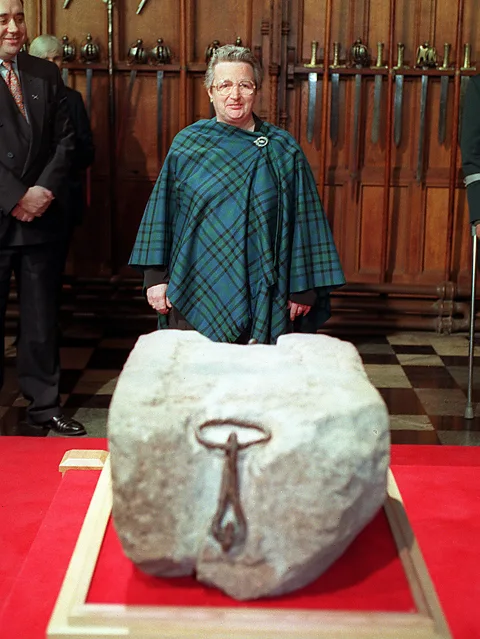
At a ceremony in Edinburgh Castle on St Andrew's Day, the stone was formally unveiled. Ian Hamilton didn't attend but his co-conspirators were there. Alan Stuart congratulated the organisers for doing "a far better job than we did in 1950". Gavin Vernon told the BBC he was still grateful that "Scotland Yard was not as efficient as it should have been [as] they should have caught us within several days".
As for Kay Matheson, she didn't mind what the location of its new home would be: "Whether it be Stornoway or Inverness or Edinburgh, as long as it's in Scotland I'm happy."
--
For more stories and never-before-published radio scripts to your inbox, sign up to the In History newsletter, while The Essential List delivers a handpicked selection of features and insights twice a week.
