The colourful mountain landscape that looks out of this world

 British Mineralogy
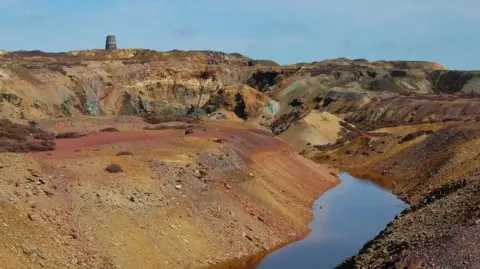
Beneath Anglesey's Parys Mountain lies a millennia-old melding of man and nature.
The peak was created over millions of years as shifting tectonic plates forced its mineral-laden rock from modern day New Zealand upwards, while humans have been mining its copper for at least 4,000 years.
The result is a breathtaking juxtaposition of Bronze Age tools nestling among some of nature's most spectacular and colourful phenomena that has seen it used as a setting for programmes including Dr Who and Black Mirror.
During its 18th Century heyday it was the largest copper mine in the world, and now the Amlwch Industrial Heritage Trust (AIHT) aims to celebrate it with a £1m visitor centre.
AIHT project director and keen underground explorer Lucy Dusgate said the area "influenced world economics, politics and technology for several hundreds of years".
She added: "At the same time it has the sort of rare and bizarre natural life you'd have to go to the depths of the oceans to see."
For decades the Parys Underground Group (PUG) has been taking tours through the mine for those fit and brave enough to explore the sights themselves.
Now, AIHT wants to recreate the experience for those 40,000 visitors a year who are unable to make the subterranean trip so they can "see and touch objects which formed part of our history for that long," said Lucy.
The plan is to create an immersive display of the underground landscape and AIHT is some way to raising the required £1m with an aim of opening in 2028.
 Lucy Dusgate
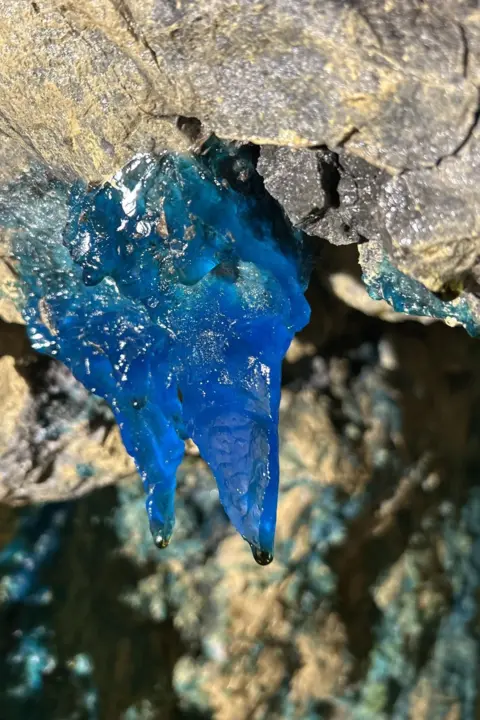
The colourful sights and ecosystem at Parys Mountain are determined by its highly acidic and copper-rich geology - bioluminescent single-cell organisms light up strata of red, gold and blue rock.
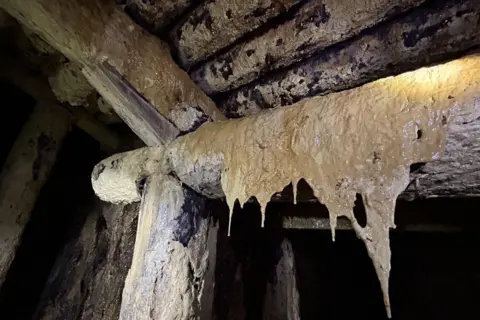
"Snotties" looking like sheets of thinly-rolled pastry hang from the roof beams but are in fact bacteria that evolved to feed off the acidic conditions.
At least four species of bats gorge on the various insects and small reptiles adapted to survive both above and beneath the surface.
Lucy described the man-made tunnels and natural caverns as a "riot on the senses".
"Before I first went underground with PUG, I imagined it would be cold and grey. In fact it's quite warm and so, so colourful.
"Stalactites and stalagmites in every conceivable hue, blue or green streams depending on the copper compound they contain and other-worldly organisms seemingly thriving where you'd think they have no business living at all."
 Lucy Dusgate
During the Bronze Age, mining at Parys was a local concern with copper ore hewn from shallow tunnels smelted on enormous bonfires nearby.
Most of this copper would have been used for pots and early coins
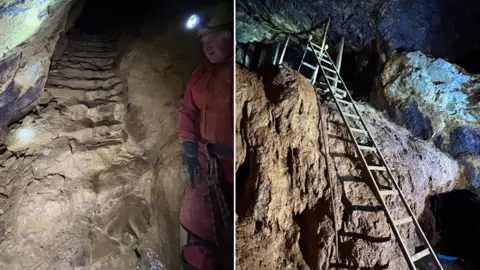
By the 18th Century, up to 1,000 men chipped - and latterly blasted - their way through 44,000 tons of copper ore each year before it was brought above ground via a "snakes and ladders" system of ramps, horse-drawn trucks and pulleys.
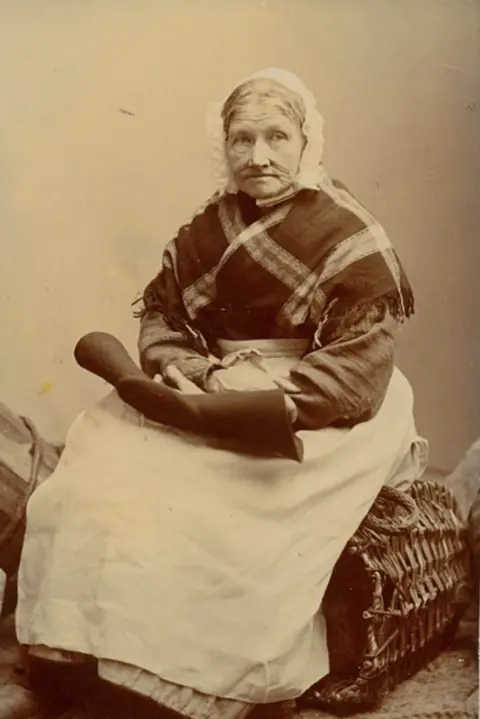
There it was smashed into more pure ore by a workforce of mostly women - many of whom were widows of husbands killed on the rock face – before being transported by barge to Swansea and Lancashire for smelting.
 Lucy Dusgate
The resulting copper nuggets were used to sheathe ships' hulls, making the Royal Navy even faster and more formidable, as well as providing a far more durable and malleable material for the piping that was vital in the steam-powered industrial revolution.
Lucy said: "It's impossible to underestimate how important the copper from Parys was all around the world, from everyday pots and pans to a means of political power."
By the end of the 19th Century, cheaper and more easily excavated Chilean copper meant Parys's dominance began to wane - but with 6.4 million tonnes of reserves remaining, Lucy said its mining days may not yet be behind it.
She added that the remains of four millennia of mining are no less mind-boggling than nature's contribution.
More than 100 Bronze Age stone axes - used to crack into the ore - have been found, with Lucy saying "you're literally tripping over them everywhere you walk".
There are also spiral staircases carved into the rock that linked the seams, but traces of modern mining are harder to come by.
"Owing to the acidic conditions wood has survived far better than metal so while there are no tools, we do have ladders, clogs and even Woodbine cigarette packets."
 Amlwch Industrial Heritage Trust
These are precisely the sorts of artefacts AIHT would like to exhibit in its proposed visitor centre, made from interlinked shipping containers in a bid to be sustainable and nod to the industrial past.
"It's funny, the difference between litter and fascinating history is just a matter of a few hundred, or in some cases, thousands of years," said Lucy.
"The two aspects of the mountain go hand-in-hand. If there hadn't have been mining we'd never have been able to experience the wonders which lurk within."
