Germany's Fairy Tale Route: The real places behind the Grimm stories

 Alamy
AlamyAs Germany's Fairy Tale Route turns 50, towns and cities along the 600km route continue to breathe new life into the Brothers Grimm's much-loved fairy tales.
I feel a childlike thrill as I cross a wooden bridge and duck through the small arched door into the courtyard of a medieval castle where I'm spending the night. I'm in Trendelburg, halfway along Germany's Fairy Tale Route, a 600km (323 mile) journey linking towns and landscapes associated with Jacob and Wilhelm Grimm and the stories that have shaped childhoods for more than two centuries.
Founded in 1975, the route was designed to invite travellers into a romanticised world of castles, forests and folklore while preserving Germany's cultural heritage. It begins in Hanau, the Brothers Grimms' birthplace near Frankfurt, and winds north through half-timbered towns, wooded hills and medieval fortresses before ending in Bremen. While many travellers drive it as a road trip, I choose to travel by train, stopping in the places where they studied, worked and got inspiration for the famous stories like Hansel & Gretel, Rapunzel and Cinderella that were collated in their famous Children's and Household Tales.
Like many children, I grew up on sanitised versions of these tales through bedtime stories and Disney films. But the Grimms' early editions, first published in 1812 and 1815, were darker, stranger and far less sentimental, with poverty, hunger and moral ambiguity running through them. As the Fairy Tale route marks its 50th anniversary, I'm curious to see how the Grimm legacy is being shaped for a modern audience.
Hanau: Where the story begins
My journey starts in Hanau, where a statue of the Brothers Grimm stands in the market square in front of the stately town hall. Jacob and Wilhelm Grimm were born in 1785 and 1786, respectively, and the statue shows Wilhelm sitting with a book open across his lap, and Jacob standing over his shoulder (although legend says at midnight, they secretly switch places).
 Hendrik Nix
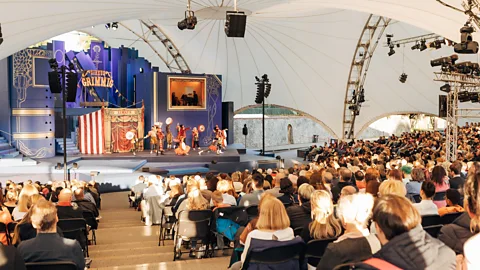
Every year from May to July, the city becomes the stage for the Brothers Grimm Festival when three Grimm fairy tales are reinterpreted for contemporary audiences. Past productions, performed in an open-air amphitheatre beside Castle Philippsruhe, have tackled beauty standards in Snow White and discrimination in Hansel & Gretel.
"This year we're staging The Wishing-Table," says Jeroen Coppens, head of PR and dramaturgy for the festival, "which, in our new interpretation, addresses political themes such as populism and fake news, topics that are extremely relevant today."
Productions are performed in German, but Coppens says international visitors are largely able to follow the well-known plots. For locals, the festival is particularly important; many of them would have attended as children with their families or school. When organisers asked volunteers to crochet a 7m-long (23ft) Rapunzel's braid last year, they received more than 1,000 responses.
Marburg: Where the brothers found their voice
From Hanau, I take a train north through rolling countryside to Marburg, a small university town 100km (62 miles) away where the brothers studied law in the early 1800s. It was here that their fascination with the German language and folk studies took root. It's also the hometown of artist Otto Ubbelohde, who incorporated aspects of Marburg in some of his illustrations for early 20th-Century editions of Grimms' fairy tales.
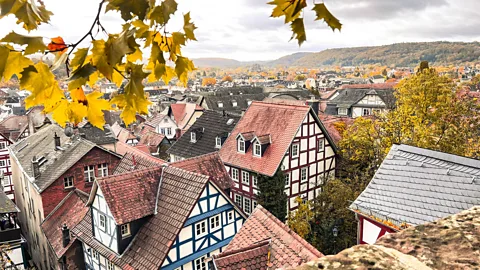
Marburg's hilly Old Town seems to lean into its fairy tale credentials. Half-timbered houses tilt over narrow cobbled streets; steep roofs cluster beneath the hilltop Landgrafen Palace. Climbing to the castle, I spot the arched entrance that Ubbelohde used in his illustration for The Queen Bee and am rewarded with sweeping views over red roofs and forested hills – landscapes that could easily host wandering children or lurking wolves.
 Marburg Stadt und Land Tourismus GmbH
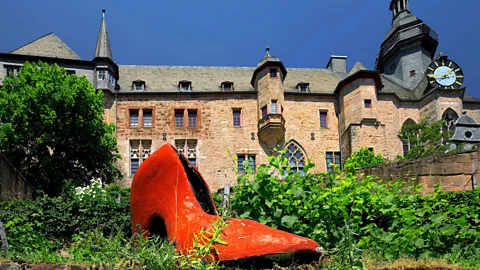
On the way back down, I pass stops on the Grimm Path, a self-guided walking trail between the castle and the historic old town that features characters and motifs from Grimm's fairy tales, such as a giant Cinderella slipper and the Frog Prince. It's clearly aimed at families, but I'm still delighted when I match a motif to its tale.
Kassel: Beyond the fairy tale
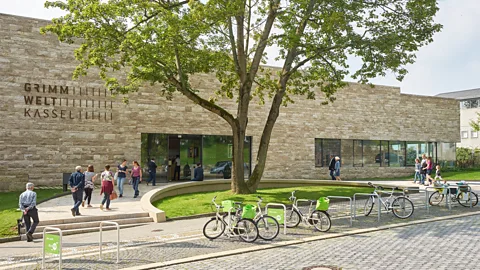
An hour north of Marburg lies Kassel, where the Grimms lived and worked for 30 years. Here, at the Grimmwelt (Grimm World) Museum, the fairytales take on a more complex shape. A glass case houses the first author copies of Children's and Household Tales, showing the brothers' handwritten corrections and additions. The brothers were not merely storytellers, but linguists who also compiled one of the most ambitious German dictionaries of the 19th Century.
"Many [visitors] are curious to learn more about the historical figures behind the stories and their work as linguists, scholars and collectors," said Claudia Rosskopf from Grimmwelt Kassel.
 Grimmwelt/ Nikolaus Frank
The museum doesn't shy away from the harsher context behind the tales. Many of the stories were collected from local middle-class women, who in turn heard them from servants, farmers and travelling merchants. These early oral versions were even darker than the tales we know today. They mirrored the harsh realities of rural life, and without written records, needed to be memorable through extreme plots and vivid storytelling. As a result, Grimms' early editions were closer to cautionary folklore than children's entertainment.
There was also a level of moral ambiguity present; for example, in the 1812 version of Hansel & Gretel, it was their mother who abandoned them in the woods, rather than their stepmother. Such poverty-driven acts of survival were not unheard of in periods of famine. In the museum, a dedicated section highlights the role food plays as temptation or reward in fairy tales, and the context of poverty in the early 19th Century.
Trendelburg: Stepping inside the story
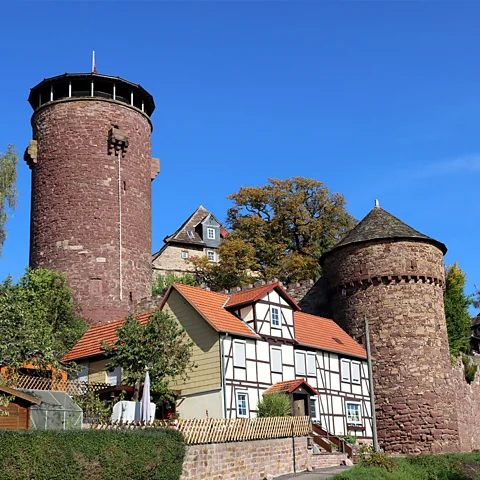
By the time I reach Trendelburg, I am fully immersed in the fairytale world of the Grimm brothers. Hotel Burg Trendelburg, the medieval castle-turned-hotel where I'm staying rises above the Diemel River, its cylindrical tower instantly recognisable as "Rapunzel's Tower". A thick blonde braid dangles from one of its windows.
 Alamy
AlamyThe tower wasn't the literal inspiration for Rapunzel – the Grimm's version was likely adapted from earlier folk tales – but over time it has become one of the route's most photographed symbols, likely due to its medieval architecture and position in northern Hesse, the brothers' homeland.
The hotel celebrates this association with a short Rapunzel performance on summer Sundays, reenacting the scene where she lets down her hair from the tower window. In addition, each May, it hosts a family-friendly medieval festival, featuring knights, sword fighting, archery, puppet theatre and fire acrobatics.
More like this:
After dropping my bags in my room and swooning over the old-fashioned writing desk and Snow-White-style mirror on the wall, I climb the tower's 130 spiral steps. From the parapet, half-timbered houses cluster below and the Reinhardswald forest stretches to the horizon. This is one of Germany's largest contiguous woodlands; wandering its trails later that afternoon, past gnarled oaks, twisted roots and fallen trunks, it is easy to imagine how such landscapes fed the stories' darker edges, such as the woods in Little Red Riding Hood.
Hamelin: A darker note
My final stop is Hamelin, forever linked to the Pied Piper, one of the darker stories in the Grimms' collection. The unsettling story tells of a piper hired to rid town of a rat infestation; he uses his magic pipe to lure the rats into the river, drowning them. When the mayor refuses to pay, the Piper leads all the children away from the town, never to be seen again.
 Alamy
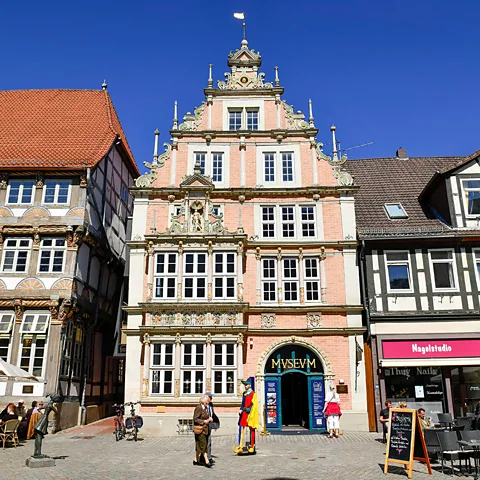
AlamyI stroll the streets of Hamelin's Old Town, down cobblestones engraved with golden rats, and admire its gorgeous Weser-Renaissance buildings, like the 16th-Century Leisthaus with its pastel pink facade, ornately carved reliefs and gold-trimmed decorations.
The building is home to the Hamelin Museum, where I discover the real-life origins of the story. Several historical records refer to an event in 1284 when 130 children went missing from the town. There are multiple theories on what happened; perhaps it was poverty-fuelled migration, or maybe they were lost to the plague. Amidst the unknown, the story evolved through the centuries, eventually making its way into the Grimms' collection.
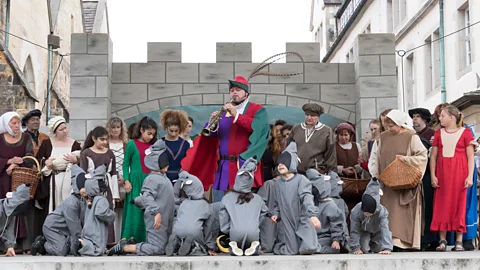
Today, Hamelin embraces its connection to the tale. The museum's mechanical theatre stages a short, automated show multiple times daily; there's a miniature clockwork show in the main square three times each day; and the town hosts a seasonal open-air play on Sundays.
"It's a proud honour to be a part of a tradition and story that spans centuries," says Brian Boyer, who plays the Piper in the open-air play, "representing ideas of honesty and reliability, with the cautious tale of keeping your word."
 Hameln Marketing und Tourismus GmbH
Fifty years on
Like the fairy tales from which it was named, the Fairy Tale Route has evolved since its origins as a scenic, romanticised journey through Germany's folklore. Today it's less about castle-hopping and more about interpretation, as stories born of famine and fear continue to be reimagined through festivals, museums and performances.
"The Brothers Grimm represent a shared cultural legacy," says Rosskopf. "Their fairy tales have been translated, adapted and reinterpreted across the world. Telling their story allows us to reflect on how cultural narratives travel, change and continue to shape societies."
Fairy tales still have an important place in our world – they act as a bridge between fantasy and reality; somewhere we can go to explore ethics and morals and reflect on our own life's narrative. Fifty years on, the Fairy Tale Route isn't just about stepping into fantasy. It's about understanding how stories survive by changing with us.
--
If you liked this story, sign up for The Essential List newsletter – a handpicked selection of features, videos and can't-miss news, delivered to your inbox twice a week.
