Viking invader's gold coin pendant found in field

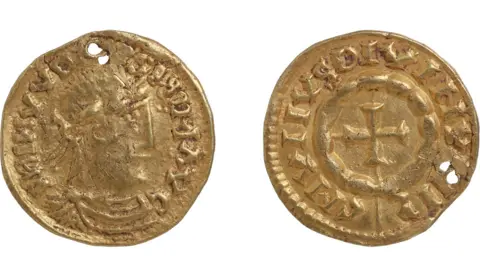 Andrew Williams/Norfolk County Council
A gold coin pendant lost by a soldier in the Viking Great Army has been discovered in a field in Norfolk.
The rare imitation of a Louis the Pious (AD814-840) solidus was found by a metal detectorist at Elsing, near Dereham, in September 2024.
The "heathen force" invaded England in AD865 and the coin was probably brought to Norfolk by one of the invaders, said coin expert Simon Coupland.
It going through the treasure process and Norwich Castle Museum is hoping to acquire it.
"It's unusual because it's made from gold, it's minted on the continent and it's associated with the Vikings," said Coupland, who is a specialist in Carolingian coins from the Carolingian dynasty of western and central Europe, centred on modern-day France.
 Getty
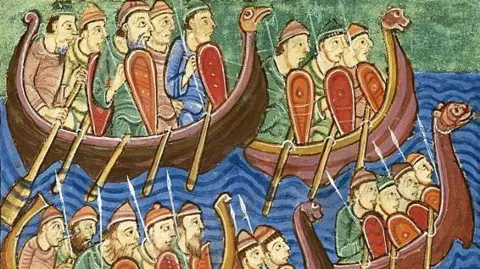
GettySo far, 22 of these imitation gold coins have been found in Britain and they chart the route of the Viking Great Army, said Coupland.
It was made up of thousands of Scandinavians and was described as "a great heathen force" by the Anglo-Saxon Chronicle.
They made their way across England along the rivers and Roman roads and by 880, had control of the kingdoms of East Anglia, Mercia and Northumbria.
In recent years, metal detectorists have helped archaeologists and historians uncover many more details of the army's movements by reporting their finds through the Portable Antiquities Scheme.
The imitation was based on a very rare original coin minted by Louis the Pious in about 816, after he succeeded his father Charlemagne as the Holy Roman Emperor.
Coupland said: "Experts disagree on whether there's a tiny handful or a handful of the originals around. One French scholar says there are only three, but potentially there are as many as six of the originals.
"An absolutely gorgeous one sold at auction last year in Belgium."
It is believed Louis might have used them as ceremonial gifts, to reward his top magnates, or give to a visiting dignitary.
In contrast, more than 100 of the later imitations have been found, with most discovered in western Europe.
"They're of a style that was made in workshops in Frisia, now part of the Netherlands, as a type of portable wealth," said Coupland.
"The Norfolk find is a particularly fine specimen compared with most. It's copying an original quite closely - you can see quite a few of the letters do look like letters."
It is also only the second one of these imitation coins to be discovered in the county.
A coroner will determine if this high-quality find should legally be classed as treasure.
Follow Norfolk news on BBC Sounds, Facebook, Instagram and X.
