'Gasps of wonder': The 19th-Century US home that embodied the super-rich

 William Abranozicz
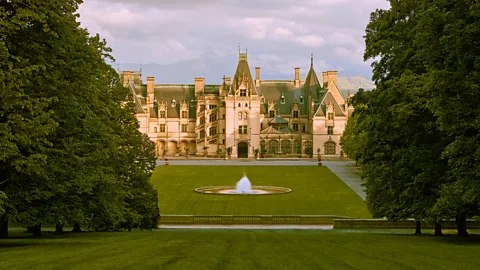
"A time-travel fantasy" and the largest privately-owned home in the US, Biltmore House was George W Vanderbilt's "American chateau built on the scale of a European palace". It came to encapsulate the glamour and opulence of the Gilded Age, says a new book. What does it reveal about the wealthiest one per cent – then and now?
When George W Vanderbilt invited family and friends to his newly-built home on Christmas Eve 1895, they arrived in private railroad cars on a track specially built to lead directly to his estate in the mountains of Asheville, North Carolina. The design of the 250-room mansion was based on centuries-old French chateaux of the Loire, a choice evident in its towers and spires. The Vanderbilt family crest was everywhere, from a Renaissance-style table to a chimneypiece in the four-storey-high banquet hall.
George's creation was "an American chateau built on the scale of a European palace," according to Biltmore House: The Interiors and Collections of George W Vanderbilt, an authoritative history of the house and its interior written by Biltmore's chief curator, Darren Poupore, and the art historian Laura C Jenkins, with photographs by William Abranowicz.
Today Biltmore is a popular tourist destination, the rooms authentic to the days George lived there. To enter it is to walk into a real-world version of Downton Abbey or the HBO series The Gilded Age. But it is also an avatar of American culture with all its aspirations and excesses in the actual Gilded Age, that turn-of-the-20th-Century time of suddenly increasing wealth for a few families, an era of what we'd now call great income inequality.
 William Abranozicz
A little more than a century after the American Revolution was fought to create a new country, some Americans were hungry for the kind of aristocratic culture the Old World represented. So they tried to buy it, building ostentatious mansions, importing art and furniture from abroad and flaunting their leisured lives and riches. That family crest at Biltmore was brand new, of course. George was the grandson of Cornelius Vanderbilt, known as the Commodore, who rose from poor beginnings to become a railroad-and-shipping tycoon. The Commodore epitomised the ruthless "robber baron" tactics of the early Gilded Age – building huge monopolies through unethical or questionable methods, including manipulating stock prices, bribing politicians and exploiting workers.
The crest is believed to have originated with George's sister-in-law, Alva Vanderbilt, who today is best known as an inspiration in the TV show The Gilded Age for the nouveau-riche Bertha Russell, played by Carrie Coon, who forces her way into high society. It's no mistake that the emblem borrows a bit of unearned history, with its acorns and oak leaves arranged to echo the fleur-de-lis of the French royal House of Valois.
'Most magnificent'
The Vanderbilts, Astors and other wealthy families were celebrities in their day, and newspapers breathlessly followed their performative displays of wealth. Months before the Christmas Eve opening, The New York Times wrote that Biltmore "is purposed to be the most magnificent residential [e]state in existence". Many Vanderbilts, like Alva, courted such publicity.
 Biltmore Company Archives
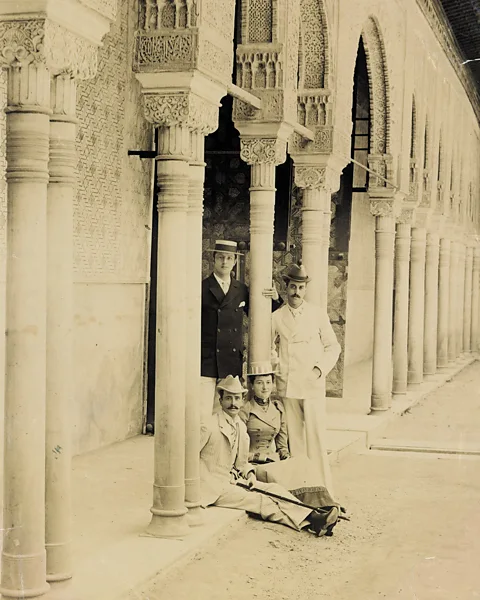
George was set apart. Jenkins tells the BBC, "He doesn't necessarily fit into a kind of Vanderbilt mould. He doesn't really participate in New York society. He doesn't inherit any of the business responsibility for his family's railroad interests. But he starts collecting from a really young age. And so we see in the design evolution of the house his travels, his education, his relationships with artists and art dealers." Over the years the bookish George travelled to Europe, Asia, the Middle East and North Africa, collecting knowledge and artworks to bring back home. Biltmore, Jenkins says, "ends up being this incredibly personal sort of portrait of a man," who was engaged with every detail of its planning.
When George decided to build his house in an isolated location – far from the extravagant Vanderbilt homes on Fifth Avenue in New York and in Newport, Rhode Island – he hired the renowned architect Richard Morris Hunt, who had created other mansions with European echoes for Vanderbilt relatives.
Frederick Law Olmsted, famous for having designed New York's Central Park, created Biltmore's formal gardens, terraced landscapes and a three-mile-long winding road leading to the estate. The road was lined with trees and flowering bushes that obscured the view of the house until a turn suddenly revealed it, a strategy designed to elicit gasps of wonder.
 William Abranozicz
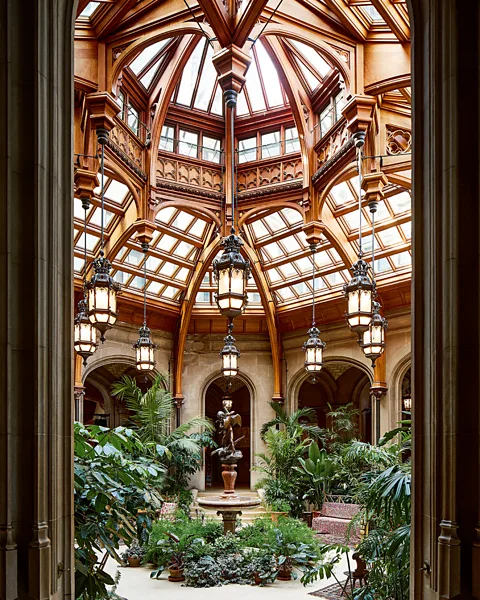
Before Hunt started his design, he and George travelled through France together looking at 15th and 16th-Century chateaux. Biltmore's exterior was especially inspired by the Chateau de Blois with its blend of eras. Side-by-side photographs in the book highlight the similarity in their Renaissance Revival style that incorporates medieval elements. Hunt added gargoyles, with some faces based on his own, like a private Easter egg. On other trips, George acquired 300 rugs in one stop in London, and from Cairo he sent back plants and palms for Biltmore's winter garden. But he added up-to-the-minute technology throughout the house – a grand central staircase is next to a narrow elevator, one of the first in a private home.
Although the house practically shouts a longing for a European past, or almost any cultured past, its mix of eras in the interiors was not a matter of ignorance or desperation. It was typical of 19th-Century designers, Jenkins says. "They're decorating particular rooms in particular ways, but there's no one unifying style in the interior. So you may have a French style salon and a British inspired smoking room and a Renaissance dining hall. They're taking these moments from the past and using them in the interiors in a way that almost evokes a residence that has been around for a long time and kind of evolved over the ages."
 William Abranozicz
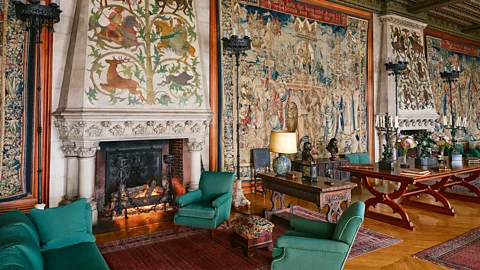
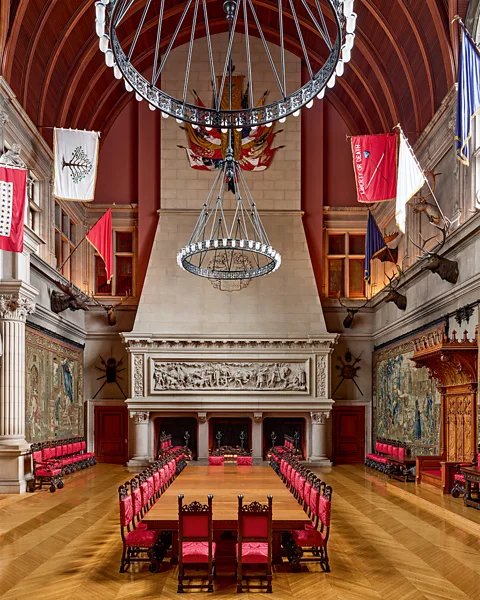
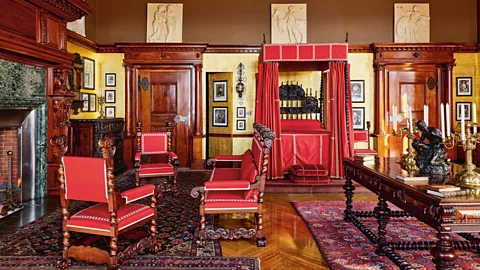
In that spirit, the entrance to Biltmore's guest quarters displays full-length portraits by John Singer Sargent of Hunt and Olmsted, which Vanderbilt commissioned. An opulent Louis XVI-style guest bedroom has furniture based on some at Versailles. And the banquet hall holds a Gothic-style carved wooden throne chair, a 17th-Century hanging bearing the coat of arms of Cardinal Richelieu, and one of the most significant works in the collection – a set of 16th-Century Flemish tapestries, The Story of Vulcan and Venus, made of wool, silk and gold.
Some elements of Biltmore were inspired by English country estates. Outside the gates, George built a town for the workers that resembled an English village, with a school and a chapel. Biltmore House has a billiards room, a smoking room and a gun room, even though George didn't like to hunt. Servants worked in enormous kitchens and laundries below stairs. "I think there is interest in how the wealthiest people lived," says Poupore about Biltmore's attraction to visitors. Though, he adds: "We get a lot of feedback from our guests that they identify more with the domestic staff."
'Pesky reality'
There had been rumblings against the very rich in some quarters all through the Gilded Age. They were living evidence of the enormous gap between rich and poor. But the economy rather than public outrage finally took a toll. And after the Great Depression even the Vanderbilts couldn't stay rich enough. In 1930, like so many of the British estates that George had emulated, Biltmore opened to the paying public to save it from being sold. George had died in 1914, and his widow and their daughter, Cornelia, had carried on at Biltmore.
More like this:
Cornelia was one of the more colourful Vanderbilts, and married – maybe no surprise – a British aristocrat, John Cecil, but later left him and their two small sons at Biltmore and fled for good. An unconfirmed newspaper report said that in New York she dyed her hair pink and went by the name Nilcha. She definitely moved to England, married twice more and quietly continued philanthropic work. Cecil stayed and managed the estate, which their descendants still run. They have expanded its businesses, with inns, shops and a winery. A 2023 film shot on location, a time-travel romance called A Biltmore Christmas, was such a hit for the Hallmark Channel that a new film has been shooting there for this holiday season.
 William Abranozicz
In some ways, the 19th-Century fascination with the Gilded Age rich is different from our connection to celebrity now. Today you can buy Kardashian make-up and shapewear, or Meghan Markle's line of jams and preserves, and acquire a bit of their glamour. No average American could even dream of entering the world of the Vanderbilts at their height.
But some things never change. Anderson Cooper, the CNN anchor who is the Commodore's great-great-great grandson and Gloria Vanderbilt's son, told the history of his family in the book Vanderbilt: The Rise and Fall of an American Dynasty, and chronicled another family in his book Astor. In Astor he points out how the extravagance and conspicuous spending of the Gilded Age is mirrored in the world today, writing: "We now see the ultra-rich in bespoke space suits riding on privately funded rockets."
Like a Hallmark movie, Biltmore itself is a kind of time-travel fantasy, allowing an escape from the fraught present into a luxurious, art-filled past, without the pesky reality of being on the downstairs side of that wealthiest one per cent.
--
If you liked this story, sign up for the Essential List newsletter – a handpicked selection of features, videos and can't-miss news, delivered to your inbox twice a week.
