11 of the Winter Olympics' most striking images - as classical artworks

 Carmen Mandato/ Getty Images
As the 2026 Winter Olympics close, the BBC rounds up some of the most stunning photos captured from the Games, and compares them to historic works of art.
According to the ancient testimony of a Stone Age cliff painting in northwest China's Altai Mountains, the art of skiing may be as old as the art of writing. The image, which depicts hunters gliding on primitive skis in pursuit of wild game, suggests that the earliest rewards such competitors received were not gold, silver or bronze medals, but the meat, hide, and bones of the animals they pursued.
When it comes to chronicling the achievement of winter athletes, things have moved on in the intervening millennia from the scratch of charcoal on shadowy rock. Our shutters are faster but the wonder is no less profound. What follows are some of the most striking images captured in the past two weeks at the Winter Olympics in Milan along with links to the great works of art their captivating contours call to mind.
1. Infrared luge
 Ryan Pierse/ Getty Images
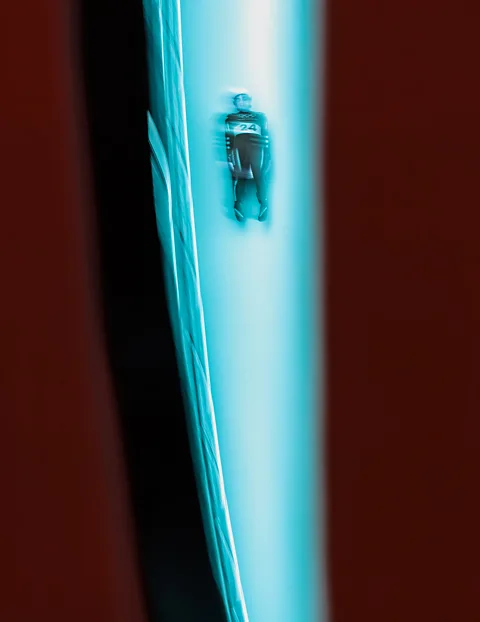
An infrared photograph of Ukrainian luger Yulianna Tunytska, participating in the Luge Women's Singles Run on day three at the Cortina Sliding Centre, seemed to capture a form in metamorphosis from form to force, as if she'd synced herself to the very frequency of the ice over which she slid. Dissolving into a radiating line, a transmitter of archetypal cold, as the world around her is a field of energy, Tunytska's frozen physique echoes Italian Futurist artist Benedetta Cappa's painting, Synthesis of Radio Communications (1933–34), part of a cycle of works that visualise invisible forces.
2. Eye of the tiger
 Tiziana Fabi/ Getty Images
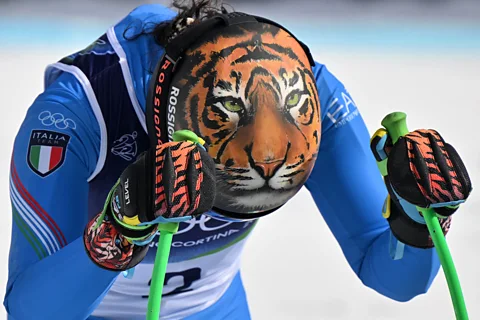
There's a quiet ferocity to the green-eyed glare of the tiger's face imprinted on the top of Italian skier Federica Brignone's helmet, as captured in a photo of the athlete training for the women's downhill event on the first day of the Winter Olympic Games at the Tofane Alpine Skiing Centre in Cortina d'Ampezzo. The urge to merge one's sense of self and her determination of spirit with the primal power of an untameable tiger was one tested almost two centuries ago by the Italian Romantic artist Francesco Hayez, whose extraordinary 1831 painting, Autoritratto con tigre e leone (Self-portrait with tiger and lion), is visible back in Milan at the Poldi Pezzoli Museum.
3. Chromatic blur
 Tobias Schwarz/ Getty Images
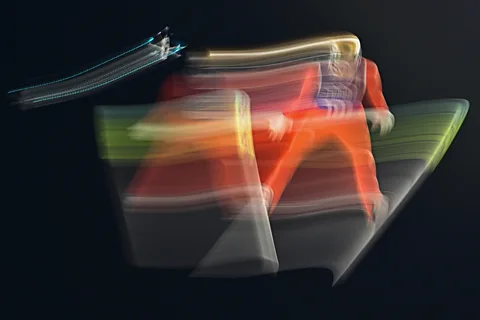
The long exposure required to capture the chromatic blur of Switzerland's Gregor Deschwanden, in mid-jump on day 10 of the games at Predazzo Ski Jumping Stadium, enabled the photographer to prise loose from the skier's body a prismatic ghost of his fleeting presence in the freezing air. The diaphanous dissolution of form into iridescence brings to mind the vivid vibrations of Hungarian painter Vilmos Huszár's 1915 tribute to Vincent van Gogh, which coaxes from the post-Impressionist's alter-ego, the sunflower, a spectral spirit we feel as much as see.
4. Monumental mountains
 Rebecca Blackwell/ AP Photo
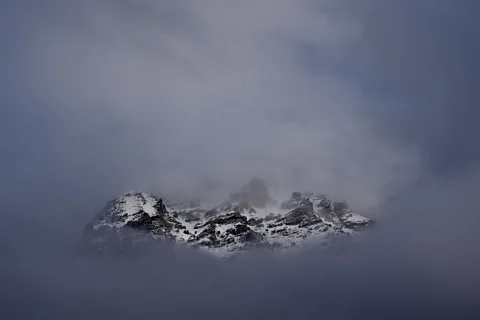
An ethereal photo of snow-capped peaks towards the Stelvio Pass, poking through a rip in the fabric of freezing fog. Ahead of a men's alpine ski race on day five of the Games in Bormio, Italy, it has a decidedly mystic, floating-world quality about it. The image's misty rumination on immanence and stillness mirrors the mindset of a late landscape by the 19th-Century Japanese ukiyo-e artist, Utagawa Hiroshige, The Kiso Mountains in Snow – one of three triptychs on the theme of setsugetsuka (or "snow, moon, and flowers"), he undertook a year before his death. Here, the monumental mountains almost dissolve before our eyes into a meditation on something mysterious that lies beyond.
5. Visual vortex
 Francisco Seco/ AP Photo
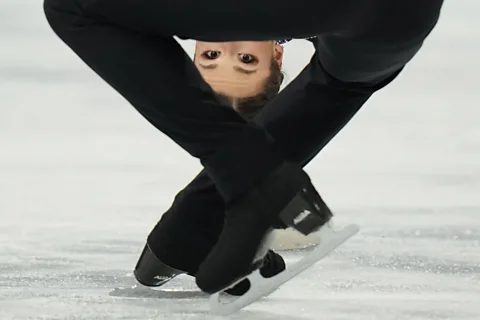
There's a centripetal power to the cropped stare of German figure skater Annika Hocke, her head inches from the ice, peering through the tight triangular aperture of her skating partner Robert Kunkel's crossed legs, as he spins her rapidly around with outstretched arms in a perilous move known as the "death spiral" on day 11 of the Games. The isolation of eyes as the implosive centre of the image, miraculously captured by the photographer, echoes the visual vortex of gazing at the heart of a forgotten 18th-Century phenomenon of so-called "eye-miniatures" in England.
6. A living vector
 Alex Pantling/ Getty Images
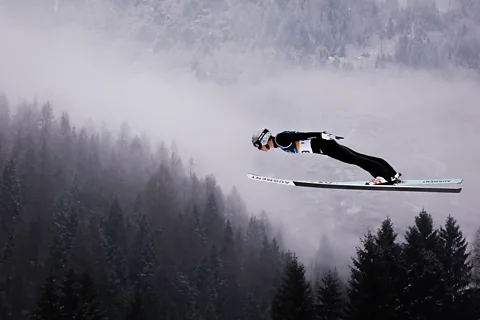
A photo of Marco Heinis of Team France slashing the canvas of air in a ski jumping trial round on day five of the games at Predazzo Ski Jumping Stadium in Val di Fiemme, Italy, was breathtaking in its incisive angularity. Body pitched forward in full-flexed flight, his skis sharpened blades, he became a living vector – an axis intersecting with the sharp pines over which he appears to drift. Heinis's linear incisions in the pale weave of winter calm recalls the controversial cuts that the Italian Spatialist artist Lucio Fontana famously made into monochrome canvases, such as Concetto spaziale, Attese (Spatial Concept, Expectation), 1968, which features a single philosophical fissure that invites a contemplation of the texture of what lies beneath the surface of our seeing.
7. Mass and motion
 Carmen Mandato/Getty Images
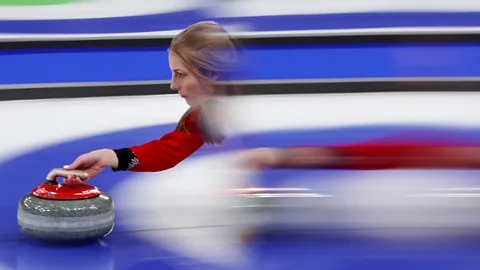
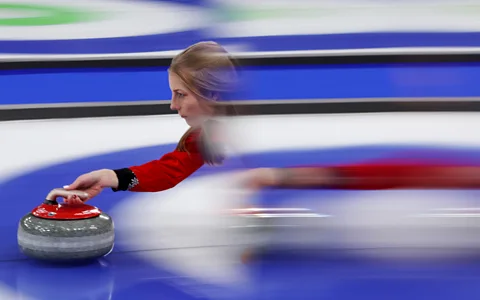
Transformed by a photographer's lens into smudgy speed lines accelerating behind the carefully calibrated push of her polished curling stone, Switzerland's Briar Schwaller-Huerlimann, competing in a mixed-doubles match against Canada on day four of the Games, appears to have become one with the rock itself. Their consciousnesses have merged. Such melting of matter into mind and vice versa echoes the fluidifying of mass and motion which Umberto Boccioni's boundary-blurring bronze sculpture, Unique Forms of Continuity in Space (1913), achieved – a work that is as philosophical as it is physical.
8. Human levitation
 Cameron Spencer/ Getty Images
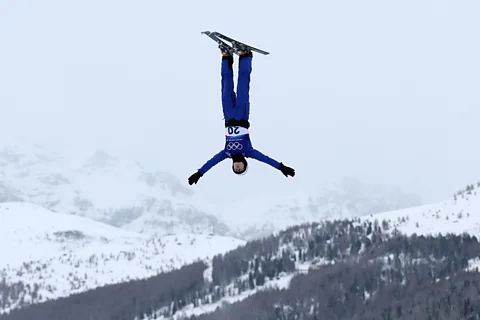
Fixed between grace and gravity, between choreographed control and calm capitulation to the laws of nature, a photo of Belarus-born Anastasiya Andryianava of Team Individual Neutral Athletes (individual Russian and Belarusian athletes), competing in Freestyle Skiing Aerials training on day eight of the games (14 February) at Livigno Snow Park, appears to test the limits of human levitation. Isolated in space, weightless yet accelerating, as if alchemised by the gnash of speed and icy air into pure aerodynamic form, her suspenseful suspension calls to mind 20th-Century Dalmatian Italian artist Tullio Crali's "aeropittural" painting from 1939, Before the parachute opens, which likewise fuses the geometries of form and flight.
9. Dignity in devastation
 Robert Gauthier/ Getty Images
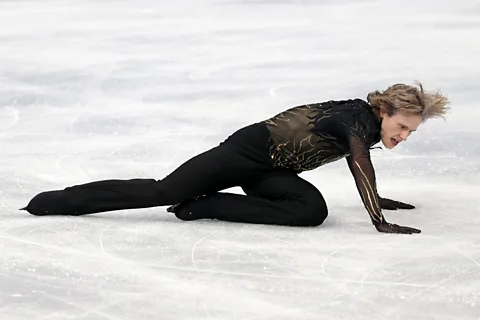
Images of US figure skater Ilia Malinin, whose acrobatic backflips have thrilled audiences and judges, falling to the ice during the men's free skating singles competition on day seven of the games in Milan, reveal a dignity in devastation. With torso twisted and arms bracing against the marble-white surface, Malinin's collapsed posture recalls that of the Roman statue of the Dying Gladiator (a 2nd Century-BC copy of a lost Greek sculpture from a century earlier), which captures exquisitely the awkward axels and rotations of a muscular mind grappling with defeat.
10. Floating in space
 Ian MacNicol/ Getty Images
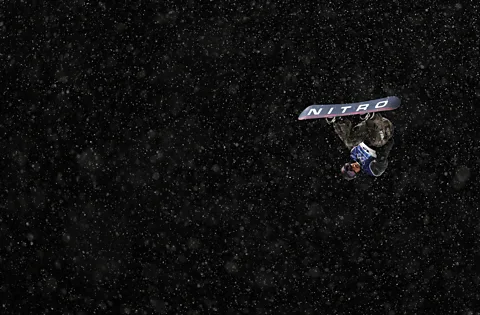
A photo of South Korean snowboarder Geonhui Kim competing in the halfpipe qualification rounds on day five of the games at Livigno Snow Park – his upended body crouched beneath his board and fixed forever in a firmament of frozen snowfall – captures a sense of exhilarating propulsion. Hanging weightlessly beneath the brand-name "NITRO", emblazoned on his board, and surrounded by a dense glitter of luminous crystals, the athlete seems almost a floating molecule, vapourised into a veil of scattered elements. The choreographed suspension of colour and energy recalls the sublime shatter of shape and form in Jackson Pollock's flung enamel masterpieces.
11. Shadows casting shadows
 Tobias Schwarz/ Getty Images
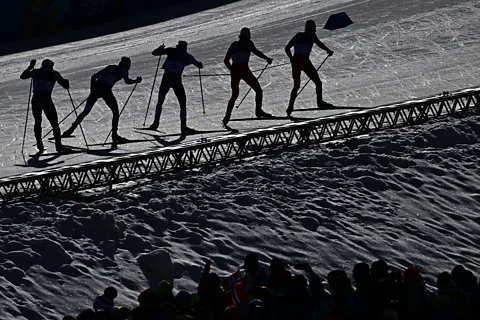
Shadows have a way of mechanising movement. Anonymised into darkness, a figure caught in shadow often seems essentialised into archetypal form – a body of borders that somehow transcends borders. Such is the power of a multinational photo of athletes taken on day three of the Games at Tesero Cross-Country Skiing Stadium in Lago di Tesero (Val di Fiemme). Shadows casting shadows, these stark yet indistinct figures recall the contours of Futurist experiments in stripping force from form. In Italian modernist Giacomo Balla's 1913 painting, Abstract Speed, darkness and light are cogs of a chromatic machine that moves beyond movement.
--
If you liked this story, sign up for the Essential List newsletter – a handpicked selection of features, videos and can't-miss news, delivered to your inbox twice a week.
For more Culture stories from the BBC, follow us on Facebook and Instagram.
