Conservation funds secured for rare church frescoes

 Hilary Rule/Ickleton Church
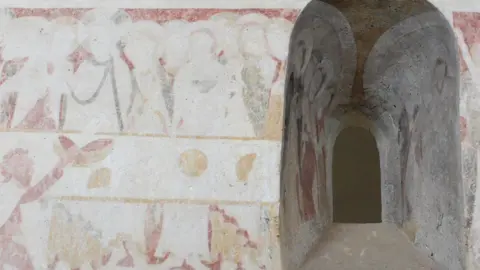
Conservation work is shortly to begin on a set of rare 12th Century church frescoes which were discovered after an arson attack.
Restoration work on St Mary Magdalene's Church in Ickleton, near Cambridge, revealed the forgotten wall paintings after the fire in 1979.
The frescoes, which include the story of Christ's Passion, are "among the earliest series of wall paintings of this quality in the country", said vicar Lydia Smith.
They are now in need of further conservation, made possible by a £244,684 National Lottery Heritage Grant. Work will begin in April.
 Hilary Rule/Ickleton Church
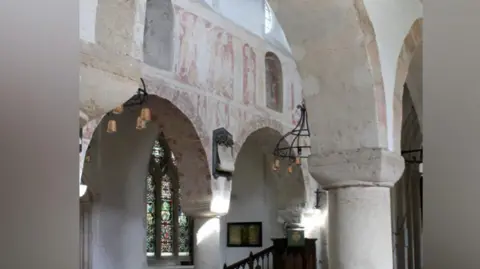
The frescoes were painted directly onto the fresh plaster walls shortly after the church was completed during the Norman era (1066 to 1154).
Smith, who is the vicar of Hinxton and Ickleton as well as the rector of Duxford, said: "Most churches were painted at this time, but it is the quality of these ones that stands out; you can go to much grander places like St Albans Cathedral and see possibly similar paintings.
"They are clearly very, very high quality, not painted by your local guys, but are also surprising for this little tiny village in the middle of nowhere."
 Copyright Hilary Rule/Ickleton Church
Smith, who arrived in the parish four years ago, said she was still drawn to the Last Supper scene every time she entered the building.
"They are a wonderful way of understanding the stories and being in touch with the medieval people who went to St Mary Magdalene hundreds of years ago," she said.
"You're in touch with the practice of story telling and spirituality from an ancient time."
Christ's Passion also covers his arrest and trial, ending with his execution on the cross.
 Hilary Rule/Ickleton Church
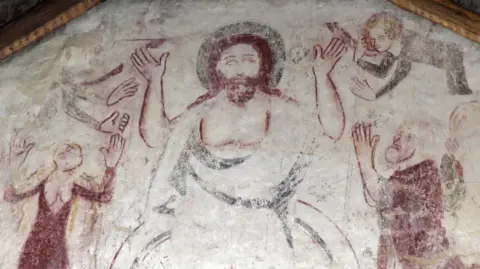
As well as the 12th Century frescoes, there is a 14th Century Doom painting, which depicts the Last Judgement.
"You can see quite a lot of the earlier frescoes, but much of this one is lost," said Smith.
"It does have one unusual feature, the Virgin Mary is seen bare-breasted as a sign of grief - she's been rending her garments - this is a real rarity in church wall paintings."
A routine five-year assessment of the church building revealed the need for conservation, partly as a result of bats living in the nave roof and tower.
Windows above the frescoes were also letting in moisture.
These will be restored first, with the work scheduled to safeguard the bat roost, while conservation work on the frescoes should start in the autumn.
Smith paid tribute to the "massive team effort" from villagers, who have spent years building local support and fundraising for the project.
They have also set up a Friends of Ickleton Church "as another way of encouraging people to treasure their treasure locally", she added.
The project will run until next March when a celebration event will be held to unveil the conserved paintings.
Follow Cambridgeshire news on BBC Sounds, Facebook, Instagram and X.
