What is the 17th Century Swash Channel shipwreck?

 National Trust
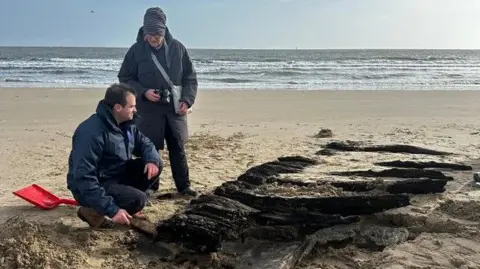
Archaeologists are excavating timbers from a suspected 17th Century shipwreck revealed on a beach after winter storms.
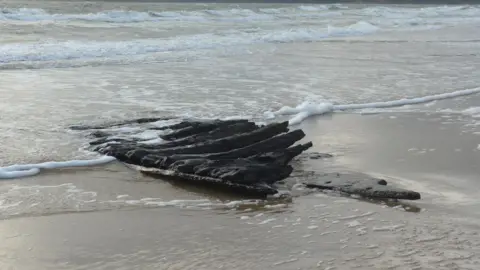
The remains were discovered at the National Trust-owned Studland Bay, in Dorset, on 28 January.
They are believed to form a missing piece of the Swash Channel wreck, which experts have identified as an armed Dutch merchant ship that sank in 1631.
Later a team of maritime archaeologists from Bournemouth University are due to excavate the timbers.
Here is what we know about the historic wreck and what happens next.
What is the Swash Channel wreck?
 Bournemouth University
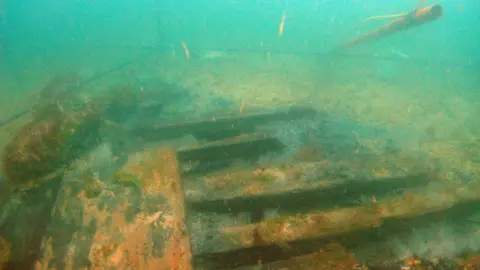
The wreck, comprising the near-complete side of a ship, was first discovered in the Swash Channel in the 1990s.
After nearly 10 years of work, the rudder and other parts were lifted out of the sea by marine archaeologists from Bournemouth University in 2013 - the largest underwater excavation since that of the Mary Rose.
Researchers found the ship's timber came from trees felled in the Netherlands or Germany in the early 17th Century.
 Bournemouth University
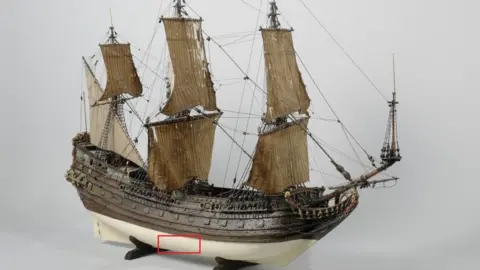
Further analysis found that it was most likely to be the Fame from Hoorn, near Amsterdam.
The heavily armed merchant ship was estimated to be around 40m (131ft) long, 10m (33ft) wide and 15m (49ft) high.
It would have been capable of carrying more than 40 guns to defend itself against pirates during voyages to the Caribbean to bring back salt.
The vessel had been anchored in Studland Bay during a storm before being dragged onto Hook Sands where it capsized.
Records state that all 45 members of the crew abandoned the ship safely when it grounded, but the wreck was looted by people in the area.
Why have timbers appeared on the beach?
 National Trust
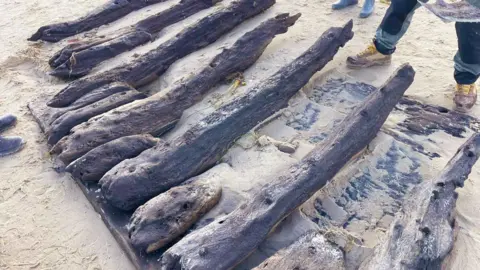
The section of ship, thought to be part of the hull, was discovered at Studland Bay in the wake of Storm Chandra.
It consists of at least 15 frames connected with wooden treenails to five outer hull planks and measures about 6m (19.6ft) long and 2m (6.5ft) wide.
The structure suggests the timbers had been buried in sand since the 1630s and only intermittently exposed over the centuries.
The National Trust said the discovery highlighted the evolving nature of the coastline, a process accelerated by extreme weather and rising sea levels.
Sarah Coggins, coast and marine advisor for the National Trust, said: "In 1630 this section of beach would have been open sea.
"Over the past 400 years, sand has been deposited, creating the dunes, wetlands and shoreline we see at Studland today.
"That is why this historic wreck is found buried in sand rather than lying on the seabed."
What happens next?
 National Trust
Because the Swash Channel wreck is legally protected - one of only 57 such designated sites in England - the remains are being removed under licence.
They will then be carefully dismantled for testing, storage and later reconstruction.
Dendrochronology will determine when and where the wood was grown and whether it matches samples previously analysed from the wreck.
If confirmed as part of the protected site, it is hoped the remains revealed at Studland will eventually join artefacts already displayed at Poole Museum.
You can follow BBC Dorset on Facebook, X, or Instagram.
