Cannon dug up during city centre work

 BBC / Becki Bowden
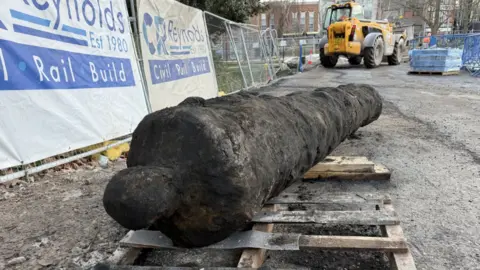
A cast-iron cannon, which could date back as far as the late 17th Century, has been discovered by construction workers.
The object, measuring about 8.5ft (2.6m) long, was found in Queen's Gardens, Hull, during work on a multimillion-pound restoration project.
Jon Jacobs, 51, of construction company CR Reynolds, who found the item, said: "I've never dug up anything like this. The main things you dig up are small bottles, bits and bobs like that, just junk, but not really anything as significant as this."
Hull City Council said the cannon was being assessed by specialists and would provide an update once "archaeological analysis is complete".
 BBC / Becki Bowden
Jacobs said he had dug about 4.9ft (1.5m) into the ground to install a water storage tank when the machine he was driving "hit the top" of the object.
"Obviously, with the cannon being cast, it does make a bit of a thud and it does shake the machine a bit with it being quite a size," he added.
"It'd be nice to know where it's from and obviously how it got there, because there was nothing else around it, it was just purely on its own.
"It will be nice to see it in a few years' time, and hopefully, if we do have grandkids, bring them round and say 'I found it'."
Jacobs said he and his colleagues were unsure what it was initially and even considered it could be a bomb from World War Two.
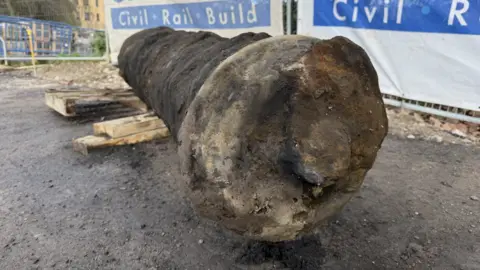
However, a series of "distinctive" rings on the end showed it was a cannon.
 BBC / Becki Bowden
Peter Connelly, archaeology manager for Humber Field Archaeology (HFA), said the site was the city's first large civilian dock before it was infilled, later becoming Queen's Gardens.
He said they believed it could have been cast some time between the late 17th Century and 18th Century and could have been underground for between 90 and 100 years.
Although it was capped at one end and therefore decommissioned, Connelly said the object, which is the main barrel of a cannon, would have been used for defence.
"Whether on a ship, or on the edge of the landscape when defending the mouth of a port, we just don't know yet," he said.
He added that such cannons were often converted into posts to moor ships, and when the dock fell out of use, the cannon could have been pushed into the dock.
Connelly said this was the third cannon to have been discovered from archaeological digs in Hull.
Listen to highlights fromHull and East Yorkshire on BBC Sounds, watch the latest episode of Look Northor tell us about a story you think we should be coveringhere.
Download the BBC News app from the App Storefor iPhone and iPad orGoogle Play for Android devices
