Ichthyosaur snout and Roman farm found in bypass digs

 Archaeological Research Services
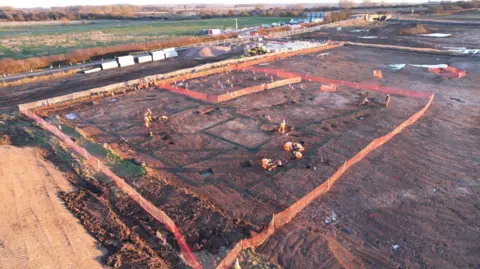
Before an inch of Melton Mowbray's new bypass was laid, archaeologists were sent in to dig below its 4.4-mile (7.1km) route round the edge of the town to see what might lie below it.
What they discovered has shed light on how people lived in the area over the past 2,000 years and identified a "dynamic prehistoric and Roman farming landscape".
During the excavation of 11 separate sites, across 62 acres (25 hectares), they also uncovered the remains of ancient aquatic creatures swept into the area by shifting glaciers.
Now, with the road set to open in the coming months, experts from Archaeological Research Services Ltd (ARS) have released images of some of their finds.
 Archaeological Research Services
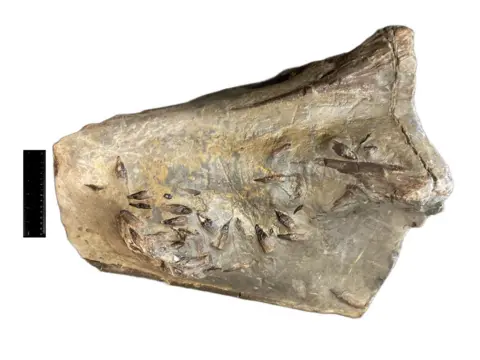
Two ichthyosaur fossils were uncovered during the dig, including the vertebrae of one of the large marine reptiles.
And what was initially believed to be nothing more than a large rock was found to contain the snout of an ichthyosaur, which was so heavy it took two men to lift it from the ground.
ARS said they probably dated to the Lower Jurassic period and had been moved by a glacier and deposited at Melton some 200 million years ago.
Both specimens are set to be displayed at the Leicester Museum and Gallery in New Walk in Leicester.
 Anglian Water
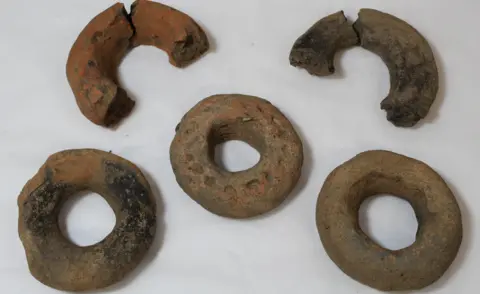
Flint tools and blades and vessels were also found in the area, along with the bones of two aurochs - an ancient breed of large cattle found across Europe - before habitat loss and hunting wiped them out in the 17th Century.
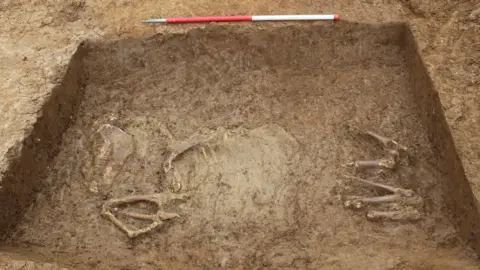
Evidence of six cremations was discovered in pits, near the River Eye, which dated back to the late Neolithic and early Bronze Age period.
 Archaeological Research Services
 Archaeological Research Services
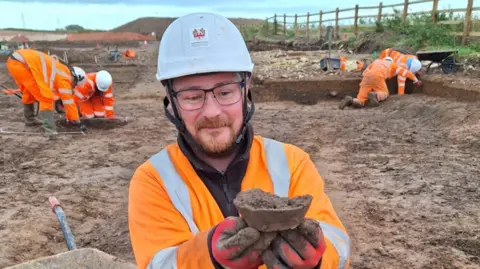
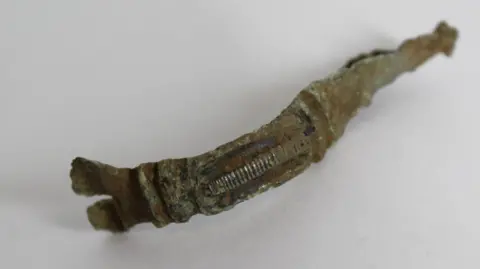
Further searches uncovered evidence of a "large and complex" late Roman period farmstead.
Investigations found traces of Mediterranean-style plantation agriculture, including vineyards and orchards, as well as Roman roundhouses and burial trenches.
The discoveries continued to span the ages, with an Anglo-Saxon settlement of sunken buildings, ditches and pits.
 Archaeological Research Services
 Archaeological Research Services
The three-year construction of the £134m road, designed to relieve traffic congestion in the town centre and unlock land for some 4,500 homes, has been overseen by Leicestershire County Council.
Many of the artefacts discovered have been passed to the authority's museums service.
Assistant director of highways and transport, Janna Walker, said: "There was so much interesting archaeology and palaeontology. It is quite a rich archaeological area.
"That was one of the factors in making this a complex project, but the discovery of these settlements has helped us learn a lot about how people have lived in the Melton area over the ages.
"People will be able to see some of that come out in local museums."
Follow BBC Leicester on Facebook, on X, or on Instagram. Send your story ideas to eastmidsnews@bbc.co.uk or via WhatsApp on 0808 100 2210.
