History professor finds huge Iron Age hoard

 Tom Licence
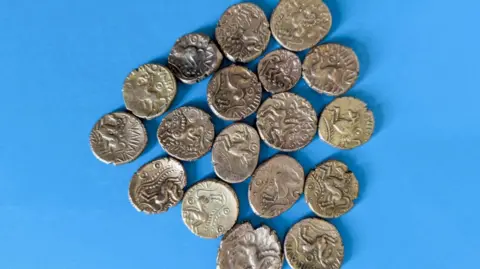
A history professor with a passion for metal detecting uncovered a hoard of 18 Iron Age gold coins.
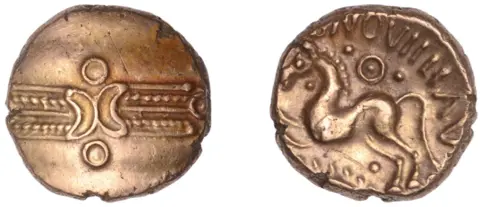
The coins are the largest known find from the reign of Iron Age king Dubnovellaunos, who ruled the Trinovantes tribe what is now mostly Essex and Suffolk, between 25BC and AD10.
Prof Tom Licence, 46, from the University of East Anglia, says he has family history in Bury St Edmunds and likes to "imagine that the coins were buried by one of my ancestors".
Known as The Bury St Edmunds Hoard, it is being auctioned off and is expected to make £25,000.
 Noonans
Licence, a professor of medieval history and literature at the university in Norwich, found the hoard in the autumn of 2024.
Among the find were 16 coins known as staters and one quarter-stater.
The professor, who was born in Essex, found the field while looking for somewhere to take his niece metal detecting.
He first found some Viking hack silver and then struck gold.
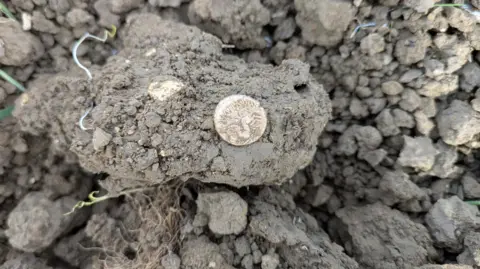
"I continued searching and was astounded to find a gold stater, and after changing the settings [on the metal detector] and going up and down rows that I had marked out – I went into hunting mode and found another six staters," he said.
"When it got to sunset, I called the landowner and took the coins to show him and his wife."
 Tom Licence
Returning later that week he found more coins, taking the total to 17.
From the hoard, Licence and the landowner have chosen to keep a single stater each.
They will split any money made from the British Museum's Portable Antiquities Scheme, which compensates finders who declare their treasure, with him planning to donate some to archaeological work in Suffolk.
 Tom Licence
The collection will be auctioned at Noonans in Mayfair on 4 March as part of a coins and historical medals sale.
Alice Cullen, coin specialist at Noonans, said the hoard fits the pattern for burials -being found on the east-facing side of a hill.
Licence believes the "morning sun illuminating the hillcrest and a spring rising at the same spot" is a combination that could point to this hoard, and others like it, having a religious significance.
Among the highlights of the hoard are the Addedomaros wheel stater, which confirms the spelling of the name on that early type, which was previously uncertain. It is estimated to fetch £3,000-3,600.
The Dubnovellaunos stater, with a previously unrecorded die, is expected to fetch £1,500-2,000.
Follow Suffolk news on BBC Sounds, Facebook, Instagram and X.
