What makes pothole repairs fail so often?

 Qays Najm/BBC
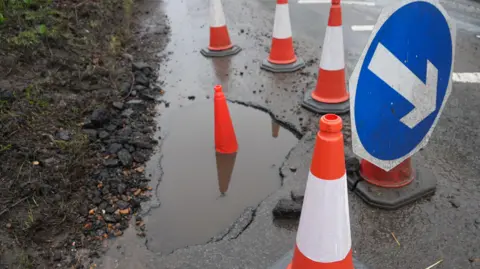
Potholes are the bane of drivers' lives and they seem to be on the increase.
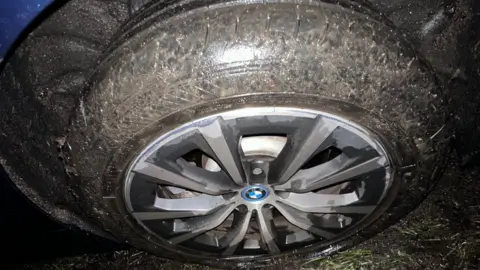
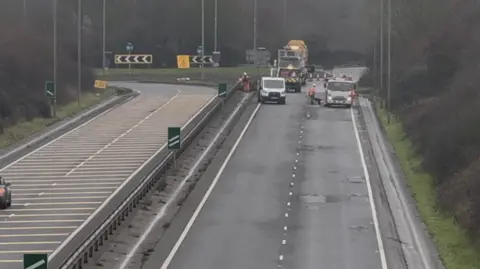
On Monday, up to 30 cars were damaged and motorists left stranded along the B1062 between Beccles and Bungay in Suffolk - all thanks to a pothole.
Another one last month resulted in 10 cars stranded along the B4038 near Kilsby in Northamptonshire.
So, how much do they cost to repair, how should they be repaired - and why do so many fixes fail?
Elizabeth Orchard, chair of the East of England regional committee of the Institution of Civil Engineers, has been answering your questions.
What does it cost to send a lorry out to fill a pothole?
 Becky Broadley
This was Essex-based Derek's question - and the short answer is, it varies.
"Broadly, it's in the region of £70 to £90 per pothole, but the highway teams do try to group the repairs together so it's not just one pothole at a time," said Orchard.
"The cost varies from area to area, and it does depend on the size of the pothole and the type of repair that's needed, so I can't give you a definitive answer."
She added: "If you've got lots in one street, they only repair the ones that we call at intervention level - about 40mm (1.57in) deep on the road and 25mm (1in) deep on the footpath or on the cycleway."
Why do potholes deteriorate so soon after being filled?
 John Devine/BBC
Lots of people asked this - and it comes down to the UK's temperate climate, with winter temperatures hovering around freezing.
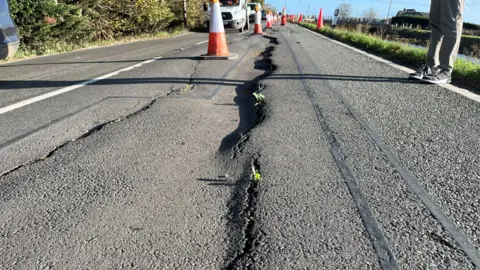
Orchard said: "Once you've got a crack in the road, what happens is the water gets into it, it freezes overnight and it blows out the material in the road surface.
"When we go in and do the repairs, sometimes that repair doesn't seal that crack completely, so the water can get in behind that and blow out the temporary repair as well - we see this happening again and again."
Highways teams have to wait until the weather is warmer to do permanent repairs, requiring night-time temperatures of more than 5C (41F), she added.
Why not use concrete for the repairs?
Ollie wondered why concrete was not used for the repairs, and that comes down to two factors.
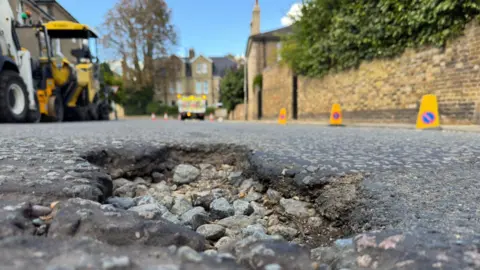
Our roads are mostly made from asphalt - with a lower foundation layer designed to carry the weight of traffic, and a top layer called binder on which the traffic runs, explained Orchard.
Most potholes occur in the top layer, but sometimes they do go through to the foundation level.
"If you were to put concrete into that hole, that can actually cause more damage that's harder to repair," she said.
"You could replace the whole road with concrete - but that's very expensive and that's probably a debate for another time."
Why can't the team that sprays the outline fill the pothole?
 Jamie Morris
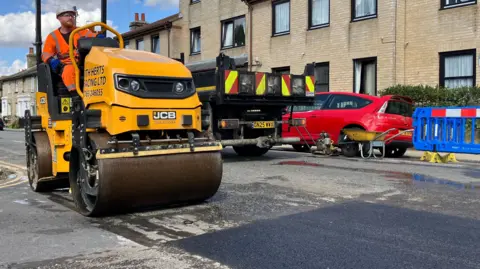
Councils usually deploy two teams to address potholes on their roads - and Anna from Bedford wanted to know why.
Orchard said: "The people that spray the pothole are the highways inspectors; they don't have the equipment to fill the holes with them and they need to check the safety around how do we fix the pothole as well.
"They're also looking again for those intervention level potholes - the ones that are 40mm (1.57in) or deeper that qualify for that repair, and the urgency of where it sits in the road and the category of road - so there are lots of different things that they're looking at."
Orchard also said "we're a few years behind" systems that are in place in parts of Europe and Canada.
"They cut out that inspection phase and actually feed it straight through from reporting it to fixing it, because the reporting process is a bit more sophisticated as are the repairing systems," she explained.
It is worth noting that councils in the East of England are introducing innovations of their own.
Norfolk County Council uses Reclamite, a sustainable asphalt rejuvenator that extends the life of road surfaces and helps prevent potholes.
And in Essex - the county council has become the first authority to lay a new type of reinforced road surface enhanced with graphene, said to be the strongest substance ever recorded.
Follow Norfolk news on BBC Sounds, Facebook, Instagram and X.
