'I wanted another child but I won't give birth again'

 BBC
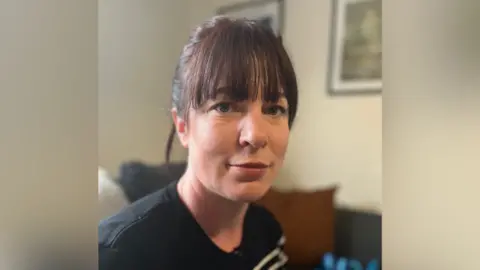
BBC"I wanted another child. If someone gave me a child, I'd have it, but I just wouldn't give birth again. You couldn't pay me to give birth again."
Kim Russell, from Melton Mowbray in Leicestershire, said she was "traumatised" by her experience of giving birth to her son Archie at Leicester Royal Infirmary (LRI) in 2016.
She has shared her story after Baroness Valerie Amos, chair of the independent National Maternity and Neonatal Investigation, asked families to share their experiences of maternity and neonatal care.
University Hospitals of Leicester NHS Trust (UHL), which runs the LRI, apologised for the "distress" caused to Kim and her family, and said "significant improvements" had been made.
Kim said she arrived in hospital on the evening of 9 June after being advised to give birth early, as her midwife told her she had pre-eclampsia, a blood pressure disorder.
"On the Thursday we got there at night and there were no beds," Kim said.
She said on Friday "nothing much happened", and was then given a pessary as a method of induction on Saturday.
"That was sort of lunchtime, late afternoon," Kim said.
"By midnight, the chemicals had kicked in and it felt like I was in labour. I think I was four or five centimetres, and I was told that there was no staff to help me give birth.
"So they were going to try to stop my labour, so took the pessary out.
"[By Sunday], I was in a lot of pain, I was whole body shaking, I was being sick, I was unable to keep water or anything down.
"Sunday visiting hours ended and my mum and partner were told they would have to go home, because there was still not enough staff to help me give birth and that there were emergencies coming in, so they needed the care.
"I was taken up and down onto the delivery suite and told that I wasn't urgent enough."
 Supplied
Kim said it got to about 01:00 BST on Monday and the midwife that had been on the Saturday night shift came back.
"She was confused as to why I hadn't given birth yet because she could see the state that I was in," she said.
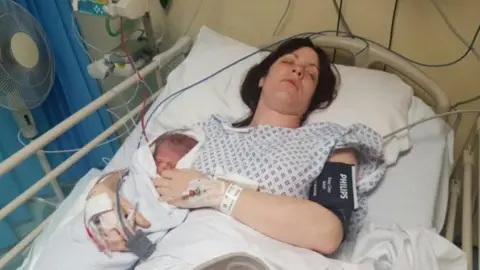
Kim was then taken to the delivery area, where staff discovered Archie's heart rate had dropped, so they decided on an emergency C-section.
"Whilst doing that they cut an artery and I lost two and a half pints of blood," Kim added.
"I can't really remember much else after that until I woke up on the high dependency unit."
After that, Kim said her partner was sent home and she was then on her own.
"I was in a lot of pain, I was exhausted, I was confused, I was sad," she said.
"The care I received wasn't how I thought it should or could have been."
When Kim and Archie, who is now nine, got home, she said Archie had "jaundice from birth trauma".
"The first few weeks were not what a new mum should feel or go through," she said.
"I have fibromyalgia which affects the nerves in my body which has been linked to the trauma of the birth.
"It wasn't right, and as much as I'm alive, Archie is alive, we have complications."
Baroness Amos told the BBC the investigation was instigated by secretary of state for health and social care Wes Streeting.
"He had heard from families up and down the country who were very concerned that, although there have been a number of local investigations of what had been happening in trusts, that things did not seem to have improved in the kind of consistent way that women and families were looking for, and indeed there was still a lot of very poor practice," she said.
When asked what change she would like to see, Kim said: "That women are cared for, they're heard, they're supported during and after on the wards.
"That there's more information afterwards. I was told what had happened but there was nothing I could look at or anyone to sit with and go through how I was feeling."
Julie Hogg, chief nurse at UHL, said: "We are sorry for the distress Kim and her family experienced during her maternity care in 2016.
"Over the past decade, our teams have made significant improvements: strengthening how we listen to families, increasing midwifery and consultant staffing, enhancing our facilities, and investing in new technology and ways of working.
"We have also embedded learning from Kim's case, including clearer communication during labour and ensuring that post birth conversations take place promptly and consistently."
Hogg said Baroness Amos' investigation was "an important opportunity for us to reflect honestly, learn from the past and further strengthen services" and that the "safety, wellbeing and experience of women, babies and families will always be our highest priority".
Additional reporting by Khush Sameja
Follow BBC Leicester on Facebook, on X, or on Instagram. Send your story ideas to [email protected] or via WhatsApp on 0808 100 2210.
