Dog walkers discovered 2,000-year-old beach footprints

 University of Aberdeen
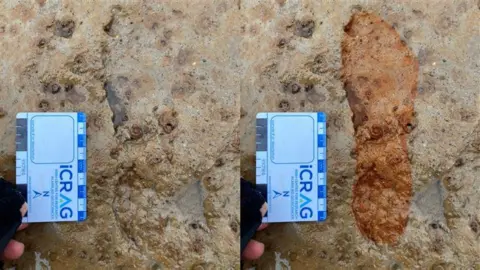
Archaeologists have described their race against time to document rare 2,000-year-old footprints uncovered on the Angus coast before the winter storms which had revealed them also wiped them away.
The human and animal prints were discovered by dog walkers Jenny Snedden and Ivor Campbell in ancient clay deposits at Lunan Bay beach near Montrose.
They had lain undiscovered beneath sand dunes but were exposed when they were scoured away by strong winds and high tides.
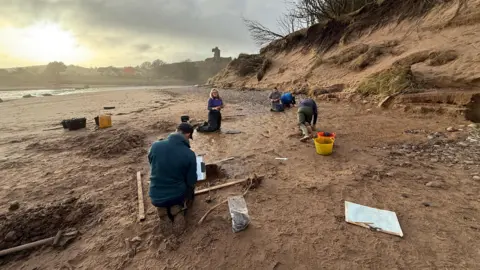
A team from Aberdeen University was despatched to document the scene, stopping to pick up supplies like plaster of Paris from craft shops on the way, before the site was destroyed by the weather forever.
 University of Aberdeen
Lunan Bay locals Ivor and Jenny were walking their dogs Ziggy and Juno along the sands late last month when they saw that storm damage to the dunes had revealed a fresh layer of clay - and Ivor noticed distinct markings.
He called council archaeologist Bruce Mann on 26 January who called in expertise from the University of Aberdeen who were on site the following day.
Prof Kate Britton from the university said it was a real archaeological emergency.
"This email came in quite late at night and we really rushed to get all our materials together," she said.
"We had a lot of late night phone calls planning how we could get to the site and record it, because it was revealed by these unseasonably harsh storms we've all been experiencing in Scotland this winter.
"But of course, those storms had revealed the site, but were also actively destroying it at the same time."
 University of Aberdeen
The team worked in wind speeds of more than 55mph (88km/h), while being struck by whipped up sand, to preserve evidence of the footprints.
The university said similar markings had been identified at sites in England including the Severn Estuary, Formby in Merseyside, and Happisburgh in Norfolk, but there was no previous record of a similar site in Scotland.
"There are very few sites like this globally, it needs to be said," said Britton.
"What's interesting is the sandy beach there now, it didn't used to be like that."
 University of Aberdeen
She said it would previously have been a "lush salt marsh" full of plants which would have attracted animals and, in turn, humans - possibly for fishing or hunting.
She added that as well as delivering a "snapshot moment" it also showed how people had lived and what their environment had been like.
The team were able to record and map the site, and capture 3D models and physical casts of the prints.
Radiocarbon dating of preserved plant remains confirmed the markings were made about 2,000 years ago.
Ongoing analysis has identified footprints of red deer, roe deer and other animals as well as humans.
They were also able to capture drone images which will help establish a baseline for examining the rate of erosion of this part of the coast - and the risks to other potential sites.
