England's top treasure finds revealed by county

 The British Museum
More treasure was found in Norfolk in 2024 than in any other county in England, according to the latest record-breaking figures.
Metal detectorists reported 138 finds in the county, compared with 110 in Hampshire and 109 in North Yorkshire.
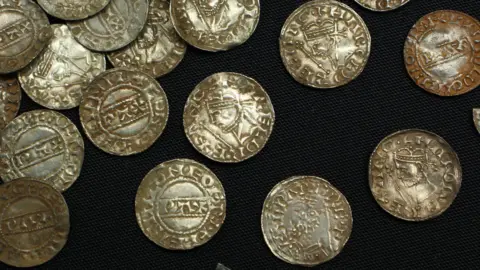
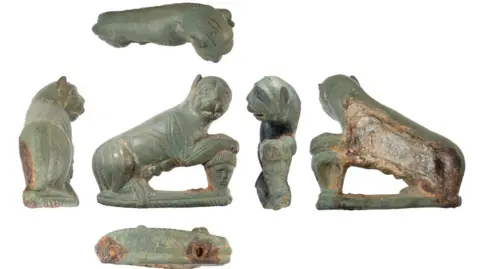
Among the most spectacular English finds were a copper-alloy Roman vehicle fitting discovered near Harlow, Essex, and a hoard of Harold II pennies unearthed near York.
Dr Nicholas Cullinan, director of the British Museum, which manages the Portable Antiquities Scheme, said it was vital "for preserving and recording Britain's past".
Norfolk also had the greatest number of finds overall - other than just items classed as treasure - with more than 7,120.
Dr Helen Geake, the county's finds liaison officer, said it was due to a combination of factors.
"It's the agricultural land, we've got a big treasure team in Norfolk, and we've got loads and loads of detectorists," she said.
"It was also a rich county before the Industrial Revolution, going back years, we've been rich since the beginning, and a lot of rich people are careless; they're less likely to look for the stuff they've lost."
Elsewhere, Suffolk had 5,410 finds, while Lincolnshire yielded 5,133 and Gloucestershire 5,034.
Although the report covers 2024, its findings have just been released.
More than 92% of objects were recovered from cultivated land, where archaeological material is especially vulnerable to agricultural damage, said the museum.
 The British Museum
At the launch of the annual report, the museum showcased the Roman vehicle fitting, discovered at Epping Forest and dating to between AD43 and 200.
Lori Rogerson, Essex finds liaison officer, said: "The Harlow fitting will quickly become one of Essex's most iconic archaeological objects."
It was declared treasure under the newly introduced significance-based criteria of the Treasure Act 1996, which means items can be defined as treasure if they are of historical or cultural significance.
It featured a female panther resting its paws on a severed head, and was probably attached to the body of a carriage or wagon or to the yoke, which hitched draught animals to the vehicle.
Archaeologist Dr John Pearce, from King's College, London, researched the item for the Portable Antiquities Scheme and said there is "nothing quite like it in Romano- Britain".
Fittings like this are not a common find in Britain, he said, but its design is distinctly Romano-British.
Pearce believed it was one of at least a pair and would have decorated the carriage of someone with enough money to commission "a fancy vehicle".
 The British Museum
The hoard of 179 silver pennies found near York was probably buried on the eve of battle in 1066 - around the time of the Norwegian invasion of England by King Harold Hardrada.
He briefly captured York following a major battle at Fulford, a short distance from the hoard's find spot.
The museum said it was an exceptional find because it only contains coins from Harold II's short reign (6 January to 14 October 1066).
Having defeated the Norwegians, Harold was defeated in turn by William the Conqueror at the Battle of Hastings.
 The British Museum
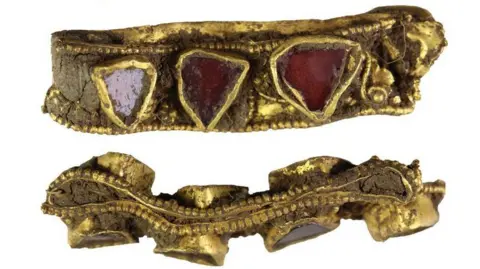
The museum also showcased some spectacular early medieval finds from Wiltshire, which experts believe may form part of a high-status burial.
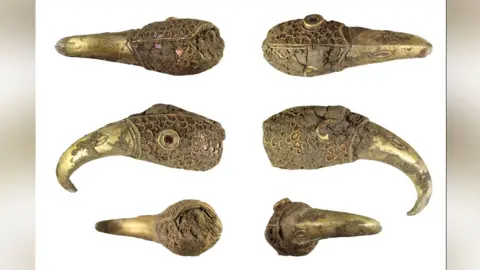
The discoveries included a silver, gold and garnet bird's-head terminal with elephant ivory inlays, possibly from a drinking-horn, several gold rings, and other metal objects.
A follow-up excavation will be led by Cardiff University and the Portable Antiquities Scheme in the coming months.
 Andrew Williams/Norfolk County Council
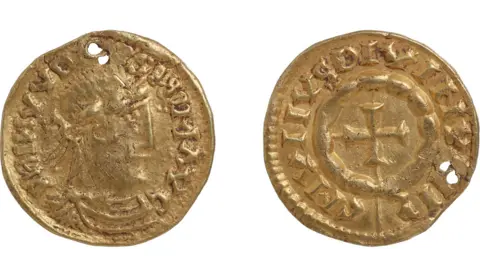
One of Norfolk's more unusual 2024 finds was an early medieval gold coin, pierced to be worn as a pendant.
It was an imitation of a coin struck for the Frankish king and Holy Roman Emperor, Louis the Pious (AD814 to 840).
Geake said experts originally believed imitations like this were made by a trading people called the Frisians, but more evidence is coming to light to suggest they were made by the Vikings.
"We tend to feel Vikings are violent barbarians and not likely to imitate beautiful, civilised European coins, despite knowing they can make beautiful things, they have an eye for beautiful objects as they pillage them, and they are highly experienced in precious metals," she said.
 The British Museum
The British Museum said 79,616 finds were recorded in 2024, up from 74,506 in 2023 and 53,490 in 2022, and metal detectorists account for 94% of them.
Ian Richardson, the museum's acting head of portable antiquities and treasure, said: "The continued rise in the number of finds reported through the Portable Antiquities Scheme is a testament to the dedication of finders across the country.
"Their responsible reporting allows us to build a richer and more detailed picture of life in the past, while ensuring that important objects are preserved for public benefit."
Baroness Twycross, Culture Minister, said: "Thanks to the finders, landowners, museums and everyone involved in the treasure process, we have the rare opportunity to display these treasures to educate and inspire future generations to come."
Follow Norfolk news on BBC Sounds, Facebook, Instagram and X.
