'They have lied and spied for the communists': The suburban spies who sold nuclear secrets to the USSR

 Alamy
AlamyThe Portland spy ring trial began on 13 March 1961. The BBC reported on a Cold War tale of espionage, adultery, exorcism – and a deceptively ordinary-looking bungalow.
The enduring image of a Cold War spy swap is of two freed captives walking slowly from opposite sides of a bleak checkpoint or bridge towards liberty. When Helen and Peter Kroger were released from prison in 1969 in exchange for a British lecturer held in the Soviet Union, it was a different story.
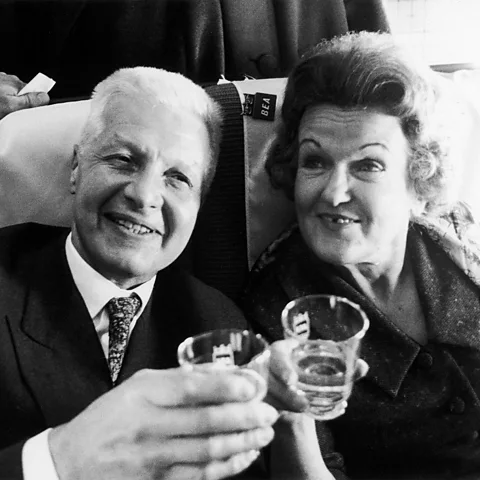
Standing beside them on a plane bound for Poland, the BBC's Tom Mangold reported: "Within less than an hour, they'll step onto the communist soil for which they have lied and spied and spent nine years in prison. After nine years: smoked salmon, egg, chicken, champagne and coffee for the Krogers as they sit, sublimely happy, in the seats originally allocated in this first-class lounge to BBC television news."
The Krogers had been convicted in 1961 of being part of the notorious five-strong Portland spy ring, one of most significant espionage operations of the era. The couple's ingenious communications set-up involved sending valuable British intelligence files to Moscow. Many felt they were getting off lightly.
The focus of the spies' attention was the Admiralty Underwater Weapons Establishment in Portland, a peninsula on the sandy southern tip of England. At this research facility, scientists and technicians worked on some of the Royal Navy's most sensitive projects, such as anti-submarine warfare systems. Despite the highly confidential nature of the work, every item being trialled was recorded meticulously. Each new device and proposed modification had its own file filled with photographs, drawings and technical specifications. To get their hands on these, the Soviets needed professional spies. Two of them were based inside the research facility itself.
Harry Houghton was a former Royal Navy officer who had been recruited by communist intelligence while working at the British Embassy in Poland. On his return to the UK in 1953 he resumed his spying activities when he got a job as a clerk in the Portland facility. He began having an extramarital affair with Ethel Gee, a colleague who had access to material of a higher classification. Posing as husband and wife, the couple would travel up to London to meet their KGB contact and hand over their stolen material.
It emerged in files released by the British intelligence service MI5 in 2019 that they could have been rumbled much earlier thanks to a tip from Houghton's actual wife, who had become suspicious about his regular London visits. Mrs Houghton said that upon his return from one trip, he "pulled out a bundle of pound notes and threw them in the air". On another occasion, she opened a parcel on his desk and found a bundle of papers marked "top secret". And when she asked her husband about a tiny camera she had discovered hidden under the stairs, he became angry. But her allegations had been ignored as it was felt that they were "made on the spur of the moment and out of pure spite".
The tiny camera spotted by Houghton's wife was a key weapon in the spies' arsenal. Photographs taken with microdot cameras could reduce whole pages of information so that they fit onto a single tiny piece of film. This could be embedded onto paper in an area the size of the full stop at the end of this sentence. One minuscule dot could contain detailed photographs and sketches. Concealed on a postcard or inside a book, these secret messages could then be sent to Moscow and would be impossible to trace unless you had been told where to look.
Spying on the spies
The other side of the spy ring – the communications experts – had developed the perfect cover story. Peter and Helen Kroger were, to their neighbours in sleepy suburban London, an antiquarian bookseller specialising in Americana and a homemaker. This was the ideal cover for their activities because it explained their regular business trips abroad with their books, even behind the Iron Curtain. Inside their outwardly nondescript bungalow, they had built a sophisticated communications centre, complete with a concealed radio transmitter and microdot equipment. Their real names were Morris and Lona Cohen, both US citizens who were veteran Soviet agents.
In the middle, the KGB contact running the operation on behalf of Moscow was known around London as Gordon Lonsdale, a Canadian businessman who specialised in supplying jukeboxes and vending machines. He enjoyed the rewards of capitalism, with his lucrative business paying for a fleet of cars and a yacht. In reality, his name was Konon Molody, a Russian-born KGB agent. His role in the Portland spy ring was to take the information from the two insiders at the research facility and pass it to the Krogers. This activity carried on undetected for several years until intelligences services received a tip that could not be ignored.
In History
In History is a series which uses the BBC's unique audio and video archive to explore historical events that still resonate today. Sign up to the accompanying weekly newsletter.
One of the Cold War's most important spies, Polish intelligence officer Michal Goleniewski, aka Sniper, was a triple agent who supplied Soviet and Polish secrets to the CIA. He told them that the Soviets had a highly placed British informant involved in naval research. While this information was vague, it was troubling enough to prompt MI5 to send investigators to the Portland facility. Suspicion soon fell on Harry Houghton, whose clandestine trips to central London with Ethel Gee were watched with great interest. On one occasion they were seen handing a bag to a man who was later identified as Gordon Lonsdale. The trail led out to the suburbs, with Lonsdale being followed to the Krogers' high-tech bungalow.
Over the next two months, MI5 and police laid a trap for the Krogers at the house across the road owned by their friends, the Search family. This surveillance operation was so dramatic that Judi Dench would later star in a hit 1983 West End play about it called Pack of Lies. Officers monitored comings and goings at the Krogers while the Searches maintained the pretence of normality. Daughter Gay Search, who was aged 15 at the time, told the BBC's Witness History in 2014: "It's astounding that Mum was so effective. I think at first it wasn't clear to my parents that the Krogers were a big part of the investigation. Bit by bit MI5 let Mum see that Peter and Helen weren't the people they claimed to be."
By the start of 1961, MI5 felt that the Krogers were getting nervous and might try to escape. On 7 January, Houghton and Gee were picked up in central London along with Lonsdale after one of their meetings. A shopping bag they were carrying turned out to contain four Admiralty Test pamphlets and a tin of undeveloped film which included details of HMS Dreadnought, Britain's first nuclear submarine.
More like this:
• The CIA spy shot down over Russia in 1960
• The US's most damaging double agent
• The Cold War spy mystery of the vanishing frogman
That same day, the Krogers were arrested. Detective Superintendent George Smith, who headed the Special Branch investigation, told the BBC that during the arrest Mrs Kroger had tried to get rid of crucial evidence. "She said, 'Superintendent, as we appear to be going away for a long time, have you any objection to me stoking the boiler fire,' and I said, 'Certainly not, but would you let me see what you've got in your handbag?'" In a white envelope he found a piece of paper with numbers in blocks of four. They were later found to be grid references to a map showing locations for meeting places.
A further search of the house uncovered a trap door in the kitchen that opened into a small cellar, while the bathroom also doubled as a photographic dark room. In the attic, officers discovered more cameras and photographic equipment, a 74ft (22.5m) radio aerial and a high‑powered wireless transmitter as well as $6,000 in $20 bills. The woman who later moved into the Krogers' home, dubbed by the media as the "bungalow of secrets", came across papers and other personal effects they had left behind. She told BBC News in 1969: "We had a friend of ours come here, a spiritualist medium, and he exorcised the place for us because we still had that feeling here – we just couldn't get rid of it."
Prisoner exchanges
The Portland spy ring trial lasted about two weeks. Lonsdale received a 25-year prison sentence, but he served less than four years in jail. In 1966 he was released to the Russians in exchange for Greville Wynne, an Englishman accused of spying in Moscow. Upon his return to the Soviet Union, Lonsdale was greeted as a hero. A James Bond-style film loosely based on his life story was made in 1968. He died in 1970, aged 47.
The Krogers were given 20-year sentences. In 1969 they were exchanged with British lecturer Gerald Brooke, who had served four years in jail for smuggling anti-Soviet leaflets. After flying to Poland initially upon their release, they settled in Moscow. Both received the prestigious Russian military award, the Order of the Red Banner. In 1998, they were each commemorated on postage stamps honouring Heroes of the Russian Federation.
Houghton and Gee each served nine years of their 15-year sentences. Gee initially moved back into her old home in Portland, where she faced taunts of "traitor" in the street. When a BBC reporter suggested that people might not take kindly to living in the same street as a spy, Houghton shot back angrily: "Well then, they can bloody well move." Gee said: "I feel quite entitled to go back home. It's done as far as I'm concerned. It's over. All I wish to do is to live a quiet life." A year later, they were married.
--
For more stories and never-before-published radio scripts to your inbox, sign up to the In History newsletter, while The Essential List delivers a handpicked selection of features and insights twice a week.
For more Culture stories from the BBC, follow us on Facebook and Instagram.
