'She loved painting people living life out loud': Why critics scorned Beryl Cook's 'saucy' paintings

 Courtesy of www.ourberylcook.com © John Cook 2025
Jolly, kitsch and bawdy, Beryl Cook's paintings were loved by the British public but derided by the art establishment. One hundred years after her birth, a new exhibition argues for a radical reassessment of her work and legacy.
By any measure, Beryl Cook's career arc was impressive. A self-taught artist, she didn't pick up a paintbrush until her late 30s and was 49 when she had her first exhibition. But by the time she died in 2008, aged 81, Cook had created more than 500 works and become one of Britain's most popular artists.
Cook's work wasn't just prolific, it was ubiquitous. Anyone who grew up in the UK in the past 50 years will have seen her paintings. Perhaps not in a gallery, but on greetings cards, tea towels, prints, calendars, postage stamps and drinks coasters. Her characters were even turned into a BBC cartoon, Bosom Pals. Cook's signature figures – ordinary working-class people, often female and ample of flesh – are instantly recognisable. And they are always having fun; in pubs and cafes, on the beach, at karaoke nights, in the bingo hall.
Yet despite her commercial success, Beryl Cook has been widely ignored by the art establishment, her work dismissed as jolly, kitsch, saucy and bawdy. Fun perhaps, but nothing to be taken seriously. When critics have turned their attention to her, the reviews have often been scathing. The late art critic Brian Sewell said of Cook's work: "It has a kind of vulgar streak which has nothing to do with art."
Cook has been shunned by the UK's major art galleries, too. Nicholas Serota, the former director of The Tate, reportedly declared "there will be no Beryl Cooks in the Tate Modern". The Tate still doesn't own any of her work – though two of her paintings featured in the 2010 Rude Britannia exhibition at Tate Britain.
Now a landmark new exhibition, one that marks 100 years since her birth, is hoping to help change perceptions of Cook, and cement her status as not just a hugely popular artist, but an incredibly important one.
 Courtesy of www.ourberylcook.com/ John Cook 2025
Beryl Cook: Pride and Joy at The Box in Plymouth – Cook's hometown – is the biggest retrospective of her work to date, featuring more than 80 paintings, plus rarely seen sculptures and textiles, and a personal archive of thousands of photographs and sketches.
It's a celebration of Cook, but also a chance to examine her catalogue in a deeper way. "It's about time for a big reassessment and understanding of not just her works, but their impact on people, artists and institutions," Terah Walkup, the exhibition's curator, tells the BBC. Walkup wants to show that Cook was a much more interesting and radical artist than she's ever been given credit for.
'People living their true, flamboyant selves'
Born in Surrey in 1925, Cook's early life involved stints working in pubs, clubs and even as a chorus girl during World War Two. After marrying her childhood sweetheart, a naval officer, and having a son, she spent several years living in Zimbabwe (then Southern Rhodesia) before the family finally settled in south-west England – first in Looe, Cornwall, and later in Plymouth, Devon, where they ran a guest house.
Her first painting was produced in an effort to encourage her son to pick up a brush, but Cook got a taste for it, creating work to fill the walls of the family's cottage and later the guest house – never with the ambition to become a professional artist. Her breakthrough came when a guest spotted her talent and introduced her to the owner of a Plymouth gallery. She not only got her own exhibition, but in 1976 The Sunday Times magazine used one of her paintings, The Lockyer Tavern, on its cover. Her success snowballed from there.
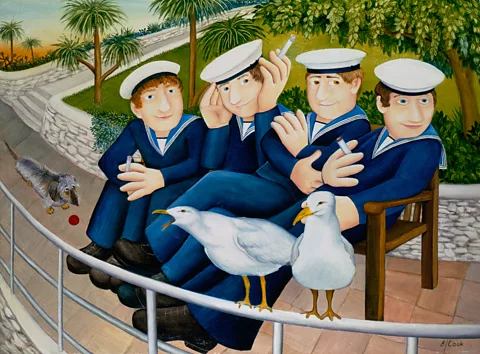
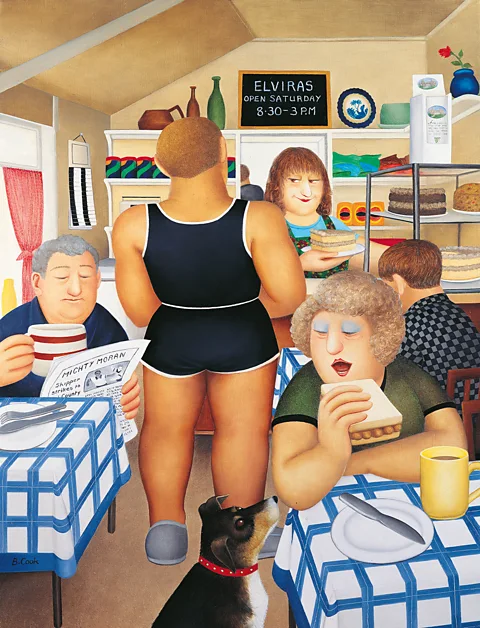
Cook largely painted the people she encountered in Plymouth: sailors and shoppers, plumbers and sex workers, drinkers and drag queens, women dressed up to the nines or baring their flesh in the pool. Her characters dance, drink, eat and laugh. There are smiles on their faces and glints in their eyes, joy emanating from every scene. "She loved painting people living life out loud," says Walkup. "She was a really keen observer. She painted people living their true, flamboyant selves." Cook's paintings are often described as comic, but there is no mockery present. "She truly paints her subjects with love and care and compassion and interest. She's fascinated by the world around her."
 Courtesy of www.ourberylcook.com/ John Cook 2025
When Cook was finding success in the 1970s and '80s, that world was experiencing enormous social, political and economic change, which is subtly reflected in her work. "I love her paintings of women in pubs around Plymouth, unabashedly occupying space, unapologetically and confidently smoking and drinking, maybe making eyes at somebody they find attractive, and just having this ownership of their body," says Walkup. "She's painting these at a time when there were still pubs that would refuse to serve pints to women".
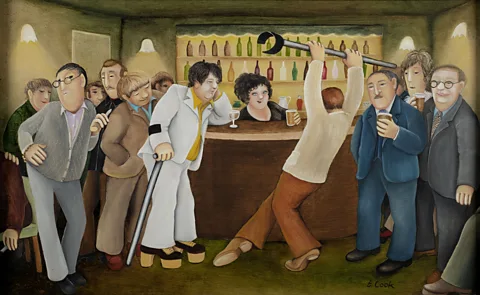
Perhaps even more progressive were her paintings of Plymouth's secret gay bars, including the back room of the Lockyer Tavern. "Its back bar was, for decades, known as a safe space, particularly for gay men to gather and socialise," says Walkup. "Beryl had many friends there. This isn't a world that would have been photographed, so the fact that she's able to capture what life was like for local queer communities then is extraordinary."
'Radical joy'
Cook's paintbrush ignored the bleaker side of life, choosing instead to capture moments of celebration and connection. A savage Guardian review of a 2007 exhibition called her characters "strictly one-dimensional," taking issue with her propensity for pleasure. "Cook won't even paint someone who looks as though they are suffering a mild headache... there is no pain in her world," wrote the critic. Beryl was the first to admit this. In a rare interview with the BBC she said: "If I saw something sad I wouldn't dream of painting that… I love it when I see people enjoying themselves."
But what if her depiction of joy was radical – a celebration of those overlooked or othered by society living life to its fullest? "She's painting older women, she's painting curvy women, she's painting queer communities, working-class communities and working-class spaces," says Walkup. "So she's painting all sorts of people and places that were subject to injustice in society. This had such a positive and significant impact on her audiences."
 Courtesy of www.ourberylcook.com/ John Cook 2025
Walkup was given access to the full Beryl Cook archive, which includes the hundreds of letters she received from fans. "There are so many letters of appreciation from people. People thank her for painting the Lockyer Tavern, for painting gay life. Her archive is also filled with letters saying thank you for painting larger ladies, thank you for painting people that look like me, having fun."
In 2024, London gallery Studio Voltaire paired Beryl Cook's work with that of artist Tom of Finland, known for his homoerotic images of bikers, soldiers, cowboys, sailors and labourers. Gallery director Joe Scotland said they shared: "a wonderful sense of pleasure and fun and desire that is free of any sense of shame".
"Beryl looked like the more avant-garde artist in that exhibition," says Adam Cohen, a Beryl Cook fan and owner of New York gallery A Hug From The Art World.
 Courtesy of www.ourberylcook.com/ John Cook 2025
In 2022, Cohen put on the first exhibition of Cook's work in America. "It was surprising to me that Beryl had never shown in the US," he says. "It was her first overseas exhibition." Originally from the UK, Cohen says Cook has always been part of popular culture. "Before I ever saw one of Beryl's paintings I encountered her in the commercial world. You'd go down the shopping aisle and they'd be Beryl Cook jigsaws, mugs and tea towels."
In this respect, Cohen thinks Cook was quietly ahead of her time, explaining that while the art world used to sneer at commercialism, it now embraces it. "Look at an artist like [Yayoi] Kusama. She's on bags, she's on scarves, she's on posters. Beryl did this before anyone."
'She should be in the Tate'
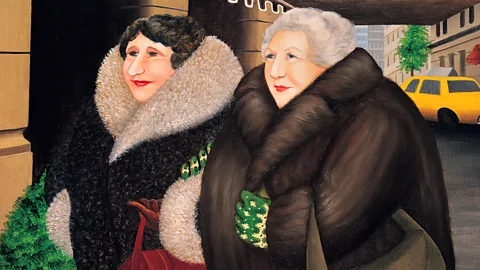
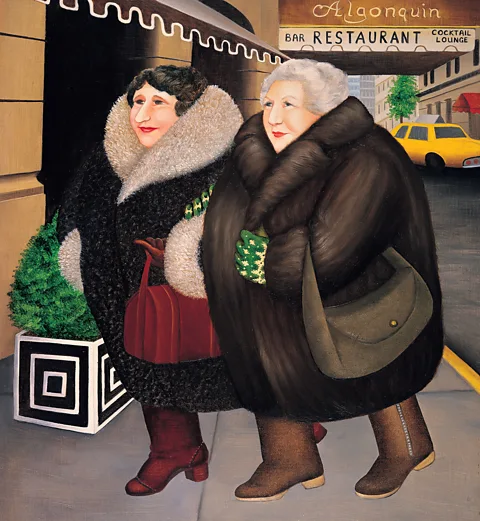
Cook travelled to the US in the 1980s and captured her time there in several paintings, including Bar and Barbara, which depicts two women in fur coats heading into New York City's Algonquin Hotel. She might be considered quintessentially British, but Cohen had no doubt that Americans would embrace her work. The New York Times said Cook's "vinegary wit translates naturally to New York".
Cohen, who's planning another Beryl Cook exhibition for 2027, is pleased the artist is finally getting her dues – but says there's still a way to go. "All props to The Box for doing this exhibition. But she should be in one of the major British institutions. She should be in The Tate."
 Courtesy of www.ourberylcook.com/ John Cook 2025
The Plymouth exhibition positions Cook within a broader art-historical context, exploring the inspirations and references that shaped her work. Alongside Stanley Spencer and Edward Burra – both known for their stylised depictions of the human body – her visual touchstones included Modigliani, Tamara de Lempicka, and the seaside postcards of Donald McGill and Mabel Lucie Attwell. Works by Bruegel the Elder and Rubens also feature. "When you look at how these artists are representing bodies, and then at how Beryl is representing bodies, there's a lot of affinity there," says Walkup.
This time, the reviews from critics aren't withering, but effusive. Giving the exhibition a five-star review, the Guardian says: "the appeal is so obvious. Cook makes life look fun".
If Cook herself was still here, it's doubtful she'd care about all the fuss. While her paintings command attention, Cook shunned it. Famously shy, she didn't go to the opening of her own exhibitions, rarely gave interviews and declined the chance to collect her OBE from Buckingham Palace, preferring a more low-key ceremony in Plymouth.
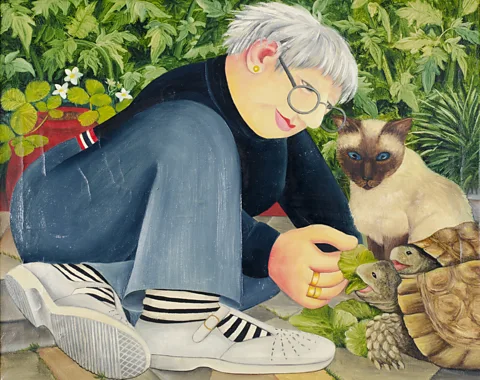
In contrast to those she painted, she lived a quiet life. A self-portrait in the new exhibition shows her feeding her pet tortoises in the garden. "I would quite like to be the one singing and dancing drunkenly in the middle of a crowd," she once admitted. Instead, she lived vicariously through her characters – just as her fans continue to do.
Beryl Cook: Pride and Joy is at The Box, Plymouth, UK, until 31 May.
--
If you liked this story, sign up for the Essential List newsletter – a handpicked selection of features, videos and can't-miss news, delivered to your inbox twice a week.
For more Culture stories from the BBC, follow us on Facebook and Instagram.
