Inside Ireland's most unusual ball sport

 Noel Sweeney
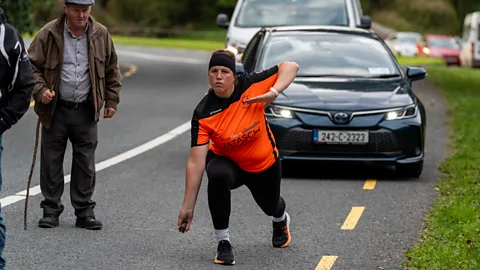
In Ballincurrig, East Cork, a 2km stretch of road becomes a stadium each October. For 40 years, locals and international players have competed in Ireland's little-known sport of road bowling, where 28oz (794g) iron balls skim bends, potholes and dips in pursuit of glory.
In East Cork, far off Ireland's tourist trail, a crowd has gathered by the hedgerows lining the roadside of Ballincurrig. A murmur ripples, then silence falls as festival Grand Marshall Bill Daly releases an iron ball. It whistles past the rapt onlookers, scrapes the tarmac and rolls towards a bend. Then comes the roar: this is the King and Queen of the Roads, the world's biggest road bowling tournament, now celebrating its 40th anniversary.
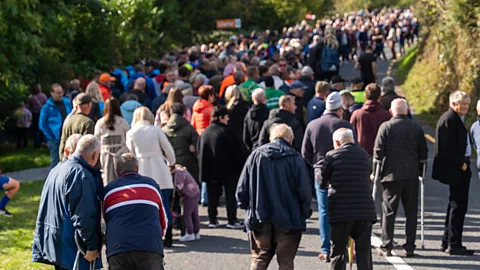
For one weekend each autumn, Ballincurrig, a tiny village with one pub and a primary school – transforms into the Wembley Stadium of Ireland's most unusual ball sport. A stretch of road becomes the stage as thousands of spectators line the grassy ditches, peering over shoulders to glimpse the iron balls whistling past. Competitors come from across Europe to test themselves on the storied course, 30km east of Cork city.
 Noel Sweeney
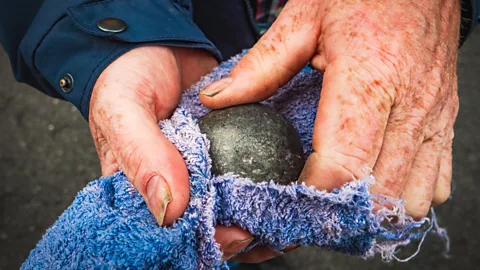
Road bowling is one of Ireland's oldest sports, though it remains little-known outside its two main strongholds of Co-Armagh in Northern Ireland and County Cork. The rules are deceptively simple: throw a 28oz (794g) iron ball along a 2km stretch of road, with the fewest throws deciding the winner. If the bowl leaves the road, it still counts but must be taken again. Each player has a small team of helpers – like golf caddies – who place a tuft of grass, known as a "sop" as a target on the tarmac. Unlike regulated ball sports, no two courses are alike; these are Irish country roads riddled with potholes, sharp bends and unexpected dips.
Beyond the thrill of the contest, the event represents heritage, community and pride of place. Though today road bowling is recognised as an official sport, its origins remain a curiosity. According to one theory, the game arrived with British weavers who settled in Ireland. Another is that it was brought over by Dutch soldiers when William of Orange came to Ireland in 1689 and that the game evolved out of Moors-style bowling, which is played in the Netherlands to this day.
 Noel Sweeney
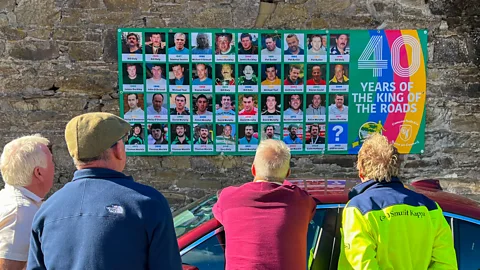
Seamus Ó Tuama, a founding member of the King and Queen of The Roads, remembers the very first competition in 1985 when Ballincurrig's newly formed club decided to stage a once-off challenge.
Plan your trip:
When to go: The King and Queen of the Roads takes place each September. If you can't make it, smaller games are played most weekends across rural Cork, especially around Clonakilty, Midleton and Fermoy.
What to bring: Comfortable shoes for country lanes, a rain jacket for unpredictable Irish weather and cash for roadside wagers.
Where to eat and drink: Celebrate with locals at Smart's Bar, then try Ferrit and Lee in Midleton for modern Irish dishes using local produce.
While you're there: Ballincurrig is a 40-minute drive from Cork city, where you can catch a gig or wander the historic English Market. From here, drive to Ballycotton for a cliff walk or lighthouse tour; or to Kinsale, a colourful harbour town that's referred to as the gourmet capital of Ireland.
"We approached some well-known bowlers at the time, Bill Daly and Harry Toal, at the All-Ireland final that year," he recalls, referring to the game's main national tournament. "We asked if they'd play here on the October Bank Holiday. We had no idea it would last more than a weekend. We just wanted to do something special.
RTÉ, Ireland's national broadcaster, turned up with cameras, Northern Irish bowlers travelled south and the atmosphere was ripe.
"It was a novelty in East Cork; we'd never seen Ulster men on our roads," says Ó Tuama. "Thousands came. From there, next year became the year after, and here we are 40 years later."
For the first decade, only men competed. In 1996, organisers introduced a women's event. "We always intended to have women's matches," Ó Tuama explains. "By the mid-'90s it was part of the tournament. Next year, in fact, will be the 30th anniversary of the Queen of the Roads."
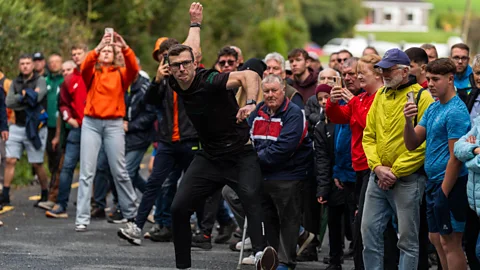
The once-humble gathering has evolved to become a fixture on the international bowling calendar. Over three days, up to 5,000 people descend on East Cork. Some are diehard devotees; others are here for pure curiosity. Some even plan their holidays around it.
 Noel Sweeney
"There's glamour to it, an international dimension," Ó Tuama says. "People are very, very conscious that this is a traditional sport of Ireland and it's a very small traditional sport. And they are, I think, very conscious that they are the custodians of that tradition."
More like this:
Among the new generation is Hannah Sexton, a young player from West Cork. She first competed in Ballincurrig as a teenager, winning the Triple Crown – an under-18 contest between Ireland, Germany and the Netherlands – twice. Now, at senior level, she has her sights set on the main title.
"For that hour you're on the road, you're in a different zone," she says. "It's just you, the road and the bowl. A bend that looks straight can catch you [out]. You want to hit the sop – that mark on the road – again and again. When you do, you know the bowl will go through. That perfection is addictive."
 Noel Sweeney
While Ireland remains the game's heartland, road bowling has flourished abroad. Dutch and German competitors return to Ballincurrig each year, joined this year by first-time entrants from Italy.
Dutch champion Silke Tulk – winner of the Queen of the Roads eight times in a row – calls Ballincurrig "the most iconic road in road bowling". "Same as Wimbledon, that's one track you play," she says. Yet for her, it's more than competition: "It's a bowling family… with loads, loads of members."
 Noel Sweeney
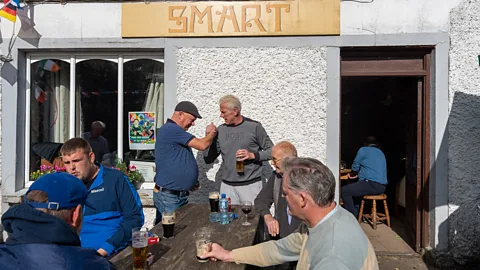
The three-day event presents itself like a festival. Families host visitors; Ballincurrig lights up with international camaraderie and Smarts Bar at the village T-junction is packed to the rafters. The matches run Friday to Sunday, culminating in a procession through Ballincurrig with pipers and winners leading the crowd. This year, the King and Queen titles went to Arthur McDonogh of Cork and Kelly Mallon of Armagh (with 11 and 18 throws respectively).
For travellers seeking to explore Ireland beyond the well-trodden paths, The King and Queen of The Roads offers a firsthand insight into rural Irish life. Between the excitement of the competition, the camaraderie of the locals and the warm cheers at Smarts Bar, it's a weekend that blends sport, culture and travel all in one. So, mark your calendar for next September when, once again, crowds will line the roads and bowls will whistle through the air.
--
If you liked this story, sign up for The Essential List newsletter – a handpicked selection of features, videos and can't-miss news, delivered to your inbox twice a week.
