'The biggest commercial juggernaut ever': Why the Oscars peaked in 1998 - and the real reason why they've slumped

 BBC/ Getty Images
The most-watched Academy Awards ceremony ever was a lavish affair in which Titanic won 11 Oscars. Since then, viewing figures have plummeted. But why?
Whatever treats are in store at this year's Academy Awards, it's safe to assume that none of them will involve an enormous Kodiak bear. Things were different in 1998. At the 70th Oscars, Mike Myers was presenting the trophy for best sound effects editing when two doors slid apart behind him to reveal Hollywood's premier ursine thespian, Bart the Bear.
Bart was a big star in more ways than one: he had appeared in Legends of the Fall and The Edge, among other films, and he was a terrifying 9ft 7.5in (2.90m) tall. On stage at the Oscars, he looked about twice that size. With a little help from his trainer, Doug Seus, Bart handed Myers the envelope with the winner's name in it, at which point Myers quite understandably declared: "I just soiled myself."
This surreal episode was only one of the evening's mind-boggling moments. As befitting a 70th anniversary bash, it was a lavish, over-the-top celebration of Hollywood's past and present. And in more ways than one, it represented the Oscars' pinnacle: a golden year for the awards during a decade in which, according to the data on Best picture winners we have crunched, they were more popular and populist than at any other time in their history. Today's producers may want to study why 1998's ceremony was such a cultural phenomenon – and what has gone wrong since.
Elsewhere in the ceremony, a montage zipped through all 69 previous best picture winners; Martin Scorsese presented a special award to Stanley Donen, the director of Singin' in the Rain; a "family photo" was organised, in which every surviving best actor and actress winner posed together.
 Getty Images
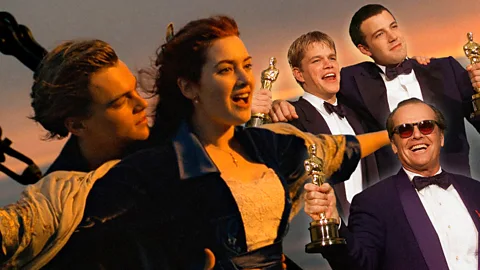
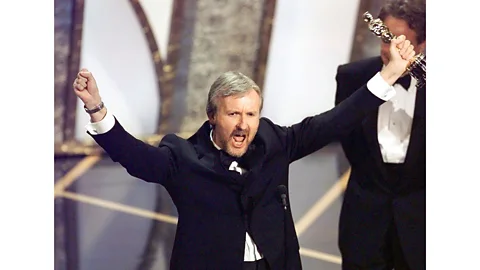
The industry's confidence was demonstrated by Celine Dion and Michael Bolton belting out power ballads. The hip young stars and screenwriters of Good Will Hunting, Matt Damon and Ben Affleck, brought along their mothers as dates. And two Oscar-nominated Rose Dawsons – 22-year-old Kate Winslet and 87-year-old Gloria Stuart – sat side-by-side. Their best actress and best supporting actress nods were just two of the 14 nominations racked up by James Cameron's Titanic – it went on to win 11 – so when Cameron waved his best director statuette, and shouted, "I'm the king of the world!", he had a point.
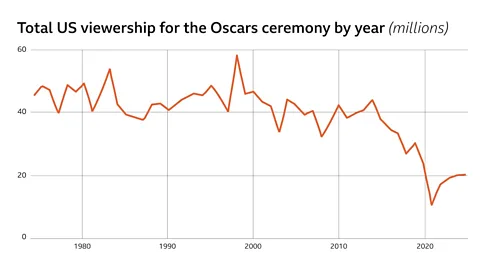
This was the climax of the most-watched Oscar ceremony ever: 57 million people in the US tuned in to see the glamour and excess live on ABC. As evidence of what a pop cultural event it was, that was 4.5 million more viewers than watched the finale of hit sitcom Friends in 2004
But in subsequent years the Academy Awards' viewing figures have sunk like a ruptured transatlantic liner. In 1999, 46 million people watched. The numbers hovered between 30 million and 40 million in the early 2000s, but they plummeted after that: 27 million in 2018, 24 million in 2020, hitting 20 million for the first time in 2018, and reaching an all-time low of 10 million in the Covid-blighted year of 2021. Last year, the figure was 20 million again – roughly a third of what it was when Cameron reigned supreme.
Film journalist Stephanie Bunbury tells the BBC that there are several factors behind the tumbling figures: a "dwindling interest in cinema", the "shift away from appointment [TV] viewing" brought about by streaming, and "the utter naffness of the event itself".
A dream Oscars film
Still, one Bart the Bear-sized reason why 1998's event was so much more popular than recent ones is that Titanic was an extraordinary, record-breaking hit. The first film to rake in more than $1bn, it stood as the highest grossing film ever made until it was toppled by another of Cameron's successes, Avatar, in 2009.
Tim Robey, the author of Box Office Poison: Hollywood's Story in a Century of Flops, tells the BBC that viewers were drawn to 1998's Oscars because Titanic was the very opposite of a flop. "Titanic had the massive clout of being, at the time, the biggest film ever made, the biggest commercial juggernaut ever to be up for the Oscars. And it was just so widely adored: people had been back to see it again and again and again, so they wanted to see it win those awards. There was a sort of 'victory lap' component to it."
In some ways, Titanic was the Academy's dream film. "It was a gigantic studio hit that became a global sensation," Michael Schulman, the author of Oscar Wars: A History of Hollywood in Gold, Sweat, and Tears, tells the BBC, "but it had the prestige of an Oscar movie, plus the technical prowess to win most of the craft categories."
As exceptional as Titanic was, though, it was part of a significant broader pattern: many of the 20th Century's best picture winners were also some of the most profitable films of their respective years. "From 1927 to 1976, roughly 90% of Oscars for best picture were awarded to films that were also in the top 10 grossing pictures for their year," wrote film historian Gene Del Vecchio in The Huffington Post in 2014. "Academy voters and the public alike enjoyed serious romance dramas like Casablanca, adventures like Around the World in 80 Days, historical dramas like Ben-Hur, and musicals like My Fair Lady. Our collective minds and tastes were the same."
There was a shift in 1978, Del Vecchio argues, when Star Wars was a box-office behemoth, while Woody Allen's far smaller Annie Hall triumphed at the Oscars. But it was still common for best picture winners to be huge hits in the 1980s and 1990s. In 1990, Kevin Costner's Dances with Wolves made close to $425m (equivalent to $1bn or £740m today) around the world. In 1996, Robert Zemeckis's Forrest Gump made $678m (equivalent to $1.4bn or £1bn today). This could be why so many people watched the Academy Award ceremony: they actually cared about the films that were nominated.
The big post-millennial shift
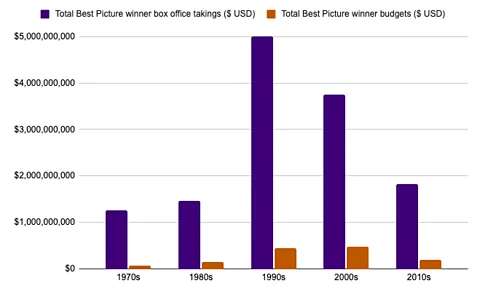
Nowadays… not so much. In the '90s, the global box office for all of the best picture winners combined was nearly $5bn, whereas in the 2010s, that figure had dropped to $2bn. While we're looking at stats, it's worth noting that, in the 1990s, many Oscar winners didn't just make a fortune, but they cost a fortune to make. The average budget for a best picture winner in that decade was $50m. In the 2010s, the average had fallen to $20m.
The 2009-2012 best picture winners – Slumdog Millionaire, The King's Speech and The Artist – all cost around $15m. And when in 2010 the best picture prize went to Kathryn Bigelow's The Hurt Locker – budget $15m, gross $50m (equivalent to $73m or £54m today) – rather than her ex-husband's Avatar – budget $237m, gross almost $3bn (equivalent to $4.3bn or £3.2bn today) – the writing was on the wall. The Oscars were no longer about expensive mainstream hits – and the ceremony no longer attracted expansive mainstream audiences. Last year's winner, Anora, had a budget of just $6m and a global gross of $58m. When the budgets and the box-office takings of best picture winners diminish, it seems, the ceremony's viewing figures diminish, too.
What has happened since 1998 is that Hollywood studios have put their money into superhero adventures, fantasy epics, video game-adaptations and other crowd-pleasing blockbusters – and those aren't the kind of films that do well in awards season. It's now extremely unusual for the public and the Academy to agree on what qualifies as a great film. The Lord of the Rings: The Return of the King was a megabudget blockbuster which grossed more than $1bn (equivalent to $1.9bn or £1.4bn today), and then won best picture in 2004. But it would be two decades before another worldwide box-office bonanza with a six-figure budget, Oppenheimer, won the top Oscar.
More like this:
"Movies have become more bifurcated between the 'prestige' films that tend to win Oscars and the franchise-driven popcorn movies that rarely do," says Schulman, "while mid-budget movies like Forrest Gump or The Silence of the Lambs, which used to align the Oscars with popular taste, have increasingly dried up."
That has the left the way clear for smaller, quirkier films to win best picture: Moonlight in 2017, Parasite in 2020, Nomadland in 2021, Coda in 2022, Everything Everywhere All At Once in 2023, and Anora last year. This isn't a bad thing. Some of these films are masterpieces which would have been ignored in earlier eras. But what's healthiest for independent arthouse cinema isn't necessarily what's healthiest for the Oscars.
Whatever critics and cinephiles might have thought, the wider public wasn't deeply invested in whether Coda would beat Power of the Dog, or whether Anora would beat The Brutalist. Much like Leonardo DiCaprio's Jack Dawson, excitement around the Oscars has vanished into the icy depths.
 Getty Images
Unlike Jack Dawson, though, there's always a chance that it could bob back up again. This year's best picture favourites, Sinners and One Battle After Another, have both done well at the box office, which could boost the ceremony's appeal. And in 2028, the Academy Awards are leaving ABC and moving to YouTube, so that might help, too. In the meantime, if anyone owns a humungous, scary, and reasonably well-trained animal, maybe they should give the Academy a call.
Additional data reporting by Rob Freeman
--
If you liked this story, sign up for The Essential List newsletter – a handpicked selection of features, videos and can't-miss news delivered to your inbox every Friday.
