'It seemed to defy the laws of physics': The everlasting 'memory crystals' that could slash data centre emissions

 SPhotonix
Big data is becoming a big problem. In the face of rising emissions from data centres, researchers are turning to novel solutions for storage. Memory crystals and DNA are two frontrunners.
On a visit to Japan in 1999, researcher Peter Kazansky encountered a mysterious physical phenomenon that he now believes holds the answer to the future of data storage.
In Kyoto University's optoelectronics lab, scientists were experimenting with writing on glass using ultrafast, femtosecond lasers which emit a light pulse every quadrillionth of a second.
But they noticed something unusual about how light was travelling through the glass that had been lasered. Rayleigh scattering is a well-established effect which describes how white light bounces off small particles in all directions (explaining, among other things, why the sky appears blue). But in this case, the light wasn't bouncing as expected.
"It was difficult to explain," says Kazansky, a professor in optoelectronics at the University of Southampton in the UK, who was collaborating with the Kyoto University researchers. "We saw light scattering in a way that seemed to defy the laws of physics."
The puzzling observation eventually sparked "a real eureka moment", says Kazansky. The researchers discoveredhidden nanostructures within the silica glass that had been created by "micro-explosions" from the femtosecond lasers.
Imagine holding a thick rock of crystal up to the sun and seeing light ricocheting off it in many different directions. With the lasering technique, the Kyoto researchers had accidentally created tiny holes that had the same property.
Some 1,000 times smaller than the breadth of a human hair, these "whirlpools" of light are so tiny as to be indiscernible to the human eye. But it soon became clear to the scientists that they had a potentially transformative utility. "This was the first proof that we could use light to 'print' complex patterns inside transparent materials at a scale smaller than the wavelength of light," says Kazansky.
Now, 27 years later, he hopes the discovery can help solve one of the most intractable problems of our information age: mass data storage.
Our data problem
In the era of the internet, AI, smart homes and surveillance capitalism, there's one thing we just can't stop producing: data. We will collectively generate 394 trillion zettabytes of the stuff every year by 2028, predicts analyst company IDC (a zettabyte is a trillion gigabytes). Every time we do anything on the internet – watch a YouTube video, send an email, ask an AI chatbot a question – strings of data points bleep off into cyberspace.
And while we might be inclined to think of data as lighter than air, whizzing intangibly through cables under the sea, or fizzing gently in "the Cloud" somewhere above our heads, it does in fact require intensive physical resources – the demand for which is now proving insatiable.
The conundrum of where to put all this stuff is inspiring some novel solutions, including Kazansky's solution of etching data into glass with lasers. But other options, such as storing data in DNA, are also being pursued by scientists and companies such as Microsoft.
 Getty Images
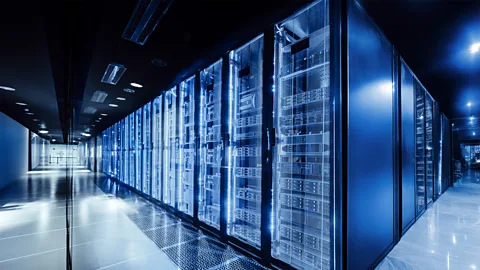
Data is processed and housed in data centres: gigantic alien structures densely stacked with 7ft (2m)-high racks of blinking servers. These humming boxes of hardware and cables are hungry for energy needed to power both their computing and the vast on-site cooling systems required to keep them from burning up. (A data centre is not a pleasant place to work: hot and deafeningly loud, it is best suited to those who can "endure a lot of pain", according to one 2025 New Yorker investigation.)
Globally, data centres now account for around 1.5% of the world's electricity demand, but their energy use is projected to double by 2030, when they are also on track to produce about 2.5 billion tonnes of carbon dioxide-equivalent emissions globally – equal to about 40% of the US's entire annual emissions. The recent generative AI boom has made matters worse, sharply increasing demand for high-performance computing systems which consume gargantuan amounts of power and expel intense clouds of heat.
The majority of energy used by data centres is expended on "hot data": data that needs to be available at our fingertips for quick access and regular updating. Think transferring money from your bank account or online documents you frequently edit.
But most data in the world is not this kind of data; up to 80% of it is in fact "cold data" – data that no one needs any time soon, and when they do, they're prepared to wait minutes or even days to get it. This includes compliance data like financial records or audit trails that must be retained indefinitely by banks and other corporations. Also in this category are the backups of all your old emails or photos, as well as archival data.
Storing this data poses problems. The majority of it is currently stored on hard disk drives in data centres. These must remain powered for the data to be retrievable, which demands energy and cooling. Another solution growing in popularity is magnetic tape, which is either stored on-site in data centre facilities or in dedicated tape libraries. It needs to be stored at temperatures of 16-25C (61-77F), meaning energy is also required to maintain its ideal conditions. It also needs to be replaced every 10-20 years as it degrades, at which point the old tape is disposed of as waste. A massive increase in data production has driven surging demand for magnetic tape in recent years.
'Memory crystals'
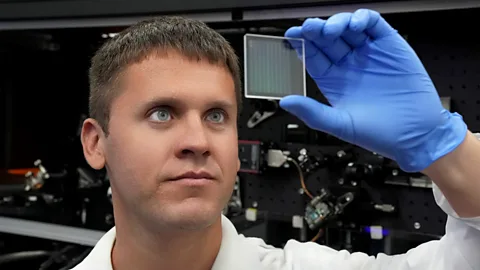
This all makes the search for alternative solutions is increasingly urgent. Kazansky is taking a novel approach to the problem. In the years following that first revelation at Kyoto University, he discovered that the whorls of tiny perforations burnt into the glass could be read in much the same way as data in optical fibres.
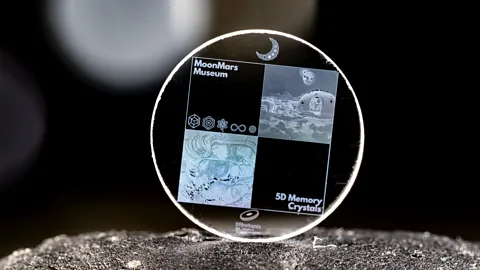
The method encodes data in five dimensions, he says, using the difference in light orientation and strength combined with the location of different "voxels" (i.e. individual 3D pixels with x, y, z coordinates).
 SPhotonix
"By utilising these properties of light, we can store data across five dimensions instead of the usual three, which is the key to achieving the high density required for 'eternal' storage," Kazansky says. (Read more about how data could be stored for millennia).
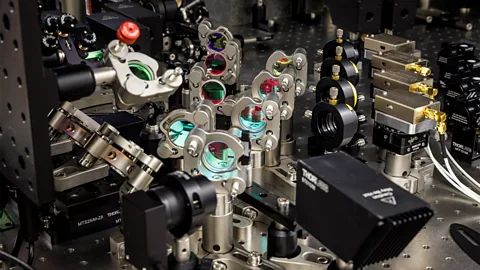
The data is read using a custom optical microscope equipped with a camera that can detect the intensity and the polarisation of light. "Because the nanostructures change the way light travels through them, we use special optics to 'see' these changes in polarisation, which are then decoded back into digital data," says Kazansky.
For Kazansky's "memory crystals", energy is needed for the data-writing process, but no additional power is required to maintain the data, and the read-out process is not energy-intensive. They can contain a giddying amount of data in a very small surface area – theoretically, up to 360 terabytes (TB, each equal to 1,000GB) of data on a 5-inch (12.7cm) glass platter – and, he claims, last essentially forever. They are made using fused silica glass which is known for its durability and thermal stability. The only special requirement is being encased in a sturdy container – as, being made of glass, they are still susceptible to smashing in the old-fashioned way.
Along with his son, Kazansky launched a company in 2024 to commercialise his idea and recently completed a $4.5m (£3.3m) fundraising round. He says that SPhotonix is already speaking to tech companies about debuting some of its prototypes in their data centres over the next couple of years. Right now, though, the focus is still on "perfecting the technology to ensure it is robust enough" for these purposes, he adds.
At present, the company can achieve a read-out speed of about 30MB per second but is expecting to increase their reading and writing speeds to 500 MB per second within the next three to five years says Kazansky. (By contrast, the latest magnetic tape storage solutions offer up to 400MB per second.) "Our goal is to make retrieving data… as seamless as using a modern hard drive," he says.
But not everyone believes that memory crystals represent the immediate future of data storage. According to Srinivasan Keshav, professor of computer science at Cambridge University in the UK, one problem is that the technology is not "backwards compatible with existing infrastructure", creating "enormous adoption barriers".
Kazansky is not the only one thinking about how to address the great data bloat of the 21st Century. Where he has found answers in grains of sand, others have turned to the granular substrate of all organic life.
DNA data
The idea to use DNA as a storage medium was first proposed in 1964 by the Soviet physicist Mikhail Samoilovich Neiman, and demonstrations since the 1980s have confirmed its viability. Its advocates say it makes for a remarkably efficient and durable solution. A single gramme of DNA could theoretically store up to 215 petabytes (PB, each equal to a million GB) of data for thousands of years.
 Getty Images
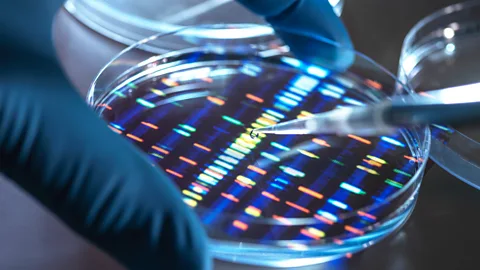
Transforming bytes into nucleotide bases turns out to be surprisingly simple. "You take your digital data and map it onto the building blocks of DNA," says Thomas Heinis, a professor in data management at Imperial College London. DNA's four base letters, A, T, C and G, are converted to 01, 00, 11 and 10. "Then you synthesise a molecule – the actual physical representation of this – and store it for as long as you want."
A favourite line amongst DNA data storage researchers is that "you could store all of the data in the world in a teaspoon", says Heinis. In reality, though, it would be very difficult to locate the data you were after in this undifferentiated globule, he says.
Crucially, though, the storage requirements aren't energy intensive. "It's energy efficient, because if you store it in a reasonable place, you don't need to cool it at all," says Heinis.
Startups are now croppingup in the DNA storage space, and progress has been made in recent years in bringing down the cost of "reading" DNA, says Heinis. But overall cost remains a hurdle. "It is still far too expensive," he says, especially when it comes to synthesising the DNA. "On the 'write' side, we haven't seen a major breakthrough yet, so that really needs to happen," says Heinis. "Once it's cheap enough, everything else will fall into place."
While Heinis describes Kazansky’s memory crystals as a "direct competitor to DNA storage", where DNA might have the edge is that "we will always be able to read DNA", due to its wide-ranging medical applications. "With other technology, the question is how long the read device will be around," he says.
Heinis points out it's now increasingly difficult to read the likes of floppy disks – which launched in the 1970s but were pretty much obsolete by the early aughts. "There are companies offering data storage for more than 100 years. But which of these companies will still be around in 100 years' time?"
Of the tech giants, Microsoft has taken the keenest interest in experimenting with new kinds of data storage. In 2016, the company announced it had stored 200MB of data in DNA, including a database of seeds held in the Svalbard Global Seed Vault, as well as the Universal Declaration of Human Rights in more than 100 languages. In 2020, Microsoft and other companies founded the DNA Data Storage Alliance.
"The demand for long-term data storage in the cloud is reaching unprecedented levels, and we are reaching the limit of what's possible with existing storage technologies," a Microsoft spokesperson told the BBC.
Microsoft also sponsored Kazansky's research group at Southampton University as part of its Project Silica from 2017-2019. "We proved the core principle together, after which they continued developing the technology independently," says Kazansky.
 Microsoft
In February 2026, Microsoft published a Nature article detailing a new achievement on this front. The company managed to store data in borosilicate glass, which is found in kitchen cookware and oven doors, in addition to the standard fused silica glass. Borosilicate glass is much cheaper – making the idea more financially tenable – while also being very durable. The company claims this data could be stored for up to 10,000 years.
Microsoft's spokesperson told the BBC that although its proof-of-concept tests have shown promise, it is not currently commercialising this research.
Rethinking computing
Of course, solving the long-term data storage problem is only part of the solution to energy-guzzling data centres. Silica and DNA are "very attractive from a sustainability perspective", acknowledges Tania Malik, assistant professor at the School of Informatics and Cybersecurity at Technological University Dublin in Ireland. "However, these technologies are unlikely to replace conventional storage for everyday computing or AI workloads anytime soon."
Malik says there are more practical ways of addressing the problem of "hot data" energy consumption in the near term. "One important area is improving infrastructure efficiency, for example through more energy-efficient processors and advanced cooling techniques such as liquid cooling or free-air cooling," she says.
More like this:
• How to get rare earths without mining rock
• The 'wonder material' that could transform solar
• How China became fixated on cloud seeding
At the same time, she adds, there is "growing recognition that efficiency must also be addressed at the software and workload level, not just the infrastructure level".
"In high-performance and cloud computing, performance has traditionally been the dominant metric, but energy efficiency needs to be treated as equally important," Malik says. "This means designing algorithms and applications that are energy aware." It also means using the appropriate amount of computing power for the task in hand, she says. "Not every task needs the largest possible AI model or the fastest possible runtime."
But in the face of exponentially accumulating data, a different kind of radical rethink may also be required, says Malik. Do we really need all of the data that we produce? Increasingly, part of the solution, she says, "is being more intentional about what we choose to keep".
--
For more technology news and insights, sign up to our Tech Decoded newsletter. For essential climate news and hopeful developments to your inbox, sign up to the Future Earth newsletter, while The Essential List delivers a handpicked selection of features and insights twice a week.
For more science, technology, environment and health stories from the BBC, follow us on Facebook and Instagram.
