How China became fixated on cloud seeding

 Getty Images
China hopes to increasingly control when and where it rains. Ally Hirschlag examines why its ambitious cloud seeding plan is so controversial – and whether it actually works.
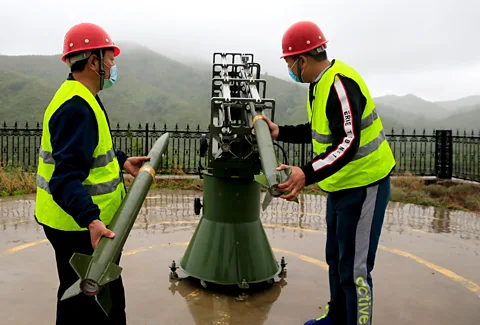
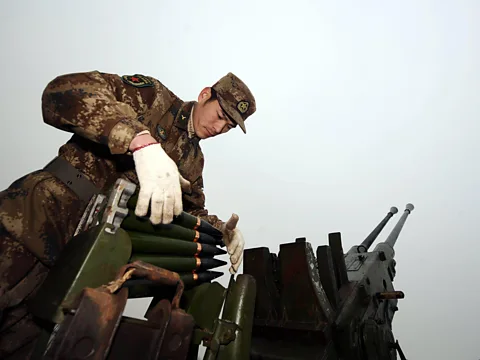
In March 2025, a fleet of 30 planes and drones fired silver iodide pellets into the sky in northern China. As the pellets hit the air, the pale-yellow powder inside them emerged and soon turned to wisps of grey, lacing the sky as the aircraft released them in criss-cross patterns. Far below them, more than 250 ground generators fired rockets holding the same pellets.
The aim was to bring relief to the drought-stricken north and northwest regions, also known as the country's grain belt. The huge operation was the country's "spring rain" project, undertaken by China's Meteorological Administration, and was timed to support crops at the start of the sowing season.
The huge operation was an apparent success, purportedly producing an additional 31 million tonnes of precipitation over 10 drought-susceptible regions.
China has been attempting to artificially increase its rainfall since the 1950s using a well-known yet still controversial method: cloud seeding. This aims to coax clouds to produce more moisture using tiny particles, often silver iodide, which has a similar shape and weight to an ice particle.
Cloud seeding has long caused concerns, from the potential environmental risks and the impacts of the chemicals used to potentially harm to people in nearby areas due to changes in rainfall patterns, and the security tensions that could follow.
And even as the world's most populous country ramps it up, scientists and experts continue to question how much it really works.
Road to rain
In recent years, China has significantly ramped up its cloud seeding efforts, largely thanks to improved drone and radar technologies. The country is now carrying out weather modification over more than 50% of its land area, mainly to increase rainfall although it is also attempting to prevent it in some areas. It has even turned to using it to manage weather on specific days, such as the Beijing 2008 Summer Olympics and the centenary celebration of the Chinese Communist Party in 2021.
Weather modification has become "a vital project for the scientific development of atmospheric cloud and water resources, serving the country and benefiting the people", Li Jiming, director of China's Weather Modification Center, said at the time of the 2025 spring rain operation. "[It] is a crucial component of building a strong meteorological nation," he added, noting the need to propel China "from a major player in artificial weather modification to a global leader".
 Alamy
AlamyChina's rising interest in controlling precipitation is obvious: since the 1950s it has been facing more frequent and severe droughts, taking a toll on the country's agriculture and economy.
The country's cloud seeding experimentation began in 1958, when an aircraft reportedly triggered precipitation over the drought-stricken Jilin Province. But cloud seeding had actually been discovered in the US a decade earlier, and, like so many brilliant ideas, it was by accident.
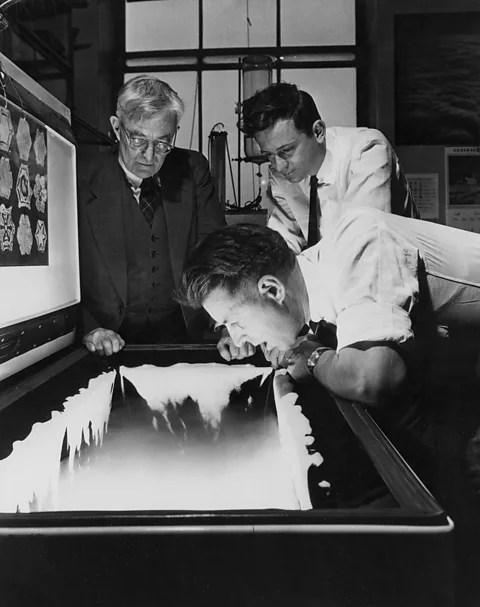
In the 1940s, Vincent Schaefer was a General Electric researcher working to prevent aircrafts from getting too icy in flight. He'd developed a special refrigerator to demonstrate how ice forms in clouds. One day, he came into the lab to find the fridge had turned off. When he put a piece of dry ice (extremely cold, solid carbon dioxide) into it to chill the inside, he witnessed a dazzling reaction: ice crystals suddenly appeared floating inside. He had artificially produced precipitation.
A year later, in 1946, Schaefer dropped pounds of dry ice into supercooled clouds above the Adirondack Mountains in New York. It appeared to trigger snowfall. (Read more about the US's early efforts to change the weather.)
In the wake of this experiment, cloud seeding endeavours sprang up around the world, albeit with mixed, inconclusive results involving data measurement challenges.
To show genuine cloud seeding results, scientists need a control meteorological setup nearly identical to the one they attempt cloud seeding with in nature. "We can't make the same cloud happen twice. So we can't do a controlled experiment," says Rauber.
Seeding snow
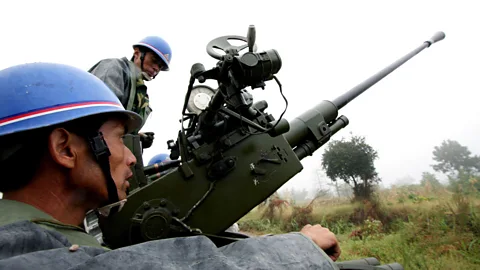
In China, and globally, cloud seeding for both experiments and practical use is most commonly done in the mountains to produce snowpack, mainly as snow is easier to see and measure than rain. Scientists use radar to find clouds containing supercooled liquid water (from -15 to 0C, or 5 to 32F), then release tiny silver iodide particles into them using aircrafts or ground-based generators. These particles freeze onto the supercooled liquid, forming ice crystals in clouds, which get heavier and eventually fall to the ground as snow or ice.
Warm weather cloud seeding works similarly but uses salt to encourage small water droplets to merge and get bigger so they fall to the ground. It is less common, however, as warmer clouds are often faster-moving and less filled with supercooled liquid, and the water doesn't collect as visibly as snow, so it is harder to track.
 Getty Images
China's first operational cloud seeding base was established in 2013, and today it has six bases that collaborate on research. Its weather modification programme is now the largest in the world, and its rainmaking ambitions have grown in tandem. In particular, the country's enormous Tianhe ("sky river") initiative aims to create a water vapour channel from the Tibetan Plateau all the way to China's dry northern region using thousands of ground-based generators.
But China has also faced criticism due to concerns over wider impacts from these operations. "Applied over a large enough scale, such weather modification technologies can present habitability and security concerns for surrounding countries," says Elizabeth Chalecki, a researcher in international relations and technology governance at the Balsillie School of International Affairs in Canada.
One recent report argued that such a large-scale intervention on the Tibetan Plateau could lead to China's unilateral control of water resources that are shared with neighbouring countries, such as India, leading to geopolitical tension. But another yet-to-be-published analysis of 27,000 cloud seeding experiments in China found the effect on other nations was minimal.
The potential harms of cloud seeding can be overblown, according to Katja Friedrich, a professor in atmospheric and oceanic sciences at the University of Colorado. For example, "there's no indication that cloud seeding gets out of hand and just suddenly you have this explosion that generates a thunderstorm", she says in reference to flooding in Dubai in 2024 and Texas in 2025, both of which have been erroneously attributed to cloud seeding.
Still, experts such as Chalecki warn there is a lack of international policy to protect against potential transboundary impacts as China's weather modification programme advances. China might even be able to get "an ancillary security benefit out of it by low-key degrading the environment and the habitability of a rival state", she suggests.
A lack of evidence
There's another problem with cloud seeding, though: scientists say China simply may not be producing the rain it says it is. "I think that the claims are not supported sufficiently by the data," says Robert Rauber, a professor of atmospheric sciences at the University of Illinois at Urbana-Champaign in the US.
Over the past decade, the Chinese government has made multiple claims that its cloud seeding programme is producing noteworthy results. One press release said the 2025 spring rain initiative had increased precipitation over the targeted area by 20% compared with 2024. And China's meteorological agency said in December 2025 that its overall artificial rain and snow operations had resulted in 168 billion tonnes of additional precipitation (around 67 million Olympic swimming pools-worth) since 2021.
 Josh Aikins/ University of Colorado Boulder
"There are a lot of claims [globally], whether it's from government agencies or companies that have the opportunity to gain from cloud seeding operations," says Jeffrey French, an atmospheric scientist at the University of Wyoming. "I do think that there are a lot of claims [out of China] that cannot be scientifically validated or backed up."
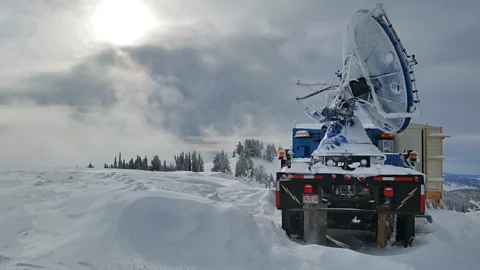
"We were able to, in a number of cases, identify exactly where the seeding material was in the clouds and make measurements directly in those areas," says French, who was principal investigator of the project. They managed this despite there being "so much natural variability, so much variation in the nature of clouds and precipitation", he says.
The researchers took additional measurements in nearby areas 1-2km (0.6-1.2 miles) away, allowing them to compare and contrast the two regions, and show a decided difference between the amount of snow produced naturally and artificially by the same cloud system.
More like this:
It's the closest any independently funded study has ever gotten to a successful controlled experiment in nature. Snowie's extensive dataset was a pivotal achievement; it not only showed that cloud seeding can work, but the complex balance of when and how it can work best. The data became a gold standard for a scientific field that was in desperate need of evidence.
The benchmark study has been cited in various peer-reviewed Chinese cloud seeding studies, with one saying the research "rigorously demonstrates that cloud seeding really has created precipitating clouds and increased surface precipitation".
Underwhelming
Still, Snowie's results indicated the output of cloud seeding is ultimately underwhelming. "That's why people were struggling to show it in these precipitating systems," says Friedrich. And while cloud seeding has been shown elsewhere to work to some extent, even scientists who have seen the results firsthand are unsure if it works well enough to be worth the effort.
Some also think that use of the technology has outpaced the scientific research, and there just isn't enough reliable data to support the results. "The problem with these cloud seeding programmes is that most of them are done by the government, like in China, like in the UAE," says Friedrich."But there's really very little independent analysis."
This is important as it's still incredibly difficult to differentiate between precipitation produced by seeding and what the clouds may have produced on their own. "In general, it is very difficult to know if cloud seeding works in every case," says Adele L Igel, associate professor in cloud physics at the University of California, Davis. "The theory and the science say that it should work, but it is hard to verify these predictions with observations and measurements routinely."
 Alamy
AlamyAnd plenty of limitations remain to it working predictably. For example, cloud seeding doesn't work if clouds with precipitation potential aren't present. And it's far less successful in the warmer months when clouds with supercooled liquid are scarce.
It all means the cost could often be outweighing the output, especially when using airborne methods. Ground-based methods, on the other hand, which rely on generators sending silver iodide or another trigger up into the clouds via air currents, are cheaper but far less predictable. "Airborne seeding is pretty efficient, but it's also very expensive, so that's why people do the ground-based seeding," says Friedrich.
It's also impossible to know what the outcome will be of wider, consistent climate modification, in China or elsewhere. "It is very difficult to assess, let alone predict, regional climate impacts and remote anomalies from weather modification operations," says Manon Simon, a lecturer at the University of Tasmania, who's done extensive research on the potential geopolitical implications of China's weather modification. It's particularly hard to know whether long-term programmes may result in more frequent or intense droughts or floods, says Simon. Ascertaining these risks, she adds, needs ongoing assessment and monitoring as well as extensive international cooperation.
A new frontier
In the almost 10 years since Snowie, seeding techniques and radar technologies have improved, which could mean more precipitation is being produced. As drone technology has improved in recent years, China in particular has increased the use of advanced drones and begun leaning on AI to improve the accuracy of silver iodide drops.
Both China and the United Arab Emirates are also experimenting with flare seeding and sending negative ion charges into clouds to help kickstart droplet bonding, which leads to precipitation.
And yet, just as with traditional cloud seeding, there remains a scarcity of independent research showing these new methods definitively produce more precipitation. Scientists now fear that rising droughts worldwide due to climate change will fuel uptake of cloud seeding technology, but not the research needed to show when and where it works cost effectively.
Experts agree: more independent data would help pinpoint when cloud seeding might work, and when it likely won't. The same data could inform safeguards for protecting adjoining nations from any adverse consequences.
But that all takes time; a hard sell when water scarcity is already here – and many countries want solutions now.
--
For essential climate news and hopeful developments to your inbox, sign up to the Future Earth newsletter, while The Essential List delivers a handpicked selection of features and insights twice a week.
