Salmon numbers in some premier angling rivers 'exceptionally low'

 Getty Images
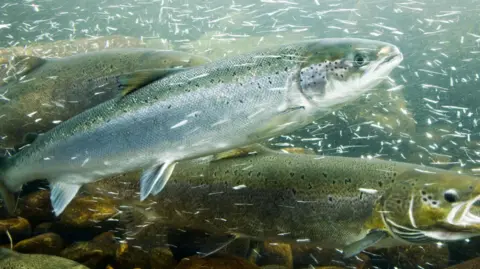
New rules to protect Atlantic salmon are to be introduced on four of Northern Ireland's premier angling rivers after fish numbers dropped to "exceptionally low levels".
The Loughs Agency said new fish count data highlighted the need for "urgent and enhanced efforts" to protect "what little stock currently exists".
It said about 3,500 returning salmon were recorded in the Rivers Finn, Roe, Faughan and Mourne in 2025 - 63% lower than the rivers' five-year average.
To protect numbers, all salmon caught when the season starts on 1 April must be released, the agency said.
"The Atlantic salmon is an iconic species and part of our natural heritage," the agency's chief executive Sharon McMahon said.
"In order to protect salmon for future generations, we are required to make urgent conservation-led decisions which are evidence-based and ultimately to protect what little stock currently exists."
The catch-and-release rules will remain in place until 1 June when anglers, until the season ends, will be allowed to keep one fish.
Atlantic salmon feed for two or three years around the Arctic Circle before returning to their rivers of origin to spawn in freshwater gravel beds.
The agency said it is recognised internationally as a "species in crisis".
Atlantic salmon in Great Britain have been listed as an endangered species by the International Union for Conservation of Nature.
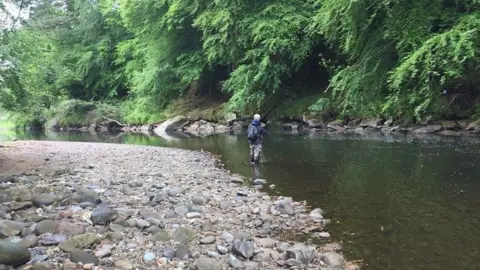
The Loughs Agency is a cross-border body responsible for waterways that flow into Carlingford Lough and Lough Foyle.
It draws on fish-counter data alongside wider environmental monitoring.
As salmon migrate long distances, the agency takes both local evidence and international data into account.
McMahon said the agency would continue to "work closely with our angling stakeholders to ensure they are fully informed and understand what these measures mean in practice".
"However, we really need their support to help steer this situation towards a more positive outlook for the future," she said.
