Do you know where your Valentine's Day flowers come from?

 BBC
BBCThe weather may be dreary, the cost of living may be crippling, but there's little that will curb our love of Valentine's Day.
Research from the retail marketing firm Savvy, based on a survey of 1,000 shoppers, suggests spending on gifts for the annual celebration of romance will rise by 12% in the UK this year to £1.6bn.
But if you are preparing to pick up red roses or a bouquet of flowers from your local florist or supermarket, have you given a thought to where they actually come from?
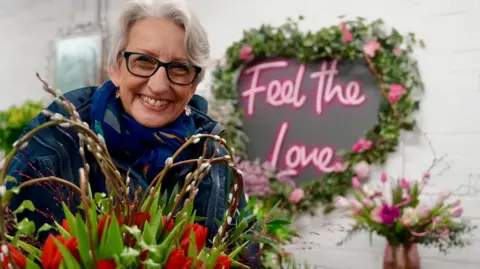
"They are likely to be imported," says Helen Chambers, a florist and flower wholesaler from Spalding, Lincolnshire.
She is not wrong. Red roses, stereotypically the symbol of romance, are not in bloom in the UK at this time of year.
According to Heathrow Airport, approximately 3,500 tonnes of flowers were imported through their terminals last February, which is an additional 1,000 than in any other month.
In her wholesale warehouse, nestled in rural Lincolnshire, Chambers sells about one million stems every year, but says 85% of them are British grown and only 15% imports.
She says this is the "exact opposite" of most wholesalers – something she is on a mission to change by raising awareness of British blooms and running events to showcase how to use them effectively.
As she finishes an arrangement, Chambers speaks of hellebores, ranunculus, anemones and alstroemeria – some of which are grown within 45 minutes of her premises.
"We're ideally placed to have flowers from Lincolnshire, Cambridgeshire and Norfolk," she says. Others are brought in from Cornwall and Scotland.
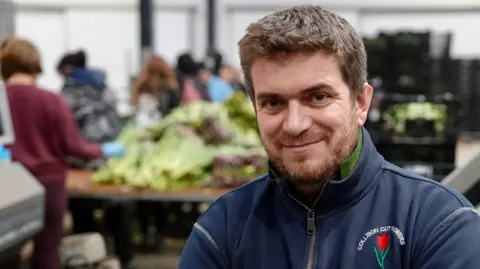
But according to John Davidson, from the British Florist Association, roses are the barrier stopping British growers cashing in on Valentine's Day.
"Roses evoke a different feeling," he says. "Tulips are beautiful flowers, but imagine if someone presented you with a bouquet of them on Valentines day.
"You would just think, 'oh!'"
Davidson champions British flowers, but says there are simply not enough of them to challenge the import market.
He says Valentine's Day is "the single hardest day of the year" for florists, because everyone wants the same thing around the world.
Ian Collinson, a grower from Terrington St Clement, King's Lynn, is trying to change that.
Thanks to £5m of investment in robotics, he will grow 35 million British blooms under glass this year.
Inside one of his greenhouses is a sea of green, speckled with colour. Four million tulips are being grown here for Valentine's Day and Mother's Day.
So, how does he do it at this time of year?
"Tulips are naturally a spring flower, so what we've done with the bulbs is trick them into thinking they've already had their winter," Collinson says.
"We've held them at a chilled temperature for between 12 and 16 weeks to give them the period they need to produce the flower inside.
"So when we bring them into the glasshouse here, they think it's springtime and they produce a flower."
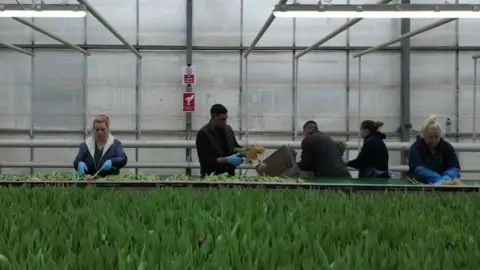
Beyond the sea of green, a host of robots help the company's staff – who themselves have very fast hands – to process the flowers.
Collinson says incorporating the latest technology helps the business work more efficiently.
"We're trying to compete with flowers that are flying in from the other side of the world, that are being produced in economies with much lower wage structures.
"With the rising cost of employing people, we need to have machinery.
"We haven't reduced our head count, but we're producing more with the same number of people."
And while Valentine's gifts are quite naturally bought from the heart, Chambers hopes more people will stop and think about where their flowers are coming from this year.
"We need to focus more on what we're doing in this country," she says.
"If we just keep flying things around all the time, we have got a massive carbon footprint.
"Why not feel the love for British grown?"
Listen to highlights fromLincolnshire on BBC Sounds, watch thelatest episode of Look Northor tell us about a story you think we should be covering here.
Download the BBC News app from the App Storefor iPhone and iPad orGoogle Play for Android devices
