How £50m 'fish disco' could save farmland
Testing of a £50m ultrasound system designed to stop fish being sucked into the cooling pipes of Britain's new nuclear power station has gone "really well".
Engineers working on Hinkley Point C, based in Somerset near Bridgwater, said the trial by Swansea University was "highly effective".
Dubbed the underwater fish disco, for six months a network of speakers have played sounds that deter fish in the Severn Estuary from swimming close to the plant's pipes.
The success of the test means project leaders are considering scrapping plans to flood 900 acres (364 hectares) of farmland in Gloucestershire, which was initially proposed to provide a compensating habitat for fish.
But why are so many fish at risk? How will this system protect them? And why did farmers more than 70 miles (112.6km) from the power plant face losing their land?

Why are fish at risk?
Nuclear power stations get hot. That is the plan. Pressurised steam drives turbines to generate electricity. To cool that steam and return it to the boilers, vast amounts of seawater are needed.
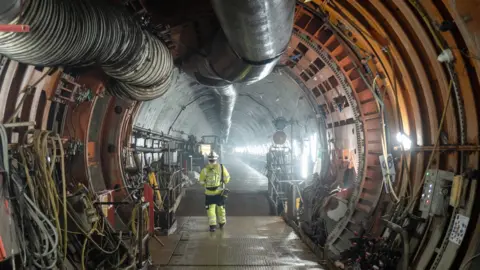
Two tunnels have been bored 1.8 miles (3km) under the Severn Estuary which will deliver 120,000 litres of water per second into the cooling system.
But engineers want water in their pipes, not fish.
 Hinkley Point C
The Severn Estuary is home to huge numbers of sprats and salmon, and the twaite shad, a protected migrating species which spawns in the tributaries of the River Severn.
Older power stations have simply placed a grill across the inlet pipes, filtering out fish, which are killed in the process.
At Hinkley Point C, officials are planning "more fish protection measures than any other power station in the world," according to John Fingleton, who recently reviewed nuclear regulation for the UK government.
How will the system protect fish?
First, the pipes will be fed by new wide inlet heads, which slow the water so that fish are not sucked in. And to prevent fish swimming within two metres (6.5ft) of the intakes, the new acoustic system is being tested.
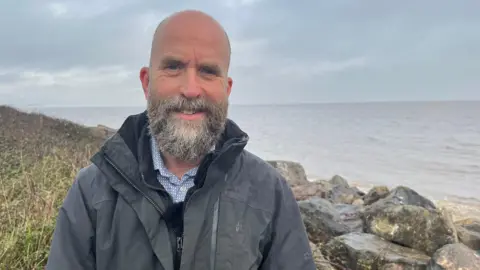
According to Chris Fayers, head of environment at Hinkley Point C, the system has been working "really well".
He added the ultrasonic speakers are lowered into the seabed "a bit like a lobster pot".
"We can raise it up again after a year to change the batteries. That means we can avoid using divers, which is a really risky operation that we wanted to avoid," he said.
The system, designed in Devon by a company called Fishtek Marine, was tested by Swansea University in the Severn Estuary.
Trials found only one tagged twaite shad came within 30 metres of the intake heads, compared to 14 before the system was switched on.
Pete Kibel, managing director at Fishtek Marine, said: "We have now developed a highly effective system that will protect fish in the Severn Estuary and potentially be an option for many more power stations throughout the world."
Why did they plan to flood farmland?
Project leaders had to find a way to "compensate" for killing thousands of fish every year. Plans were drawn up to flood 900 acres of farmland in Gloucestershire, on the banks of the Severn, to create saltmarsh habitats for breeding fish.
Councillor David Merrett, chair of the Arlingham Parish Council and dairy farmer, said: "When we first had the email about it, I thought it was a joke."

A village meeting was called for Hinkley Point C to explain their idea.
It was packed. I have never seen a village hall so full of angry locals.
"The area they were targeting was 500 acres of prime farmland, meadows, and orchards", explained Cllr Merrett.
"So to flood that seemed like a completely daft idea."
Now, it seems, the nuclear engineers are relenting.
If the "fish disco" is approved, they "should not need to create 900 acres (364 hectares) of salt marsh as environmental compensation", according to Fayers.
Merrett said parishioners will be "thrilled" if the flooding scheme is scrapped.
But the final decision is yet to be taken. The fish disco will be tested for another six months in 2026 to establish more evidence it works.
Then Fayers' team will have to ask the environmental regulators for final approval.
Costly conservation?
But some question whether this expensive technology is worth it.
Britain has become the "most expensive place in the world" to build nuclear power plants, according to a government review of nuclear regulation.
The estimated cost of Hinkley Point C has risen to £46bn from the £18bn predicted in 2017, and it is expected to open in 2031.
John Fingleton, who wrote the report, singled out Hinkley Point's elaborate fish protection measures as a case study of "overly cautious regulation".
Mr Fingleton added: "Motorways wouldn't be very useful if we all drove at five miles (8km) an hour, but that's sort of what we're doing in nuclear safety."
While the acoustic deterrent costs £50m, the wider fish‑protection system - including larger inlet heads and a return pipe for fish - will bring the cost to £700m.
But how many fish will actually be saved for this money?
EDF and Natural England agree that without the extra acoustic deterrent, around 2.6 million fish could be sucked into the cooling pipes every year.
Since many are tiny, the experts say it is roughly equivalent to the daily catch of one Cornish fishing boat.
Other campaign groups, like the Wildlife Trusts, insist that many more fish are at risk. They highlight research from Natural England that found that over seven million fish would die if no measures whatsoever were put in place.
Developing and approving Hinkley's fish protection system has cost millions, taken years, and hundreds of farmers and local residents have been threatened with losing their land.
Now the new lightweight disco in a lobster pot has been tested, many hope this chapter in the extraordinary story of Britain's new nuclear power station will be complete.
Follow BBC Somerset on Facebook and X. Send your story ideas to us on email or via WhatsApp on 0800 313 4630.
