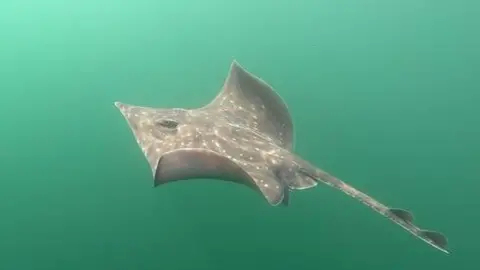
Europe's largest skate recovers in Scottish waters

 Fenella Wood, University of Aberdeen
Numbers of critically-endangered flapper skate are beginning to recover in Scotland, new research has suggested.
The study, conducted by Heriot-Watt University in Edinburgh, involved interviews with commercial fishers from all over Scotland, who reported a significant increase in flapper skate caught while fishing for other species over the past four years.
Half of those interviewed had seen them daily.
The species is most frequently seen along the west coast near the Isles of Rum and Skye and in the western waters of Shetland.
The flapper skate is a long-lived species which matures at about 15 years of age, producing eggs that incubate for over a year, making flapper skate and their egg cases particularly vulnerable to fishing mortality.
A previous study on the Sound of Jura showed that as a result of higher survival rates for young species, the number of flapper skates in the Marine Protected Area (MPA) was increasing faster than outside.
Both studies show that measures to protect and restore flapper skate inside and outside MPAs are working.
The improvements started in 2009 when commercial fishing of the flapper and common blue skates became illegal anywhere in Scotland.
 Fenella Wood, University of Aberdeen
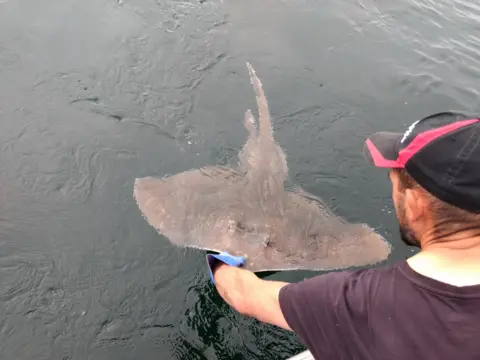
This required anyone catching them to return them to the water unharmed as soon as possible.
Dr Jane Dodd, NatureScot's shark, ray and skate specialist, said: "Flapper skate are just beginning their recovery but they are far from restored to their historical range.
"Collaboration is essential to deliver the release of particularly large flapper skate while maintaining the safety of fishers, especially as continued skate recovery could lead to even more encounters over a wider area."
NatureScot also encouraged members of the public to help with conservation too by helping track how well flapper skates are doing.
Anyone who sees a flapper skate in Scotland can photograph it and upload the photo on the SkateSpotter app.
