Union rejects offer to end long-running NHS strike

 BBC
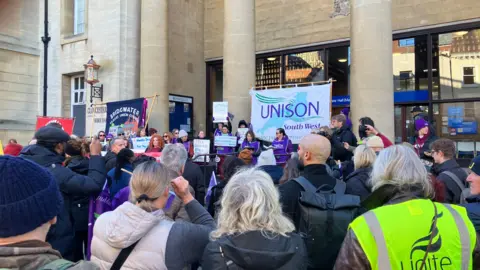
BBCSpecialist health workers have turned down offers that would have ended the longest strike in NHS history.
A total of 37 phlebotomists, who specialise in drawing blood, walked out of Gloucestershire Royal and Cheltenham General hospitals in March 2025 over a pay dispute.
Members of the union Unison were balloted on two options to end the 300-day strike which would have included a one-off payment for lost back pay.
Unison South West regional secretary Tim Roberts said: "I can confirm that talks are taking place between Unison and Gloucestershire Hospitals NHS Foundation Trust."
He added: "Phlebotomists remain hopeful that progress can be made through these discussions so that they can return to the job they love."
The lack of resolution means more uncertainty for patients who have conditions make it difficult for blood to be taken.
Kevin McNamara, the chief executive of the two hospitals, said the trust had made an offer of a new "higher-banded" role. The other ballot option that was turned down was for the dispute to go to a national independent panel to give a binding settlement.
Unison claims the current phlebotomist classification of Band 2 pay is not enough for the responsibilities of their role.
Previously, McNamara said the national campaign to move healthcare support workers from Band 2 to Band 3 did not include phlebotomists.
The first offer from the trust was for a jointly and independently commissioned independent panel to assess the job description.
Option two was the offer of a phlebotomy outpatient healthcare support worker role with the offer to make up pay for the past two years to the top of band 3, as well as protecting all the unsocial hours enhancements.
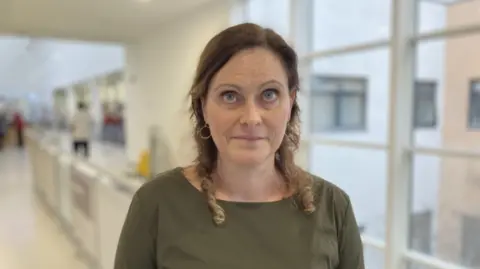
Claire Radley, director of people from the trust, told the BBC she was "really surprised" and "a bit disappointed because the two offers were developed collaboratively with the phlebotomists and Unison".
Radley said the union was now asking the trust to pay them as a band 3 without going through the independent panel and want to revert back to the providing the service in the same building as before the strike, rather than in outpatients.
"During the industrial action we have learned lots about the provision of phlebotomy services," she said.
"We have developed a model which means we are getting patients out of the hospital much earlier as a result of the bloods being available much earlier and it is a better outpatient experience," she added.
One phlebotomist, who wanted to remain anonymous, told the BBC: "We've only just found out the trust want to get rid of our department and the bespoke and skilled role of phlebotomists.
"Forcing us to become healthcare assistants will impact the quality and level of care that patients ought to rely on. For patients who are difficult to bleed they will know they need a trained phlebotomist.
"The fight is no longer about fair pay. This is about preserving a level of care that everybody should be entitled to."
The trust said it is going to consider its position and respond to Unison within a the next week.
Follow BBC Gloucestershire on Facebook, X and Instagram. Send your story ideas to us on email or via WhatsApp on 0800 313 4630.
